


 Francais
 Deutsch
 Italiano
Refine Your Search
US-Gliders- stock footage and images
- Showing 8725 to 8730 of 22001 results more
more Hide
Hide
The first-term inauguration of United States President Franklin Delano Roosevelt (FDR) at the eastern front of the U.S. Capitol
Opening credits of “The Fighting President”, a film about United States President Franklin Delano Roosevelt. Scrolling description about how the economic collapse of the United States made it possible for Americans to vote for Franklin Delano Roosevelt as their new President. First Inauguration of United States President Franklin Roosevelt at the eastern front of the U.S. Capitol. “I, Franklin Delano Roosevelt, do solemnly swear that I will faithfully execute the Office of President of the United States, and will to the best of my Ability, preserve, protect and defend the Constitution of the United States. So, help me God”. Crowd cheers after President Franklin Delano Roosevelt ends his oath.
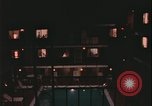
Voyeur uses binoculars to look for a woman to sexually assault in neighborhood, paramedics carry unconscious rape victim in stretcher
A voyeur uses his binoculars to search for a woman to prey on. View of various apartment windows at night, going from window to window, showing neighbors in their evening activities such as watching television, playing an electric guitar or reading books. View becomes fixed on woman putting on makeup. Woman dabs night cream on her eyelids and checks her mirror. Man looking through binoculars at night to spy on woman. Lights go off in apartment viewed through window. The woman brushes her teeth in the bathroom. Shadow of walking figure seen through window curtains at night. Woman dressed in robe and fuzzy slippers stretches in her bedroom. Dark figure of a man walking on a fire escape at night. A black cat in a window at night. Camera pan across apartment mailboxes at night and stopping on one with name “Donna Jenson”. Man looking under door mat and above door lantern for hidden key and putting key into door lock at night. Close up of a finger searching through phone book page. Man walking through passage way at night. Woman's hand opening chain door lock and opening door to reveal man standing at door in the night. Dark shadow of a man walking a fire escape at night. Black cat walking on window ledge at night. Paramedics put unconscious woman on stretcher into an ambulance.
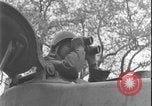
United States soldiers use binoculars, load rifle with ammunition during American occupation of Halle, Germany in WW2
A United States soldier on tank uses binoculars to observe surroundings in Halle, Germany during World War 2. A United States soldier takes out ammunition from his pocket and loads his rifle in front of fence in Halle, Germany.
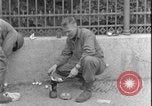
United States soldier cooks scrambled eggs using his G.I. pocket stove (Coleman Model 530) in Halle, Germany during WW2
United States soldier cooks scrambled eggs using his G.I. pocket stove (Coleman Model 530) in Halle, Germany during World War 2. Closer view of soldier serving scrambled eggs from pan to small metal dish, beside the dish is the G.I. pocket stove, a Coleman Model 530. United States Soldier eats scrambled eggs as he sits near fence in Halle, Germany.
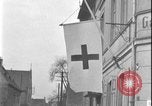
Hospitalized German soldiers at Red Cross building; liberated British soldiers receive cigarettes from US soldiers in Germany during WW2
Red Cross flag drapes in front of Gasthof zur Tanne, used as a Red Cross building, in Germany during World War 2. Hospitalized German soldiers and a nurse stand outside the Red Cross Building, watching United States tanks pass. German civilians watch United States tanks pass by the Red Cross Building, “Gasthof zur Tanne” written on the building. United States tank pass by German patients. Hospitalized German soldier, wearing glasses, smiles and talks. United States Army soldiers on top of tank. Liberated British soldiers greet United States soldiers in tank. United States soldiers give and light cigarettes to British soldiers. British soldier smokes cigarette and smiles. American soldier from top of tank lights a cigarette for British soldier. Man runs towards American tank. United States tanks pass by people on the road.
Women line up at post office, woman writes a letter using V-Mail, the primary method of correspondence to soldiers stationed abroad, during WW2
"strictly G.I." title card. Women line up at post office to send mail. Poster advertising “V-Mail”, the primary method of correspondence with soldiers stationed abroad during World War Two. Poster reads "Reach Your Boy Overseas." Man at teller window gives woman a standardized V-Mail envelope. Hands sorting through pile of blank V mail forms. Hands of a woman writing a letter from Betty Smith to CPL. Larry Ross on V-Mail using fountain pen. Hand with pencil addressing V-Mail. Woman's hands folding V-Mail envelope.
CRITICALPAST.COM: About Us | Contact Us | FAQs - How to Order | License Agreement | My Account | My Lightboxes | Shopping Cart | Advanced Search | Featured Collections | Website Terms & Conditions | Privacy Policy ©2026 CriticalPast LLC.
License Agreement |
Terms & Conditions |
Privacy Policy
©2026 CriticalPast LLC.