


 Francais
 Deutsch
 Italiano

Refine Your Search
US-Gliders- stock footage and images
- Showing 8911 to 8916 of 22001 results more
 Hide

Rescue operations following Mexican earthquake. Meeting with Doug Jewett, U.S. rescue expert.
Earthquake damaged buildings are demolished in Mexico. Women washing clothes and bathing children on side of a road. Tents around road. View of a city showing damaged houses in between erect buildings. Model of a building. An earthquake victim taken on stretcher. Healthy babies with their mothers. A child suffers injuries. A women is taken out of a earthquake hit house. Rescue operations at fallen buildings. Animation of people trapped at various sites in the building. People in a meeting. Dough Jewett, an United States Rescue Expert speaks. Remains of a fallen building. A victim is treated. A child in a nurse's arms.

A press conference on use of laser for eyes in United States.
A doctor checks eyes of a woman. A man addresses a press conference. Cameraman recording the proceedings. Another person speaks in the conference. Animation of structure of eye and two spots marked on it. View of a a laser beam for the eye, for medical purposes. Another man speaks in the conference. Journalists take down notes and cameramen record the conference proceedings. Narrator references Macular Degeneration.
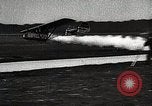
First practical attempts to use rockets for propulsion.
The German Ente (duck), world’s first rocket-powered airplane. Designed by Alexander Lippisch as a sailplane, it was purchased by Fritz von Opel who equipped it with rockets. It is seen with Opel painted on its fuselage, in its first rocket-powered flight on June 11, 1928 (flown by Fritz Stamer). In a slate, Adolf Hitler is quoted to the effect that : One cannot achieve what one cannot first imagine. A slate refers to the inadquate resources and consequent difficulties of early experimenters. Men help Prince Michalikais, with his "invention", in New York, where he attempts to propel himself with rockets while on ice skates. He wears a board on his back equipped with rockets. On first attempt, the rockets burn without propelling him and associates throw snow on his back to extinguish any fire. On next attempt, rockets fire but he loses his balance and falls.

Eisfeld-Valier rocket propulsion system tests using simple chassis with steel wheels running on narrow gauge railroad.
July 17, 1928, Friedrichshohe, Harz, Sachsen-Anhalt, Germany. Trial run of an Eisfeld-Valier propulsion system on a simple rail car (chassis mounted on steel wheels) running on the Harz Narrow Gauge Railway ,in central Germany. A man fits rocket boosters in the chassis. A flag marks the start point. The car leaves the start point and attains speed of over 100 Km per hour. Spectators stand near the track. July 25, 1928. Another trial run of the rocket-propelled rail car. Men near Eisfeld-Valier-Rak-1propelled rail car on tracks. Men fit rocket boosters in the car. The boosters are ignited. The car attains a speed of 180 Km per hour. July 26, 1928. Official speed run of the Eisfeld-Valier-Rak 1rail car at Stiege, Germany. On this third run, the car reached 180 km / hr but continues its strong acceleration, causing it to derail and fly off the track at a speed estimated to be 300 Km per hour.

The First "gyro aircraft" concept used by Reinhold Tiling to brake descent of his recoverable rockets.
Karl Poggensee and Reinhold Tiling demonstrate the workings of their first 1929 model of a so-called gyro aircraft, employing tilted wings that cause autorotation to slow the descent of a rocket and facilitate its recovery. Animated sequence shows how a rocket would be recovered in this manner. A man holding up a similar rocket. He is surrounded by spectators.
Professor Eugen Sänger's ideas for using rockets in national defense and space exploration
Drawings and pictures of Professor Eugen Sänger's S.R.13 and 14 Rocket motors from September, 1934. He holds a motor in his hand and points out its features. Photograph of Austrian patent certificate number 144809 issued to Doctor Eugen Sänger in Vienna, effective September 15, 1935, for Rocket engine and method for its operation. Glimpse of illustrations in the document. Drawing of planned 500 Kg thrust rocket motor designed by Sänger Rocket Motors. Eugen Sänger's drawings for a rocket-propelled missile to hunt airplanes. Design of a rocket motor (the S.R.X), on June 10, 1934, with 1000 kg thrust for a tropospheric experimental aircraft. Image of a letter to Dr.Sänger, from the the Federal Ministry of National Defense, dated February 3, 1934, stating that his ideas were not practially realizable.
CRITICALPAST.COM: About Us | Contact Us | FAQs - How to Order | License Agreement | My Account | My Lightboxes | Shopping Cart | Advanced Search | Featured Collections | Website Terms & Conditions | Privacy Policy ©2026 CriticalPast LLC.
License Agreement |
Terms & Conditions |
Privacy Policy
©2026 CriticalPast LLC.