


 Francais
 Deutsch
 Italiano

Refine Your Search
US-Gliders- stock footage and images
- Showing 9121 to 9126 of 22001 results more
 Hide

U.S. president Truman greets heads of state, signs Marshall Plan, and speaks at 1948 Democratic campaign convention.
A car arrives at the White House in Washington DC. President Harry S. Truman greets President of Mexico, Miguel Aleman, during state visit of Mexican President to Washington DC on April 29, 1947. Next scene shows President Truman being presented a Jewish Torah by Dr. Chaim Weizmann, first President of the newly declared State of Israel. Exterior view of south side of White House. Truman with Secretary of State, George Marshall, by the fireplace inside the White House. They discuss world affairs looking at a globe. An animated map shows the increasing Soviet Communist influence in Europe. April 3, 1948, President Truman signs the European Recovery Program (ERP), better know as the Marshall Plan, as members of Congressional leadership look on. Sacks of grain being off loaded at a dock in Italy, as part of Marshall Plan aid. Scene shifts to October 6, 1948 with crowd gathered outside the Democratic Convention at Convention Hall in Philadelphia, Pennsylvania. Convention delegates applaud during President Truman's address. Officials on stage. Truman talks about his sincere desire to promote peace throughout the world. Pictures of Franklin Roosevelt and Alben Barkley on stage. Exterior view of north side of the White House. Truman seated at a table.
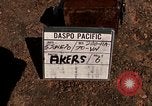
Aerial views of U.S. Camp J.J. Carroll and Fire Support Base, Charlie One, Vietnam, during Vietnam War.
Views, from a low flying helicopter, of Camp JJ Carroll in Vietnam. Dual blade bunkers and gun positions at the Base. Dirt roads traverse the camp area. Tanks, or self-propelled guns are parked in some areas. Fresh excavations are seen around Fire Support Base Charlie One showing underground wooden bunkers and bunkers under construction. Trucks are moving cargoes. Dust is being raised in background from vehicular traffic on a road leading in and out of the Camp. Change in color and beginning of slightly closer look at the Camp. A main gate with vehicle barriers and a guard shack.
Buses used for public transportation in the United States.
Growth of suburban areas caused by inter-development of the automobile and the public road system (1897-1927). Buses carry heavy loads and serve as a means for mass transport. Double-decker buses among the traffic. Cars pass by. Trams on the street. People climb into a bus at a city depot.
Using electric furnace for steel making during World War 2
Steel is manufactured in sufficient quantities in electric furnaces where higher temperatures are attained under close control in a manufacturing plant. Two workers inspect the furnace. Another worker manipulates electrical switches and controls on a panel. Molten iron seen splashing through open furnace door. Workers wearing protective glasses manually shovel measured quantities of alloying elements into the hot furnace at the factory.
Manufacturing steel using the Bessemer process (WW2)
Manufacture of Steel during World War II in United States. Bessemer converter seen in tilted position being charged with molten iron from a ladle, under control of crane operator. Bessemer converter operator manipulates lever to cause converter to tilt up and air to blast through the molten iron. This burns excess carbon, silicon and manganese and converts the iron into steel. Molten steel is poured into molds. which are removed after steel solidifies. Hot ingots are moved on rail cars to a place, where they attain a uniform temperature and are ready for rolling. Ingots stored in pit.
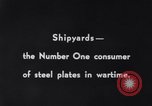
Use of steel plates in construction of ships in World War II (WW2)
A shipyard in the United States during World War II. A newly christened ship slides down an inclined slipway on its launch.
CRITICALPAST.COM: About Us | Contact Us | FAQs - How to Order | License Agreement | My Account | My Lightboxes | Shopping Cart | Advanced Search | Featured Collections | Website Terms & Conditions | Privacy Policy ©2026 CriticalPast LLC.
License Agreement |
Terms & Conditions |
Privacy Policy
©2026 CriticalPast LLC.