


 Francais
 Deutsch
 Italiano
Refine Your Search
US-Gliders- stock footage and images
- Showing 9289 to 9294 of 21911 results more
more Hide
Hide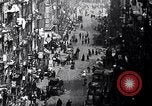
Lives of typical immigrants to the U.S., early in the 20th century
Tenements and open-air markets, part of life for many new immigrants, in Manhattan, New York City, early in the 20th century. Brief footage of elevated view of street likely in lower east side of Manhattan. Series of still images: Children pose on a fire escape platform. Merchants with pushcarts line the street. Men open a fire hydrant that spews water into the street. Men place cups in the stream. Children wade in the water. Many small children seen on the sidewalk. A boy tries to drink the last few drops from the hydrant, after it is turned off. Boys stand in an alleyway, near garbage cans. A boy at home preparing to wash in a basin. A boy holding a puppy in an unsanitary tenement apartment. View of Italian immigrant family members crowded into a Mulberry Street tenement. In contrast, a group of well-to-do young women are seen outdoors dressed in white, carrying parasols, as they learn social etiquette. A young woman, in a carriage, with a chaperone. Two well-dressed, mature women, conversing. A family, including several children, all engaged in needle work at home, for a pittance in wages. Men and women at sewing machines manufacturing clothes in a crowded "sweat shop.".
Garment workers demonstrating, for improved working conditions, encounter resistance in Eastern U.S. cities
Clothing workers in a factory in the United States. Street scene in garment district of Midtown Manhattan, New York City, in 1912. Garment workers, and supporters of their labor rights quest for better pay and shorter hours, pose for a photograph. Workers display many signs expressing their needs, in English, Italian, Russian, Hebrew and other languages. Garment workers, of various specialties, gather in demonstration for better treatment. Employees of the Alfred Benjamins Company refute management's claim that they are satisfied with working conditions. They display a large sign on the sidewalk. Four-sided box signs are also seen (written in Italian and Hebrew). Mounted police move along a street as a foot patrolman arrests a protester. Photograph of lawyer, Fiorello LaGuardia. Garment workers at work in a sweat shop. A large group of young women garment workers marching in a labor rally or demonstration during a strike. Two signs are seen, one reading: "Why are we prohibited from picketing?" and the other, partly hidden, explains why they are striking. A contingent of uniformed policemen with night sticks, stand in front of a building in Baltimore. Smiling women stand carrying signs. One reads: "Our employers are powerful (because) they are organized.We shall be more powerful." Another reads,"We shall fight until we win." Many other signs express similar sentiments. Portrait photograph of 17 year old Ida Brayman, with caption reading: "Who was shot & killed by an Employer Feb. 5th 1913 during the great struggle of the Garment Workers of Rochester (New York)."
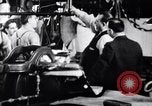
U.S. Labor strife - strikes and lockouts in the clothing industry in the 1920s
Post-World War 1 United States marked by labor-management strife and strikes, especially in the garment industry. Clothing workers are seen busy at their jobs in a factory in New York City. A man is seen symbolically closing and locking a steel door (narrative refers to a company "lockout.") Footage of police officers and crowd of laborers on New York City street. Police try to maintain order as crowds fill garment district streets in protest. Montage of persons awaiting a June 1921 decision by the Supreme Court of the State of New York, Kings County. Narrator announces that Justice James C. Van Siclen, has granted an injunction (against all picketing by the Amalgamated Clothing Workers of America). Narrator quotes Van Siclen's opening statement in the decision: "The court must stand at all times as the representative of capital, of the captains of industry..." View of Sidney Hillman, leader of the Amalgamated union (ACWA) sitting with other union members. View of a bustling New York City street lined with tenements and pushcarts in the lower east side of Manhattan. A man washing his face at a sink. A woman preparing a meal over a stove. Four children sharing a large bed. A gathering of idled clothing workers in a school room setting. Some in art classes. Dancers entertaining locked out workers. Young people presenting a puppet show. Narrator states that the lockout lasted 6 months, but the union prevailed. View of pleased union members.
The U.S. Air Force tests rocket-assisted takeoff on a C-47 transport aircraft
A United States Air Force C-47 aircraft (tail number 43-48765) is seen parked on a grass airfield, with its rear door open and entry ladder down. Camera zooms in on so-called jet-assisted takeoff (JATO) cylinders fastened underneath the aircraft. Closeup of the aircraft landing gear and tires. Closer view of the JATO cylinders, that appear to be twin 12AS-250 Junior JATO cylinders made by Aerojet Corporation.. Two Air Force officers approach and board the aircraft, which is being guarded by an armed Staff Sergeant. Camera pans across to the aircraft as the crew starts number 2 engine, as a fire guard with extinguisher stands by. A collection of military and other persons stands by vehicles in the background. The fire guard walks to number 1 engine which the crew starts. With both engines running smoothly, the pilot waves to the fire guard from his open cockpit window. Next, the aircraft is seen taxiing on the otherwise empty airfield. It turns near a large tree and commences a takeoff roll. The Jato bottles fire and the aircraft is launched into the air after a very short ground run, with smoke spurting from the JATO rocket cylinders. Another view of the Jato takeoff is seen as well.
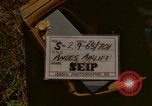
CCT serviceman unloads road construction equipment from C-130A cargo planes of U.S. Air Force as natives watch, Chiloya in Peru.
Andes airlift in Chiloya and Bella Vista in Peru. C-130A cargo airplanes of the United States Air Force airlift road construction equipment from Chiloya. Air Command CCT serviceman works on a control radio jeep. Natives walk close to control radio jeep and watch the unloading of heavy construction equipment. Servicemen unload material from the plane. C-130A cargo airplane takes off from dirt airstrip.
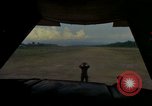
C-130A cargo planes of U.S. takes off after offloading road construction equipment in Bella Vista village from Chiloya, Peru.
C-130A cargo airplanes of the United States Air Force airlift road construction equipment from Chiloya to Bella Vista village in Peru. Cargo door of the C-130A cargo plane closes after offloading. Peruvian men climb up on dump trucks and take out a big spanner from it. Plane takes off. Air Command CCT servicemen at forward control jeep and village natives behind them. Plane takes off and flies over the village. Servicemen inside a native shop.
CRITICALPAST.COM: About Us | Contact Us | FAQs - How to Order | License Agreement | My Account | My Lightboxes | Shopping Cart | Advanced Search | Featured Collections | Website Terms & Conditions | Privacy Policy ©2026 CriticalPast LLC.
License Agreement |
Terms & Conditions |
Privacy Policy
©2026 CriticalPast LLC.