


 Francais
 Deutsch
 Italiano
Refine Your Search
US-Gliders- stock footage and images
- Showing 967 to 972 of 21920 results more
more Hide
Hide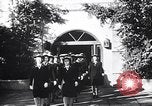
U.S. Coast Guard sailors and SPARS report to various Battle Station across the United States.
U.S. Coast Guard SPARS (US CG Women's Reserve) march at the Training Station. CG men and women recruits take their places at various Battle Stations across the U.S. U.S. CG men and women personnel report for duty on shore and at sea. SPARS arrive in Washington and New York. A sailor watches through binoculars, a SPARS with documents, sailor on cutter, SPARS drives a car, sailor by a plane. A radioman and woman operate the radio. Men and women gunner mates on cutters. A U.S. CG pilot in the cockpit, SPARS parachute riggers at work. A deck gun on a cutter. A crew of 8 sailors observe the gun. SPARS take their places at a shore station. The captain and his crew come aboard a cutter. U.S. CG cutters at sea. Includes narration by Ginger Rogers and James Cagney.
U.S. campaigns against Japanese in Marshal Islands, New Britain, and Rabaul, in the Pacific during World War II
U.S. offensives against Japan in the Pacific Theater during World War 2. A United States Carrier Task Force in the Pacific Ocean. Fighter planes and dive bombers on the deck of the Task Force. Sailors push trolleys containing bombs. A map shows Marshall Islands. Douglas Dauntless dive bombers take off to strike against the enemy. U.S. Navy fighter planes engage defending Japanese aircraft and down many of them, as seen in gun camera footage. The first wave of Douglas Dauntless dive bombers returns to its carrier for refueling, rearming, and debriefing. Sailors on the aircraft carrier man anti-aircraft guns to defend against attacking Japanese aircraft. Black flak fills the sky and a number of Japanese aircraft are destroyed by the anti-aircraft fire. A Japanese bomb explodes near the flight deck of a carrier. (Narrator notes that 85 Japanese aircraft were destroyed in this one operation.)An animated map shows New Britain Island. U.S. Major General William Henry Rupertus, Commander of U.S. Marines on a ship. He looks through a pair of binoculars as a U.S. planes (B-24 Liberators) drop bombs on Rabaul. U.S. warships launch an attack at the enemy positions. Fire and explosions. The Marines load into landing craft and move towards the shore. They land behind an intense naval bombardment. Marines head ashore from beached LCI-1 Class Landing Craft Infantry (Large), number 343. M 16 tanks, equipment, and artillery roll ashore from Landing Ships Tank (LSTs). . The tanks lead the way through the jungle terrain and the marines advance behind them. Marines fire mortars as they advance. They flush out Japanese from trenches and bunkers. A damaged Japanese Mitsubishi fighter plane and wreckage of others. Some dead Japanese soldiers. The Marines wade through deep water as they push on to Rabaul. Others advance through deep mud. More views of them slogging through mud.
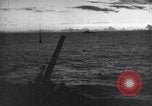
U.S. Task Force attacks Japanese positions on Island of Wotje in Gilbert and Marshall Islands during World War II.
Attack on Wotje Island, February 1, 1942. Crew members move F4F-3 Wildcat's and Douglas Dauntless SBD aircraft across crowded flight deck of the U.S. aircraft carrier, USS Enterprise (CV-6) during raid against Japanese positions in the Gilbert and Marshall Islands, by Task Force 8, of the U.S. Pacific Fleet, commanded by Vice Admiral William Frederick Halsey, Jr, during World War 2. Oversize U.S. stars are evident on the aircraft, at this early stage of the war (1942). Crewmen roll bombs, on dollies, across the deck. F4F Hellcat aircraft sit with engines running as some Douglas Dauntless aircraft commence take off. The destroyer USS Gridley, DD-380 passes abeam the Enterprise at time 00:37. A Curtiss SOC Seagull airplane catapults from the heavy cruiser USS Northampton, CA-26. Several U.S. aircraft seen in flight. View from stern of a U.S. heavy Cruiser as a destroyer crosses her wake, behind. The heavy cruiser USS Northampton, CA-26 and the heavy cruiser USS Salt Lake City, CA-25, in background (time 1:09 to 1:11) bombard Wotje island. Black smoke billows from a ship burning close to shore. Brief glimpse of the heavy cruiser USS Northampton, CA-26's triple battery of 8-inch guns. The heavy cruiser USS Salt Lake City, CA-25 fires a broad side. Scene from the stern of heavy cruiser with fires burning on Wotje Island in background. Formation of Japanese aircraft attacking U.S. ships are fired upon by antiaircraft guns. Black flak bursts seen in the sky. Vice Admiral Halsey consulting with other officers aboard his flagship, USS Enterprise.
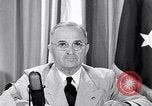
President Harry Truman of United States speaks about peaceful uses of atomic energy, following Potsdam Conference.
President Harry S. Truman of United States addresses the United States people after returning home from the Potsdam Conference, during World War II. President sitting at a desk and speaking into a microphone, talks about atom bombs. He says bombs were dropped against those guilty of the attack on Pearl Harbor, and those who have starved and beaten American Prisoners of Wars. Further he says that the atomic bomb has been used to shorten the duration of war, thereby saving numerous lives. He says the U.S. will continue to use the atomic bomb until Japan surrenders. He notes that the United States, Great Britain and Canada have the technology to produce atomic bomb, but that it will not be revealed until means have been found to control the bomb, so as to protect the world from total destruction. He talks of preventing the misuse of atomic power, and the importance of countries using it for the service and betterment of mankind. He describes it as an awful responsibility, and he thanks God that it has come to the United States and not to its enemies, and that the U.S. prays that God will guide it to use atomic power for His ways and His purposes.
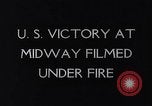
Scenes from Battle of Midway during World War II. U.S. Naval Academy cadets graduating June 19, 1942.
Scenes from the Naval Battle of Midway, in World War 2. A helmeted sailor, on deck of a U.S warship, silhouetted next to a propeller blade. A Fletcher-class U.S. Navy destroyer in background. View from near top of a Curtiss SOC Seagull airplane on the USS Portland (CA-33),as she fires two of her 5 inch antiaircraft guns, amidship,during the battle of Midway. Air is filled with low-altitude black flak smoke. A Japanese G4M1 model 11 ("Betty") bomber flies close by at low altitude across the line of sight. Smoke rises from the Portland's gunfire. Another Betty bomber low over the water in far background. Aerial view of a burning Japanese cruiser, far below, maneuvering to evade American attacks. View from U.S. airplane circling closer to the smoking Japanese cruiser. Closeups of panned stills showing severely damaged Japanese warships. Scene shifts to a large formation of Navy personnel in dress whites, where U.S. Admiral Chester Nimitz is decorating navy personnel who distinguished themselves in the battle. Nimitz sits, visiting a wounded sailor, at a hospital. U.S.Army Air Forces B-17 Crews, who bombed Japanese ships, are seen being interviewed on Midway Island. Scene shifts to war production workers assembling aircraft in factories in the United States. U.S. warplanes being manufactured. B-24 Liberator bomber aircraft being rolled out of a plant. Graduation ceremony at the U.S. Naval academy, in Annapolis, Maryland. Spectators watch as the cadet corps parades. View inside the historic hall of the old academy filled with spectators, cadets graduate a year early due to the war. Graduating cadets shaking hands with Academy administrators. Cadets of the class of 1943 cheer and throw their hats in the air at end of commencement ceremonies on June 19, 1942.
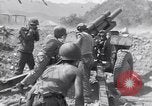
U.S. Army soldiers, howitzer, tank, machine gun, flamethrower in battle during Korean War
Republic of Korea and U.S. Army soldiers fire M-114 howitzer during Korean War. One soldier's sleeveless shirt has "ROKFO" stenciled on it. Smoke rises due to explosions at targets in the mountains. U.S. Army Patton tanks on road with infantry walking along road sides. U.S. soldiers running and maneuvering in field, under enemy fire. climb on the mountains. U.S. troops fire a machine gun. U.S. tank uses a flamethrower, against enemy target. Jet of burning napalm arcs through the air some distance and drops downward striking target.
CRITICALPAST.COM: About Us | Contact Us | FAQs - How to Order | License Agreement | My Account | My Lightboxes | Shopping Cart | Advanced Search | Featured Collections | Website Terms & Conditions | Privacy Policy ©2026 CriticalPast LLC.
License Agreement |
Terms & Conditions |
Privacy Policy
©2026 CriticalPast LLC.