


 Francais
 Deutsch
 Italiano
Refine Your Search
US-Gliders- stock footage and images
- Showing 9763 to 9768 of 21914 results more
more Hide
Hide
U.S. Marines stand around a Japanese interpreter speaking into a microphone in Tinian, Mariana Islands during World War II.
United States 4th Marine Division in Tinian, Mariana Islands during World War II. A Japanese interpreter in civilian clothes speaks into a microphone. Marines in combat dress stand around him. A Japanese female interpreter near the interpreter speaking into the microphone. A loudspeaker mounted on a jeep. Marines standing around it. Officers look through binoculars.
U.S. Marines search Japanese prisoners and M4A3 tanks fire into distance in Tinian, Mariana Islands during World War II.
United States 4th Marine Division in Tinian, Mariana Islands during World War II. Marines search Japanese prisoners. Prisoners including women and children move under guard. A Japanese interpreter in civilian clothes speaks into a microphone. A Japanese female interpreter. M4A3 tanks fire into distance. Smoke rises as a result of the firing.
U.S. Marines examine damaged structures and Knocked out tanks on Saipan, Mariana Islands during World War II.
A line of landing craft silhouetted on the horizon. An explosion on the shore behind them. Camera pans from beach, across a bay to a beached landing craft, and then back past some damaged huts, to a destroyed Japanese motorcycle that an American marine examines. A marine climbs through a damaged Japanese wooden structure. A marine examines a knocked out Japanese 1st Yokosuka SNLF Type 2 Ka Mi Amphibious tank
U.S. forces plan airbase construction after the battle of Saipan during World War II
America forces begin preparing Saipan as an advance base in the Pacific campaign against Japan in World War 2. Japanese military prisoners as well as civilian women and children are seated on the ground, shaded by a tree on a coastal plain in Saipan. American officers review a map laid out on the hood of a jeep. They converse in a group as they stand near a rudimentary small gauge railroad track in the sand. Sheer cliffs are close behind them and the ocean is nearby. A jeep is seen parked and another moves along a bumpy path. Officers and soldiers stand on and near the small gauge rail line. Several jeeps are parked. Camera pans over sheer cliffs behind. (Some contain openings that housed Japanese fortifications.) Camera pans over wide flat area where the Japanese were building an airfield near Marpi Point on the northern end of the island of Saipan. Construction materials cover the area and several jeeps travel through it. Final scene shows more Japanese civilians in a group where several American soldiers are attending to their needs.
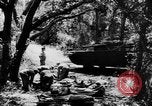
A DUKW is used to transport wounded from a shore to a ship in the United States.
A film on workings and general features of DUKWs. Men carry wounded on stretchers in the United States. The wounded are loaded aboard a DUKW in a wooded area. The wounded on litters in the DUKW. The amphibious truck gets into water. It approaches a ship. The DUKW is carried onto the ship. Trucks move along a beach. Men stand at attention near parked DUKWs.
An American officer discusses with men in a tent of the U.S. Vietnamese Refugee Processing Center at Eglin Air Force base
American military officers in the United States, at the Eglin Air Force Base Vietnamese Refugee Processing Center. An officer wearing goggles speaks to men and a woman seated in a tent. The men talk. A man smokes a cigarette. The men discuss a document. The officer speaks. Other men stand behind him.
CRITICALPAST.COM: About Us | Contact Us | FAQs - How to Order | License Agreement | My Account | My Lightboxes | Shopping Cart | Advanced Search | Featured Collections | Website Terms & Conditions | Privacy Policy ©2026 CriticalPast LLC.
License Agreement |
Terms & Conditions |
Privacy Policy
©2026 CriticalPast LLC.