


 Francais
 Deutsch
 Italiano
Refine Your Search
US-Gliders- stock footage and images
- Showing 1081 to 1086 of 21920 results more
more Hide
Hide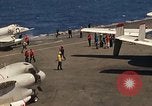
U.S. Navy Admiral John Sidney McCain Jr. watches the launching of several Navy planes from the deck in the Mediterranean Sea.
U.S. Navy Sixth Fleet in the Mediterranean Sea. U.S. Navy A-4 Skyhawk being put on to the catapult of USS Independence (CVA-62). Rear view of the A-4C type aircraft revving up for launch. A part of E-2A Hawkeye aircraft is seen parked in the foreground. A-4C being launched from catapult. U.S. Navy Admiral John Sidney McCain Jr. (father of John S. McCain III) watches the launches. Lt. Commander on the bridge looks through binoculars. McCain in the foreground. Admiral smokes a long cigar and watches the launches. U.S. Navy Vice Admiral William I. Martin (Commander of the Sixth Fleet) and Admiral McCain on the bridge. Admiral puts his long cigar in his mouth on the bridge. Ships officers in the background. Admiral chats with Vice Admiral on the bridge and again places his cigar in his mouth. Martin smiles and talks with cigar in his mouth. U.S. Navy F-4J Phantom II type aircraft on catapult, ready for launch. Plane being launched.

U.S. President Dwight David Eisenhower visits Turkey and Pakistan and is greeted by the people.
U.S. President Dwight David "Ike" Eisenhower during a visit in Asia. U.S. President arrives in Ankara, Turkey. He gets off an aircraft and is greeted by Mahmut Celal Bayar, the President of Turkey. People on either side of the streets welcome Ike. Policemen ride bikes in a formation. Both the Presidents in a motorcade. People look from the windows of their houses. A poster of U.S. President on a building. A sign reads 'Turks trust Ike'. He is given a farewell. The President gets in a plane and leaves for Pakistan. The President arrives in Karachi. Flags of the United States and Pakistan. U.S. President is greeted by Pakistani President Muhammad Ayub Khan. Soldiers stand in a squad. U.S. Persistent climbs up a carriage drawn by six horses and is escorted by guards. People stand on either side of the streets to greet him. People look from the gallery of their houses. He gets off the carriage and visits the tomb of Muhammad Ali Jinnah, the founder of Pakistan. He witnesses a display of horsemanship. Ike stands with Ayub and waves.
Members of crew using anti-aircraft height finders in Aberdeen Proving Ground, Maryland.
U.S. height finders used in World War I. The Barr and Stroud anti-aircraft height finder used in Aberdeen Proving Ground, Maryland. Members of the crew use the height finders. The crew uses the Bausch and Lomb 8-foot height finder.
A U.S. fleet including several battleships underway at sea in the United States.
A film titled 'Sky Fleets of the Navy' on maneuvers of U.S. ships. A U.S. fleet underway at sea in the United States. The bow of a battleship cuts the water. Battle ships steaming in a battle formation. USS Lexington underway in the background. A line of cruisers and battleships in formation underway at sea. USS Utah, radio control ship for target practice during bombing by U.S. Navy aircraft carrier squadron. Officers talk. They salute each other. One of the officer talks to a bugler who blows a bugle. Men of USS Utah leave the ship so that it may be used as a bombing target. The ship under radio control. An officer on the control ship uses equipment and instruments to operate the ship by radio control.
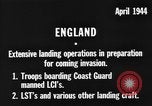
In England, U.S. Amphibious forces (in Exercise Tiger) practice for the invasion of Normandy, during World War II
U.S. troops descending from a pier, in England to board an LCI (L)- landing craft infantry, Large, during World War 2. Other LCIs are docked along the pier, including LCI -21. Ships and landing craft maneuver off shore from Slapton Sands, Devon, England, where U.S amphibious forces practice for the invasion of Normandy in World War 2. Closeup of troops underway in a Higgins boat landing craft. View from camera ship's deck, of a Transport ship, nearby and of several LCI(L)s in the distance. Closeup of U.S. Landing Craft Tank, LCT(5)-305, passing the camera ship. USS LST-30 and another ship are seen nearby. USS LST-310 is seen with a long floating dock in front of it. Next, the floating dock is turned sideways to her front hatch and soldiers are seen clearly on the dock. U.S. Landing Ship Tank - LCT(5)-305, passes behind. Next, the floating dock is seen moving away from LST-30. A ship, armed with guns, that appears to be numbered US 12F6. Closeup of LCI(L)-87 with Coast Guard Commander Miles Hopkins Imlay, seen on her bridge. (She is the flagship of his command, Flotilla 10.) View from ship beached on Slapton Sands, of Markers set up on the beach and Sign reading: "B." View from ship looking down on the sand where several officers are discussing the exercise. A truck driving out of beached landing ship.
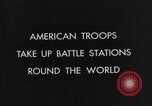
As the United States enters World War II, U.S. military forces are seen, deployed in various places throughout the world.
American troops are seen in arctic gear moving on skis through blustery snowy weather in Iceland, during World War 2. They were sent in 1941 to relieve British troops occupying Iceland since 1940, during World War II. A guard post at the American camp, with Quonset Hut in background. Closeup of U.S. sentry in arctic gear holding rifle with bayonet affixed. View from above, of numerous tents partially covered with snow in the American camp. Change of scene shows U.S. troops disembarking from transport ships at the British Isles. They march with their combat gear onto a square where Army trucks wait to transport them inland. Another scene shows the American troops, viewed from behind, parading in London. Other scenes show them marching in various areas of London. Saint Paul’s cathedral is seen in the background of one scene. A large number of American M3 Stuart Light tanks move on a railroad train in Britain. Scene shifts to the Middle East, where railroad cars and various military supplies for Russia are be offloaded from American ships. A Russian officer is seen signing receipts for war materiel, from a U.S. Army Technical Sergeant. A row of American Army trucks are lined up behind them. The Russian and American exchange salutes, and shake hands. Next, a troop ship carrying American troops is seen arriving at a port in India, where they disembark with their gear. An American Army Sergeant in a pith helmet pays attention to a little Indian girl. Scene shifts to China, in 1942, where Brigadier General Claire Lee Chennault, Commander of the China Air Task Force, of the Tenth Air Force, that replaced the American Volunteer Group (Flying Tigers), is seen with Brigadier General Caleb V. Haynes, Commander of the India Air Task Force. A colonel joins their discussions. A Consolidated B-24 Liberator bomber is parked behind them. View of Curtiss P-40 Warhawk fighter planes, with Flying Tiger markings, parked on a flight line. A B-24 bomber landing on a runway, between hills, deep in China. Closeup of Nationalist China Generalissimo Chiang Kai-Shek, saluting. Huge numbers of Chinese troops assembling in a formation. Next, an expeditionary force of American troops is seen arriving on a troop ship in Australia. They line the ship’s deck and wave. General Douglas MacArthur arriving in Australia to assume the office of Supreme Commander, South West Pacific Area (SWPA). .Glimpses of U.S. Navy activities in Australia: setting up defenses of islands; unpacking a Kingfisher float plane and making it ready for use on a desert island. The final segments of the film show American forces in August ,1942 sailing to Adak in the Aleutian Islands, to strengthen American defenses there. Troops seen descending by rope ladder from the American transport ship USS J Franklin Bell (PA-34), into her landing craft for deployment on Adak Island. Scenes of landing craft reaching the beach and offloading troops, vehicles, and supplies. View of beach filled with supplies. One landing craft is clearly marked with ""P34" showing that it belongs to the USS J Franklin Bell ( later reclassified as APA-16).
CRITICALPAST.COM: About Us | Contact Us | FAQs - How to Order | License Agreement | My Account | My Lightboxes | Shopping Cart | Advanced Search | Featured Collections | Website Terms & Conditions | Privacy Policy ©2026 CriticalPast LLC.
License Agreement |
Terms & Conditions |
Privacy Policy
©2026 CriticalPast LLC.