


 Francais
 Deutsch
 Italiano
Refine Your Search
US-Gliders- stock footage and images
- Showing 11143 to 11148 of 21913 results more
more Hide
Hide
Montage of scenes involving military equipment and operations emphasizing signal corps communications
'The Signal Corps Fights' depicts the role and contribution of the U.S. Army Signal Corps in combat and war. Montage of military equipment and combat scenes (some staged). Opens with glimpses of: massed formation of U.S. Army soldiers; similar formation of bombs in a munitions factory; row of P-47 fighter planes parked on an airfield; a huge radar antenna; battery of U.S. 120 mm M1 anti-aircraft guns; troops marching toward the camera; Martin B-26 Marauder aircraft dropping bombs, that explode on the ground; formation of German He 111 bombers in flight; U.S. battery of 120mm anti-aircraft guns firing; gun camera views of U.S. fighter strafing German aircraft on the ground, and attacking a German Messerschmitt bf 109 head-on (The tail is blown off and the pilot bails out at the last instant); fire engulfing some soldiers. Next, a soldier is seen at a large signal corps field telephone switchboard, and other communications switchboards are shown with operators. Momentary glimpse of troops, ostensibly engaged in combat. A soldier communicating from under a camouflage netting, and one holding a rifle and talking in a phone as he strings wire from a spool in his backback. A german soldier ostensibly cutting a U.S. communications cable that he discovers in the field. A U.S. soldier crawling along the line to find and repair the damage, followed by a staged "attack" by the German soldier. They engage in a knife fight. Soviet infantry advancing on the Eastern Front. Soviet T-34 tanks advancing. Soviet soldiers engaged in combat. An unusual U.S. tank with two guns, and side protection over track wheels. M3 Stuart light tanks going down hill with infantry in france during World war 2. Hand of signal corps soldier using a key to send morse code message. Soldier in bunker using field telephone. Signal corps soldiers communicating with field switchboards during combat. Momentary glimpse of German Messerschmitt bf 109 and another aircraft speeding past. Bomb exploding. Huge clouds of black smoke billowing, behind camouflaged German military vehicles parked. Twisted frames of German wrecked vehicles and rail cars. Huge number of German soldiers marshaling to retreat from advancing Allies. German officers conferring.
United States and Soviet soldiers meet at the Elbe River during World War II.
U.S. flag being lowered as bugler sounds and narrator alludes to the death of U.S. President Franklin D. Roosevelt, near the end of World War II. American troops and tanks rolling through German cities identified by narrator as Madeburg, Nuremberg and Leipzig, at end of World War 2 in Europe. U.S. troops cleaning out last vestiges of resistance in street fighting. Numerous German citizens lining sidewalks in city and waving white flags. On April 25, 1945, U.S. Army Second Lieutenant William Robertson with soldiers Frank Huff, James McDonnell and Paul Staub, meet Soviet Lieutenant Alexander Silvashko and several Soviet soldiers on the remnants of the Elbe bridge of Torgau. A U.S. Army Brigadier General mingling with Soviet officers. On April 26,1945, Major General Emil F. Reinhardt Commander of the U.S. 69th Infantry Division, walks with Soviet Major General Ruskovof the Soviet 58th Guards Rifle Division near Torgau. They are accompanied by other U.S. and Soviet officers. U.S. and Soviet officers exchange mutual salutes. U.S. and Soviet soldiers mingle, as a Soviet soldier plays accordian and some drink toasts, smoke cigarettes, and pose together. View of the Nazi party rally grounds in Nuremberg where a U.S. soldier is seen near the huge Swastika atop the Zeppelin Grandstand. Flashback views of Nazi rally there. Heinrich Himmler, Adolf Hitler and Viktor Lutze at the rally. Three American soldiers walking along the same walkway in the rally grounds. Explosion seen as the Nazi swastika symbol atop the Zeppelinfeld grandstand in Nuremberg is blown up by American troops.
Technological advances in the United States after World War 2 shared with other NATO member countries
U.S. Marines dropped off from U.S. marine helicopters at a landing zone during maneuvers. and then running on a field. Representatives of United Nations permanent member countries in a weekly conference session meeting of the permanent council. Exterior views of U.S. Capitol building with American flag flying. U.S. Congress in session in Capitol building. Technological advances in U.S. U.S. President Eisenhower on a visit passes beneath a sign "Atoms for Peace" and observes various displays dealing with atomic power and nuclear power. An early nuclear power plant in Idaho, and view of an electical power plant control room that uses power from the nuclear plant. Doctor in a hospital checks a patient using a atomic scanner. American workers work in Oil fields in the United States -- view of many oil rigs in one area and two oil workers working on an oil rig. Tractors and modern large harvesting devices being used in farms. Miners sit in mining rail carts and then enter a mine on the rail cart. Sign on wall at coal mine entrance reads, "Inland Steel Company." And below it another sign, "Price Mine Number 1. 1950." (deep mining operation in Price, Kentucky). Mechanical mining cutter used in mine is seen turning out many large chunks of coal. Rail carts transport raw ore out from the Price, Kentucky coal mine.
The battle of Khe Sanh in the Vietnam War.
Film begins showing two U.S. Air Force McDonald Douglas F4 Phantom jet fighters in flight. Narrator says American intelligence reports on January 29, 1968, of a 4th North Vietnamese Regular Army Division in the Khe Sanh area, bringing total enemy strength to about 40 thousand regular troops. View of photo interpreter rolling large wet film taken by Air Force surveillance aircraft. Map of Hue, area of South Vietnam, showing disposition of American forces in the region. American Marine Colonel David E Lownds, Commander of Khe Sanh garrison, describes North Vietnamese offensives against some American held positions. Views of North Vietnamese attacks being repelled by artillery and air strikes as well as organic infantry weapons like the A1 millimeter mortars, 3.5 rockets, and M79 machine guns. U.S. aircraft drop munitions on enemy positions. Infantry firing guns mounted on vehicles. An F4 Phantom drops napalm that creates a swath of fire. Closeup of North Vietnamese newspaper warns that the Americans face a defeat comparable to that of the French at Dienbienphu. American newspapers express concerns about the fate of the Marine Garrison at Khe Sanh. U.S. Army General William Westmoreland, Commander of U.S. troops in Vietnam, is seen and heard expressing confidence that American forces would win the battle of Khe Sanh. American troops listen as he speaks. Marines in briefings and in combat, including African American Marines. American artillerymen load and fire a 175 mm field gun at Camp Carrol, and a location called the Rock pile with a network of trenches. Inside that base, are seen Ontos M50A1 multi barrel anti-tank tracked vehicles armed with 105 mm recoiless rifles. A marine fires a 4.2 inch mortar, and another fires a recoiless rifle. Marines firing a 155mm howitzer. Scene shifts to deck of an aircraft carrier. View of Navy F4J phantom fighter aircraft being launched from the USS Ticonderoga (CVA 14) (Note: this may be an anachronism. Reportedly, the F4J was not operating from aircraft carriers in the Vietnam until after 1968). F-4 Phantom fighters taking off from an Air Force base. Aerial view of a U.S. Air Force B-52 bomber dropping conventional bombs on North Vietnamese targets. View from the air of bombs exploding on the ground over battlefield terrain. A C-130 transport plane dropping supplies to U.S. marines on the ground. View from below of the parachutes descending with supplies. Closeup of C-130 dropping mail from above. More views of parachute drops from C-130 aircraft to Khe Sanh. C-123 transport landing at a Marine base and a C-130 taking off. Another C-123 landing. Another having load delivered by low level extraction. Marines on the ground at Khe sanh opening packages of supplies and using a tractor to transport large boxes. On February 13, Marines suffered casualties when a platoon was ambushed just outside the base perimeter. View of Marine on a litter. Heavy black smoke rises at the base from shelling by North Vietnamese artillery. A C-123 aircraft takes off with dense black smoke in the background. Another napalm attack by a U.S plane creates a large conflagration. View from above of a B-52 dropping bombs only yards outside the Khe Sanh perimeter. Marines patrolling close in the base. More views of B-52s bombing North Vietnamese targets. View of nighttime bombing operations. A Marine plotting enemy movements on a plexiglass chart. Marines manning machine guns as enemy rockets and mortars continue to pound the garrison. Officers are seen in CINCPAC Command center. Continued U.S. bombardment and air strikes appear to prevent massing of enemy forces for an assault. Marines controlling hills in the area. A UH-1 Iroquois (Huey) helicopter flying low over the base. During a lull in battle Marines fill sand bags, maintain their weapons, play cards, and keep occupies as they sit and wait. Some play basketball with an outdoor improvised backboard and net. Some marines select books from a library. A marine plays a guitar as some others listen. Closeups of Marines in trenches including white and African American Marines. Marines doing their wash and having a meal of C rations. Marines preparing their own combinations of ingredients into meals being cooked over open fires. Views of many marines eating the various mixes of C-rations they called "casseroles." Marines in trucks pursuing retreating elements of North Vietnamese on Highway 9 that had been opened by Marine engineers. U.S. Army First Air Cavalry reinforcements arrive in operation Pegasus. Marine engineers working to restore bridges and roads needing repairs. Soldiers detecting and neutralizing mines. Bell UH-1 helicopters ferry troops. Captured enemy arms and ammunition. Surrendered North Vietnamese soldier prisoners of war marched under guard.
United States troops landing and fighting with Japanese troops in Leyte, Philippines (WW2)
U.S. Third Fleet underway at sea, heads for Leyte in October 1944 during World War II. Warships fire heavy guns at Leyte. Ships advance under naval bombardment. Explosions on ship. U.S. troops aboard landing crafts. Japanese troops and defense during the barrage. They take positions and begin to attack. U.S. landing crafts attacked. Dramatic close up views of faces and expressions of many U.S. soldiers as they prepare for the invasion. U.S. troops leave landing craft and wade through water on to beaches. Japanese troops firing at incoming American forces with rifles and machine gun fire. American soldier raises American flag on island. Artillery fired and U.S. Army tanks advance. Wounded U.S. soldiers carried on litters. U.S. Army soldiers staying low and crawling on beach to avoid enemy fire. U.S. Army soldiers advancing, using rifle fire, hand grenades, and flamethrowers to attack entrenched Japanese enemy positions. Dead Japanese soldiers. Smoke arising from explosions in jungle.
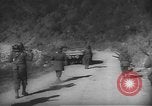
American Third Army Division forces operating on the offensive in the "Iron Triangle" and then pulling back, and finally participating in UN offensive "Operation Pile driver"in the Korean war
U.S. troops of the Third Army Division move along a mountainous road, past some parked army vehicles. Several of them scurry to take shelter by some boulders. Smoke rising from valley below as a soldier, in an M3 Half track, points and sets up an antenna. Four 50-caliber machine guns are mounted in the back of the half track. American soldiers firing rifles from a protected area. Two soldiers with an air-cooled machine gun. Spent cartridges are scattered in the sand by their weapon. Glimpse of troops firing the four 50 caliber machine guns in the back of the M3 half track. Overwhelmed by superior numbers, the U.S. troops are ordered to pull back. View of U.S. soldiers moving back from their protected position. American troops in vehicles moving back along the dirt mountainous road. Next, U.S. forces are seen moving South over snow-covered terrain. One U.S. mortar team fires a round to their rear. A Brigadier General conferring with another officer about mounting a counterattack back up the peninsula. Third Division troops are seen heading North, again, firing tank artillery as they proceed. Smoke rises from their shells exploding ahead of them. Infantry move carefully through burning villages and into the Korean central mountain sector. Smoke rises from a large explosion as the North Koreans launch an offensive in May. American troops rushing up a hillside to engage the enemy. A U.S. Sherman tank firing rounds from valley floor. Shells from U.S. armor exploding atop a hill occupied by American troops. Afterwards, the troops advance further. One fires at an enemy bunker just to be sure it is not occupied. Machine gunner atop a U.S. tank fires at haystacks that might hold enemy soldiers. Another view of a Sherman tank firing its main gun. Smoke rising from the shells striking a hill in the distance. Glimpse of a U.S. soldier with a North Korean prisoner of war. U.S. troops advancing through rice paddies filled with water. Narrator states that this was a full scale United Nations Offensive called "Operation Pile Driver." More views of American infantry setting up firing lines and firing water-cooled and air-cooled machine guns.
CRITICALPAST.COM: About Us | Contact Us | FAQs - How to Order | License Agreement | My Account | My Lightboxes | Shopping Cart | Advanced Search | Featured Collections | Website Terms & Conditions | Privacy Policy ©2026 CriticalPast LLC.
License Agreement |
Terms & Conditions |
Privacy Policy
©2026 CriticalPast LLC.