


 Francais
 Deutsch
 Italiano
Refine Your Search
US-Gliders- stock footage and images
- Showing 11209 to 11214 of 21913 results more
more Hide
Hide
American Air Defense activities during the Cold War
Film opens showing a U.S. Navy Gleaves-class destroyer in a bay. Closeup of radar antennas atop a U.S. Navy ship. A U.S. Navy submarine operating on the surface in icy waters. It has what appears to be a cylindrical shelter on its deck. The boat is covered in ice. Several men in foul weather gear are on its deck. Interior of a radar monitoring center, where a sailor, wearing a headset, monitors a plan position radar scope, where an unidentified aircraft is detected. Scene shifts to a U.S. Air Defense centers where such information is plotted on charts. Sign on table reads: "Supervisor GOC" (referring to the Ground Observer Corps) Civilian volunteer members of the Ground Observer Corps (organized by the U.S. Air Force in 1950) enter a room for a meeting. Narrator states that their mission is to operate 14 thousand observation posts and 49 filter centers. View shows predominately women volunteers in the group. Two uniformed Air Force men show silhouette diagrams of American military aircraft. Women connecting numerous phone callers at a large switch board installation. A barber serving a customer in his shop. A volunteer ground observer, at an outdoor post, watches as a flight of U.S. Air Force P-47 aircraft flies overhead in formation. A U.S. Army member of the Anti-aircraft Command, is seen at a desk. He receives a report of an unidentified aircraft and pushes a button to sound bells alerting soldiers who leave a dining hall in the midst of a meal to respond to their battle stations. They are joined by soldiers from elsewhere in the area. All rush to their assigned locations. View of them running across a field. A large suspension bridge in the background. Soldiers manning 120mm M1 anti-aircraft guns amidst views of rotating radar antennas. Soldiers loading shells into the guns. Soldier monitoring the unknown aircraft on radar equipment. View of hurriedly abandoned dining hall with uneaten meals on the tables. Soldiers lowering gun barrels and placing covers over them after the alert is cancelled.
President Harry S. Truman reads prepared speech after dropping of atomic bomb on Hiroshima Japan during World War 2.
U.S. President Harry S. Truman delivers a speech following the dropping of the atomic bomb on Hiroshima, Japan, during World War II. U.S. President Harry S. Truman seated at desk in cabin of a ship. He reads prepared speech stating that a single American aircraft dropped one atomic bomb on Hiroshima and destroyed its usefulness to the enemy. He reminds listeners that the Japanese began the war from the air at Pearl Harbor. He speaks about the U.S. Armed Forces and the production of atomic bombs in the United States. The President states that the U.S. is now prepared to completely destroy every productive enterprise of Japan, by bombing Japanese docks, factories, and communications. Truman states that the U.S. shall completely destroy Japan's power to make war. President Truman notes that acceptance of the Ultimatum of July 26th issued at Potsdam, could have saved the Japanese people much suffering. But it was rejected by Japan's leaders. He states that the U.S. have spent more than two billion dollars on the greatest scientific gamble in history and have won. This is due to the greatest achievement of organized science in history.
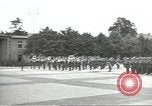
Soviet Union officially transfers control of the American sector of Berlin, to the United States, in a ceremony after end of World War II in Europe
Ceremony in Berlin, Germany, marking official transfer of American Sector of Berlin to U.S. Authorities, following end of World War 2, in Europe. Troops of the U.S. 41st Infantry Regiment, 2nd Armored Division, stand in formation as a U.S Army band plays the American National Anthem (Star Spangled Banner) on the esplanade of the Adolf Hitler Barracks, in Berlin. This is followed by a 48-gun salute fired by "RC" battery of the U.S. 78th Field Artillery Battalion, as all troops assembled render hand salute. Scene shifts to U.S. General Omar Bradley, Commanding General, Twelfth United States Army Group, standing at a microphone. He states that "this ceremony marks the meeting of the United Nations, here, in Berlin and a complete defeat of Germany." He continues with other remarks. Among allied senior officers seen with him are: U.S. Major General Floyd Parks, Commander of the U.S. Sector in Berlin; French Major General Duschesne, Commanding General of French troops in Berlin; and Soviet Major General Nicholei Nicholeiovitch Barinov, Deputy Commander of the Soviet troops in Berlin. Following Bradley's remarks, he, Parks, Duschesne, and Barinov, walk side-by-side across the esplanade, followed by the other military leaders as the Army band plays. Scene shifts to a formation of soldiers from the Soviet 5th Army. Following commands heard, The formation executes a right face,left shoulder arms, and marches off as the band plays.s.
The production of war films and other work in the Signal Corps Photographic Center in the United States (WW2)
Soldiers of the U.S. Signal Corps in the European Theater during World War II. Signal Corps cameramen of Army Pictorial Service photograph and film an amphibious landing. The soldiers wade ashore. U.S. soldiers advance on a battlefield, firing rifles. Camera man present. Street fighting on the war front. The wall of a building leans and crashes to the ground as a U.S. Army camera man captures moving image footage on camera. U.S. soldier rips a Nazi German eagle symbol from a building and it crashes to the street. A U.S. Army Air Corps B-17 aircraft in flight , seen from beside and close up from below and beside. View of exterior of Signal Corps Photographic Center building in New York. Men working inside the Signal Corps Photographic Center in the United States. Soldiers at film cutting machines at work, and view of film canisters in storage. The production of films in the center including a segment from "Why We Fight" and one from "The Fighting Men" pictures. Several war related films, and training and orientation films are produced. The foreign version of the films are also made so that they can be seen by other countries. Scene of an American soldier speaking Japanese in a U.S. military created film. Bing Crosby singing "Accentuate the Positive" during a filmed segment for the American G.I. audience at a USO show. Elevated view of war material and equipment stacked in a massive warehouse building, with Signal Corps workers moving about in the building. Men working and placing more equipment in the building. 'MacArthur's Headquarters' written on a wooden shipping crate. Boxes of war materiel being loaded into trucks, railroad train cars, and ships for transport to the war front in World War 2. Views of various kinds of Signal Corps communication equipment, radios, transmitters, cameras, vacuum tubes and other electronic equipment that was innovated during World War II. A moisture-proof switchboard is tested in the field. A U.S. Army Signal Corps soldier holding a phone during the switchboard testing.
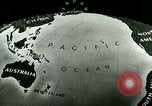
African American soldiers engaged on all fronts in World War 2
Film opens with map of the world showing the various theaters of operation in World War II. Narrator refers to Allies liberating town after town, as they advance. View of American troops being welcomed in a European town during an advance (probably Italy in 1944). Next, African American troops are seen boarding troop transport ships. A huge convoy of ships is seen from the air. Huge piles of war materiel on a dock. Ammunition being delivered by landing craft from the transport ship USS Hunter Liggett (APA-14) to American troops at a beachhead in the Pacific. An African American sailors directs the lowering of a piece of artillery from a ship into a landing craft. Construction equipment being used to clear the way for a new landing field. Docks, roads, and bridges being built as the Allies advance. American troops in the swamps of the South Pacific. American Army engineers clearing trees to build the Alaska Highway (ALCAN Highway) in 1942. Corps of Engineers building the Ledo Road (from India to China) during the war. African American soldiers building a bridge across a river in Europe. A U.S. Army truck under fire, driving along a dirt road in Europe as shells burst all around it. U.S. troops firing various kinds of field artillery and tank guns. U.S. infantryman using a flame thrower. Closeup of African American soldier using a bayonet and others firing small arms. A tank being blown up by artillery fire. A Japanese Mitsubishi A6M3 Zero aircraft maneuvers overhead in the Pacific theater. An African American soldier runs to man his Browning .50-caliber, water-cooled antiaircraft machine gun, and begins firing as the Zero fighter plane strafes his position. Closeup of Japanese pilot in his cockpit and his machine guns firing from leading edges of his plane. His rounds strike all around the U.S. gunner, who turns and follows him with more fire. His tracers show behind the plane. Closeup of the African American gunner as he continues firing. View of the Japanese airplane rolling over and diving. Next the Japanese plane, aflame, crashes on a tropical island and explodes. (Note: It is apparent that some of these combat scenes have been made up of clips from other sources, edited into this film.) (World War II; WW II; World War 2; World War Two)
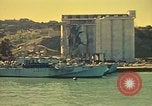
Combat ships and patrol boats at the Tunis Port during the North Africa Invasion.
Stationary U.S. Navy ships and vessels at the Tunis Port in World War 2. U.S. Navy combat boat with a gun, ammunition belt and the American flag passes a combat ship. U.S. Navy craft approaches another boat while on patrol. U.S. Navy sailor uses flag semaphore to signal another boat. Another personnel looks through binoculars as he talks to the pilot. Several U.S. Navy patrol crafts with the American flag. Several British sailors stand on the deck of a combat ship with flags in the background. Two men on a combat boat stand behind a gun, one with headphones on. A combat boat approaches another boat. Several Allied warships and patrol boats at sea.
CRITICALPAST.COM: About Us | Contact Us | FAQs - How to Order | License Agreement | My Account | My Lightboxes | Shopping Cart | Advanced Search | Featured Collections | Website Terms & Conditions | Privacy Policy ©2026 CriticalPast LLC.
License Agreement |
Terms & Conditions |
Privacy Policy
©2026 CriticalPast LLC.