


 Francais
 Deutsch
 Italiano
Refine Your Search
US-Gliders- stock footage and images
- Showing 11227 to 11232 of 21913 results more
more Hide
Hide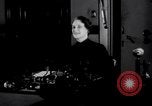
Nellie Tayloe Ross and officials oversee first gold shipment to Fort Knox from United States Mint in Philadelphia
Nellie Tayloe Ross, the 28th Director of the Mint, and Employees at the United States Mint, Department of Treasury oversee the first shipment of government gold from the U.S. Mint in Philadelphia to the U.S. Bullion Depository at Fort Knox, Kentucky. Clip shows casting and weighing of government gold, at the U.S. Mint facility in Philadelphia Pennsylvania. Nellie Tayloe Ross seen speaking and seated at a desk with other officials nearby. Mint officials check the quality and dimensions of a cast gold bar to be transported to Fort Knox in Kentucky. Gold molded into bars by ram machines. Nellie Tayloe Ross signs papers. Molding machines and employees at work. Molten gold in a kiln. Man casts it into gold bars. Officials and armed guards keep an eye on the process. Gold bars are placed on one side of a large scale and weighed. Exterior view of the U.S. Mint department building in Philadelphia. View is of the third U.S. Mint building in Philadelphia, North facade, facing Spring Garden Street (building later owned by the Community College of Philadelphia, as of 1973). Late 1930's automobiles seen passing by the U.S. Mint on Spring Garden Street.
Soldiers, equipment, airplanes, training centers, commanders and others forming the organization of the United States Army.
Organization of the United States Army in World War 2. Massive group of soldiers doing exercise calisthenics on a parade field. Large groups of soldiers march and salute the U.S. National Flag. A tank production factory with war production workers. Soldiers boarding a troop transport ship. View of the USAT Edmund B. Alexander troop ship (formerly USS America, ID-3006) at a harbor filled with U.S. Army troops in transport. Graduation ceremony underway at a military service academy (possibly Westpoint) and awards given. Selection of soldiers for the U.S. Army. Infantrymen and artillerymen fighting in a battle. Generals and Chiefs of Army staff at a discussion and facing the globe in U.S. Capitol. Animated flowchart showing various levels of service and departments in the U.S. Army. Secretary of War is the Supreme Commander, followed by Chief of Staff and a Deputy Chief; general staff succeeds the hierarchy. Operations division has three major constituents: - Strategy and Policy group, Theater Group and the Logistic group. Nine theaters of operations are shown on globe. Military officials at work. Soldiers working in clerical duties and message centers. Personnel typing and filing papers. A soldier emptying a bin of shredded papers. Soldiers in intelligence operations listening to message transmissions and wearing headphones. Letters of soldiers transported in a bomber aircraft seen taking off. Commanders discuss, training to ground, air and navy soldiers. Westpoint cadets in a training exercise with transit sighting devices in a field. Officers including a U.S. Army 4 star general (possibly General Malin Craig) review a map. Trucks ready to supply equipment at war front. Construction site of the Pentagon, with dirt, trucks, and buses in the foreground. Pentagon in the background and Washington Monument in the distant background. Four groups of general staff, G-1, G-2, G-3 and G-4 are there to look after various departments such as induction, promotion, information, policy, mobilization, size, conflicts, transport and supply.
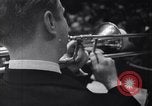
America plunged into World War 2. Montage of various World War II scenes over the span of the war years
American Jitterbug dancers seen at a contest in 1938. View of feet in shoes, as wearers tap their feet and beat time to music. View of drummer using wire brush on drum. Stadium of people cheer for a dancing cinematographer who is using a motion picture camera to film the event. In contrast, Nazi troops seen parading by torchlight. Nazi flags everywhere and Nazi party ceremonies, overseen by Adolf Hitler, in Germany. Nazis burning books. "Attention Jews" with skull and crossbones painted on stores and business establishments. Nazi Storm Troopers intimidating Jewish businesses and advocating boycott. Glimpse of Heinrich Himmler, in foreground, and Hermann Goering, in center of group of Nazi officials. Junkers Ju-87 Stuka dive bombers attacking Poland in 1939. German artillerymen firing heavy guns. A German railroad gun firing. German paratroopers jumping from Ju-52 trimotor transport aircraft. In contrast, patrons are seen descending in parachutes on the Parachute Jump ride at Coney Island Steeplechase Park, in Brooklyn, New York. Life Savers company sponsorship sign seen atop the parachute jump tower. People eating hot dogs, and firing guns at the shooting gallery on Coney Island's boardwalk. Germans march Polish prisoners of war. German troops invading Denmark and Norway. German troops passing a road sign for Chemin des Dames in Picardy, Northern France. Bomb exploding at Pearl Harbor, Hawaii, on December 7, 1941. American forces engaged in war against japan in the Pacific and against the Axis powers in Europe. U.S. soldiers throwing hand grenades. American wounded being carried on litters. People cheering liberating Allied forces in a European town. British soldiers on a vehicle displaying cartoon of Prime Minister Winston Churchill. Soviet forces advancing in snow. U.S. steel and war plants in operation. Men and women war production workers in American defense plants and war materiel factories, using drills, lathes, and power tools in the spirit of "Rosie the riveter." C.I.O. Poster to promote voting, during the war. Closeup of Sidney Hillman, President of Amalgamated Clothing Workers of America. Spectators line sidewalks to get glimpse of President Franklin D.Roosevelt (FDR) in a motorcade. Silhouette of two soldiers helping wounded comrade. FDR's funeral cortege. U.S. troops taking a break, in a war zone. American school children run into a field. An atomic bomb explosion.
Allied forces commence operations crossing the Ruhr River in Germany during World War II
On February 23, 1945, Allies commence operations to cross the Ruhr River in Germany, during World War 2. U.S. artillery soldiers fire 155mm guns from West bank of Ruhr River, against German lines on the East bank. Troops of Allied 1st and 9th Armies await signal to follow advance platoons that crossed the Ruhr earlier. Compelling close-up views of serious expressions on faces of U.S. Army soldiers as they prepare to move forward. M4 Sherman tanks fire guns at the river edge. Through misty conditions, troops of 104th Infantry Division, 415th Regiment, carry assault craft and begin crossing the river and attacking the industrial area of North Duren. U.S. soldiers are seen running across fields near large factory buildings and firing from them. Troops walk along street in Duren, after its capture. U.S. troops seen entrenched. A medic adjusts his personal flotation belt. Two U.S. Army soldiers smoking cigarettes while standing in a ditch with flotation devices around their waists as they wait the moment for the river crossing. They leave their positions and move along a road to cross the river at Linnich. All soldiers are wearing personal flotation belts as they paddle small assault boats across the swift moving river under enemy fire. One assault boat is overturned. Drenched soldiers make it to land and continue their advance. Army engineers construct a floating footbridge, under enemy fire. A soldier runs across the bridge as an American light airplane flies low overhead, surveying the operation. U.S. troops move through destroyed towns and villages. Large column of captured German prisoners of war is marched toward the rear, with arms held above their heads, passing by giant piles of debris and wreckage from bombing of the town.

The Philippines gains independence from the United States on July 4, 1946; also scenes from 1941 Japanese invasion WW2
The Philippines are established as an independent nation. Crowds of Filipinos gathered at Rizal Park (Luneta Park) in Manila on the July 4, 1946. View of Independence Grandstand (a temporary structure built in front of the Rizal Monument) with American flag and Philippine flags on tall flag poles.. View looking down on General Douglas MacArthur at a podium, speaking into microphones. Camera pans over various segments of the audience. A map shows the Philippine Islands in context of its neighbors in the Pacific Ocean. Camera pans closeup across faces of many Filipinos gathered at the independence event. View of the Jones Bridge over the Pasig River in downtown Manila. Heacock’s Department Store on the Escolta. The Legislative Building. (later the National Museum of the Philippines). Ocean going ships in a harbor. Cargo being offloaded from a ship onto smaller boat. An industrial complex with eight tall smoke stacks emitting smoke. Steel and petroleum plants. Filipino workers in an assembly plant. The Legislative building with people coming and going. Air raid sirens sounding and people running in streets of Manila at onset of Japanese invasion of the Philippines in December, 1941, at start of World War 2, in the Pacific. People running across the Jones Bridge, seeking shelter. Others boarding a bus. Smoke rising from Japanese bombing. Glimpse of Japanese tanks entering Manila during attack and invasion. Japanese infantry climbing a hill. Bodies of persons killed during the Japanese invasion. Glimpse of Japanese troops occupying Corregidor. U.S. General Wainwright negotiating the surrender of Corregidor with Japanese General Homma. View of an American warship firing during the U.S. campaign to defeat the Japanese on islands in the Pacific. An American landing ship carrying U.S. troops who storm ashore. General Douglas MacArthur striding ashore with a retinue of officers, at Leyte, Philippines, on October 20, 1944. as he keeps his promise to return to the Philippines. Views, back again, to MacArthur speaking at the Independence Day ceremony in Manila on July 4, 1946. Also seen at the ceremony are: U.S. Senator Millard Tydings, (co-sponsor of the 1934 Tydings–McDuffie Act, which provided independence to the Philippines after a 10-year transition under a limited autonomy), and Paul V. McNutt, U.S. High Commissioner of the Philippines, who read President Truman's proclamation of Philippine Independence to the assembly. Camera pans over the gathering which includes many U.S. Service personnel in uniform. The oath of office is administered to the elected President of the Philippines, Manuel Roxas. At the conclusion, the American flag is lowered by Paul McNutt, as President Roxas raises that of the Republic of the Philippines. A celebratory parade in Manila includes a float with signs reading: "Let's Produce and Rebuild," among other things. Other floats represent "Mountain Province," and "The City of Manila," "The University of the Philippines," and "The Division of City Schools." One float, sponsored by the Chamber of Commerce, contains a huge replica machine gear, and models of an aircraft and a ship. It's message is about turning the gear that helps make the nation great. American and Filipino soldiers march, carrying their respective national flags. A white-helmeted military band plays for the marchers. Final scene shows large loose formation of military aircraft in flight very high above the Independence Grandstand, at Rizal Park.
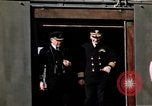
Gun crew fire guns mounted on Queen Elizabeth ship.
Ship's C.O. with a U.S. Navy Captain, come out on the deck. A British Merchant Marine Captain talks with the U.S. Navy Captain (Navy Captain has a sub. insignia over his breast pocket). U.S. Navy officer smokes a pipe on the deck. Two junior U.S. Navy officers on the deck. U.S. Navy Commander on weather deck. Two British crewmen with a U.S. Navy officer, look out over the sea. Rocket-type launcher in a tub, above weather deck. Sign reads 'Stand Well Clear, When Klaxon Sounds'. Rocket launchers on ship. One of the gun mounts fire in the background. Crew on weather deck, near fantail area. Wake of the ship in the background. Crew fires 4'' gun on stern of the ship. Gun crew on gun, breech opened. Crew works around rear of the gun. Gun fires. Small group of weather deck. U.S.A. officer, U.S.N. officer and a ship's officer talk. Weather deck of the ship and crew walk by in foreground. Personnel look at a plane in flight. (World War II period).
CRITICALPAST.COM: About Us | Contact Us | FAQs - How to Order | License Agreement | My Account | My Lightboxes | Shopping Cart | Advanced Search | Featured Collections | Website Terms & Conditions | Privacy Policy ©2026 CriticalPast LLC.
License Agreement |
Terms & Conditions |
Privacy Policy
©2026 CriticalPast LLC.