


 Francais
 Deutsch
 Italiano
Refine Your Search
US-Gliders- stock footage and images
- Showing 109 to 114 of 21920 results more
more Hide
Hide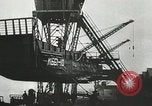
United States 9th Armored Division crosses the Rhine River over the Ludendorff bridge at Remagen, Germany,in World War II.
United States 9th Armored Division crosses the Rhine River in Germany., during World War 2. Opening scene shows several amphibious assault craft being moved by crane at a port in Belgium, where they are loaded on tractor trailer trucks and driven across Belgium to support Allied advance into Germany. British sailors ride atop the craft. They are brought into a town where a signalman, standing atop one, uses semaphore flags to transmit a message. Next, a smoke generator is seen creating a smoke screen over the area. Landing vehicles tracked (LVT) are moving over ground adjacent to the Rhine River. A formation of American B-17 bombers flies overhead. View from bomber, showing bombs striking German industrial targets. Closeup of two U.S. soldiers watching from the West bank of the Rhine, as U.S. bomb strike targets on the East Bank. View of smoke rising from bomb strikes. View of bridges destroyed by German forces. Closeup of three U.S. soldiers standing together. A German Messerschmitt Me-110 warplane passes overhead. Wrecked railroad bridge seen from above. The East bank seen from an aircraft. Soldiers refueling from 55 gallon drums. Troops moving through smoke screen. Two soldiers looking at the Rhine where the Ludendorff steel bridge is seen still standing. View of bridge at Remagen, from a cliff on the West bank of the Rhine. Soldiers in a jeep approach the bridge on West bank. View from jeep driving on riverbank underneath the bridge. Soldiers running across the footpath on the bridge. View from vehicle driving across the bridge. Troops and equipment crossing the bridge into Germany on East side of the Rhine. Large sign posted on bridge tower, reading: "Cross the Rhine with dry feet, Courtesy of the 9th Armored Division." Group of American soldiers watching as others cross the bridge. Several British Lancaster bombers are seen over the Rhine River. Inflight closeup of one releasing a large bomb. Camera tracks its fall to explode on target. Medical Corpsmen hurrying along the river bank, carrying a stretcher. Troops entering small boats and amphibious assault craft to cross the river. A U.S. Army Air Forces P-47 aircraft diving. A pilot wearing an oxygen mask seen in a cockpit. Troops in an LVT crossing the Rhine. More views of American and British troops crossing the Rhine by water. Troops being organized as they move out on the Eastern shore. A column of British troops moving on a road and escorting German prisoners. Two of the prisoners looking up as a formation of U.S. C-47 aircraft fly overhead. View inside a C-46D transport as troopers jump from its double rear paratroop doors. View from aircraft as paratroops descend with chutes open. A C-46 flying low over a German town, towing a Waco CG-4A glider. Army vehicles crossing river on a pontoon bridge. Closeup glimpse of a British officer. British troops riding in army trucks. (Note: Vehicles: seen in this film include: Diamod T 981, M20 MB GPW, M8 Armored Car Landing Craft, LVT, Rogers Trailer M9, M4 Sherman, Quad Mount, DUKW, WLA, CCKW )
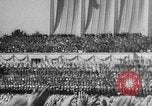
Growth of the German Nazi party and military might (German remilitarization) during the 1930s leading up to World War II
Nazi rally in Nuremberg, Germany ca.1934. Massed Storm troopers and spectators salute Hitler. An artillery piece is fired. Hitler personally recognizing loyal Storm troopers. Animated map of Asia, showing Japanese occupation of Manchuria, and Italian occupation of Ethiopia. Newspaper headlines describe Britain and France hesitating to support League of Nations oil sanctions against Italy; and U.S. increasing its oil exports to Italy by 600% (ca. 1935). Hitler and Hermann Goering looking pleased in Hitler's private railroad car. Adolf Hitler at a planning table covered with maps. German citizens traveling abroad and Joachim von Ribbentrop visiting London, as ambassador to Great Britain, in 1936. View of Léon Degrelle and his Catholic-fascist, Rexist party in Belgium (ca. 1936). View of Colonel Francois de la Rocque speaking at a Cross of Fire (Croix-de-Feu) party night rally in France. Konrad Henlein, leader of the Sudeten German Party in Czechoslovakia. Arthur Seyss-Inquart, Austrian National Socialist official, seen in an automobile during a parade. Sir Oswald Mosley addressing followers and defending Hitler. Street scenes of public disorder attributed to Nazi sympathizers in France and Belgium. Mass meeting of the German American Bund in Madison Square Garden, New York City,1939. U.S. flags and picture of George Washington decorate stage. Fritz Julius Kuhn addresses the gathering and members rough up a protester. Views of heavy industry in Germany, especially steel manufacturing for remilitarization. Persons working at a German concentration camp. Dramatized execution by machine gun. View of Heinrich Himmler. German President Paul von Hindenburg. German national conscription of 1935 during military mobilization efforts. German youth training pilots with gliders. German paratroopers, Junkers 52 aircraft, German soldiers goosestep, views of German tanks. Ju 87 Stuka plane. German invasion of Rhineland, 1936. Construction of Siegfried Line. Antitank barriers, bunkers, dragons teeth. Hitler visiting Westwall. German military parade.
Allied Army paratroopers land at Arnhem Netherlands and advance inwards fighting with enemy during World War II.
United States Army and British Army airlifts paratroopers from England to the border of Holland during World War II. British and American transport airplanes and gliders land near Arnhem Holland (Netherlands). Soldiers, tanks and guns supplies offloaded and soldiers begin fighting with the enemy. Soldiers of Dutch Army aid the Allied forces. Allied soldiers rescue injured soldiers and advance towards enemy lines. Allied soldiers meet with Dutch Resistance or Dutch Underground Army members wearing identifying armbands. Group of German Army prisoners is seen including many young boy soldiers. Allied landing draws attention of German units allowing U.S. Army units to cross border into Germany. American soldiers near a bridge and crossing into Germany. They pass near railroad station at Roetgen Germany. Nazi German prisoners use horse carts and bicycle transport while being led away under Allied guard.
Aviation history; historic early flight scenes; first hand accounts from persons who knew and worked with the Wright brothers.
Views of traffic on a city street around the turn of the 20th century. A mix of horse and buggies and motorcars and bicycles. People waiting for a trolley car. Reenactment of persons using an early telephone and of early filmmakers at work with camera on motion picture film. The Wright brothers home at 7 Hawthorne Street, West Dayton, Ohio. The Wrights' former housekeeper, Carrie Grumbach, recalls December 17, 1903, a telegram arriving about the Wright brothers successful first powered flight. Glimpse of Wright brothers machine shop. Charlie Taylor, who had worked in their shop, speaks of being pleased at their accomplishment. View of the Wrights flying gliders at Kitty Hawk, North Carolina. Charlie Taylor describing how he machined and built the motor for the Wright brothers airplane. Glimpse of that motor or a facsimile. Men positioning the Wright brothers airplane for launching, and French citizens gathered to watch a demonstration of their airplane in France. French aviation pioneer, Henri Farman with two other men in his Voisin-Farman I airplane. They begin takeoff. Closeup of Brazilian aviation pioneer, Alberto Santos-Dumont. Other early aircraft in flight. A Wright Flyer passing over the Fort Myer drill ground in Virginia. An Army balloon in the background. Retired United States Air Force Brigadier General, Frank P. Lahm, walks across the tarmac on an airport and speaks for interviewer (unseen). He speaks about the difficulty the Wright brothers had in convincing the U.S. Army of the value of their airplane. He tells that in December, 1907, Wilbur Wright was finally granted an interview with the Board of Ordnance and Fortifications, which led to a contract, in 1908, with the Signal Corps. Moving imagesof Orville Wright and assistants bringing a Wright Flyer to Fort Myer, Virginia, to conduct flight trials for the Army. Views of the airplane being flown all around the area, watched by spectators. (This footage is a mix of 1909 footage where the aircraft shows two half-rounds of canvas in the front elevator, and 1908 footage, taking off and flying, where the aircraft has a single half-round of canvas in the front elevator.) After landing on the 9th of September, 1908, then, Lieutenant Lahm, accepts Orville Wright's offer to fly with him. Lahm climbs aboard the airplane, sits next to Orville Wright, and they are seen taking off and flying about for six minutes and forty seconds. (Lahm is the first. military officer to ever fly in an airplane.) The next scene shows the wreck of a Wright Flyer, in which Army Lieutenant Thomas Selfridge was killed and Orville Wright injured, on September 17, 1908.
USAAF B-24 Liberator drop supplies and jeeps loaded with soldiers move past cheering crowds in Netherlands during World War II.
U.S. 101st Airborne Division in Holland during World War II, during Operation Market Garden. Soldiers aboard a jeep moving across a field. Other soldiers walking along the field with gliders aground in the background. United States Army Air Forces B-24 Liberator aircraft in flight overhead. Supplies are dropped from the aircraft. Jeeps loaded with U.S. Army soldiers move along a road past cheering civilians. A woman waves a large American flag, greeting the troops. (This is possibly the town of 't Zand.)
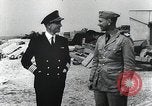
Seabees construct an artificial harbor during the Allied invasion of Normandy, France in World War II.
A film about the role of U.S. Navy Seabees in construction of artificial harbors in the English Channel during the Allied invasion of Normandy in World War II. U.S. Navy Captain Clark, in charge of artificial harbors and Commander Calair, in charge of installing Phoenixes and pier heads in the English Channel. Ships underway in the English channel. Tugs at a harbor. Beetles being pulled. A tug prepares to tow a Phoenix. Men work on lines. Whales spread across the channel. Pier head at sea. A dumb barge underway at sea. A captain looks at the towing operation from the bridge of a vessel. Aircraft in flight. Crew aboard a phoenix. Gliders in flight above the convoy. A signalman sends a blinker signal. Animated diagram depicts the creation of an artificial harbor. First tow arrives at Normandy on June 6, 1944. Landing crafts at the Normandy beach. Artificial harbor being constructed. A bridge being completed and pier head being attached to it. Seabees at work.
CRITICALPAST.COM: About Us | Contact Us | FAQs - How to Order | License Agreement | My Account | My Lightboxes | Shopping Cart | Advanced Search | Featured Collections | Website Terms & Conditions | Privacy Policy ©2026 CriticalPast LLC.
License Agreement |
Terms & Conditions |
Privacy Policy
©2026 CriticalPast LLC.