


 Francais
 Deutsch
 Italiano
Refine Your Search
US-Gliders- stock footage and images
- Showing 11461 to 11466 of 21913 results more
more Hide
Hide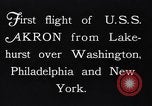
Dirigible USS Akron during its first flight from Lakehurst, New Jersey to Washington DC.
First flight of the dirigible USS Akron from Lakehurst, New Jersey to Washington DC. Airship floats in air, U.S. navy symbol and Akron written on it. The cabin at the bottom of Akron. Buildings and Potomac River shoreline seen from it. Views as it flies over the National Mall, the White House, the Washington National Monument, Lincoln Memorial, Main Navy and Munitions Buildings, and several Potomac River Bridges including the Memorial Bridge. Empty land seen at Gravelly Point where National Airport was later built. Passengers in the dirigible looking out the windows at the sights below. Control room, navigation captain and crew members talk, including good views of the ship's captain, Lieutenant Commander Charles E. Rosendahl, U.S. Navy. A cook checks on roasts cooking in an oven. Airship flies directly over Washington Monument. Views of Union Station from the airship, and then views from directly over the U.S. Capitol. Many views of the airship in flight taken from an adjacent airship or plane. Views of another U.S. city on the east coast, and then views of the airship flying over Manhattan Island. New York City skyscrapers and skyline seen from the airship.
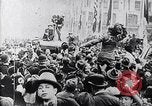
Post World War I political issues in the U.S.A. including Red Scare, anarchists, labor strife, and KKK
A huge crowd on streets of New York City cheering and celebrating victory over Germany in World War I after signing of the Armistice. A cemetery of U.S. soldiers died in World War I. Cross burning and views of hooded Klan members at a Ku Klux Klan (KKK) ceremony, with several uniformed U.S. Army soldiers in foreground, dimly lit (possibly at Stone Mountain Georgia but location not confirmed). Palmer Raid victims: Suspected leftists, left wing, and anarchists seen being led away in a group by police after their homes were raided and searched without search warrants, and some were deported, under program led by U.S. Attorney General A. Mitchell Palmer, during 1919 and 1920. (Second group shown is likely in Paterson, New Jersey; note sign for J.T. Doremus Hardware on building in background.) Palmer Raid arrestees seen behind barbed wire fences where they were held without charges for three months and denied legal representation. Some arrestees being escorted by U.S. soldiers in uniform. Vigilante businessmen and town leaders enforcing 12 hour work days at Steel factories in Pittsburgh Pennsylvania and Gary Indiana. Vigilantes (deputized and armed by local authorities) seen with rifles and shotguns marching down streets enforcing labor demands and countering steel workers on strike. They approach a striking worker on the road side and seize a stick he is holding. They beat a protestor with sticks. Together with police they begin to hit and beat back the protesting crowd of men. Someone fires a gun in the crowd and shooting starts on both sides during fight. An injured or dead steel worker on the ground is lifted up by a man and carried away.
USDA documentary titled 'Terracing in the Northeast' depicts terracing techniques for soil control and improved farming
From a U.S. Department of Agriculture documentary titled 'Terracing in the Northeast.' Depicts soil problems in farming and solutions via terracing. Trees near farm land. Withered, irregular plants on poor soil. Healthy crops ready for harvest in a large terraced farmland. Trees and barns at the end of field. A farmer plows field with a tractor. Crops in the farm land. Two men walk on the field. Farmers care for growing plants. A man checks the black soil suitable for the growth of crops. Water flows through a channel to irrigate the crops. Two farmers operate a hand plow. A man plows hardened soil of field standing on a horse-drawn plow. From an H.W. Wilson Company listing in 1940 of its Educational Film holdings: This is a Soil conservation service film. As beautiful scenes of the countryside unfold the commentator tells us that much of America's oldest farming land is in the Northeast. The serious soil erosion situation is frequently taken care of by terracing. We learn how terracing is done, its advantages and see land so cultivated. Terracing is used successfully for growing potatoes, tobacco, truck farming and for fruit culture. Cover crops are planted and when turned under add fertility to the soil. It is necessary to inspect the terraces regularly and to keep the channels of the outlets clear. An informative picture showing construction and uses of terraces and other erosion control measures as applied to northeastern part of United States. New Hampshire.
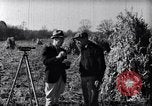
Various farming instruments and techniques involved in terraced farming in the northeastern United States
Terracing in the northeast United States for more effective farming. Various farming instruments involved in terraced farming in Northeastern states of the United States. Agriculture experts in a village measure level and various properties of field using instruments. A farmer uses divine sticks to detect underground water. Farmers plow the field using a tractor. Early Caterpillar and Case tractors shown. Tractors pull plows and plow the fields. Various farming equipment used by farmers. A pair of mules pull a plow. CASE tractor with a large spinning bit plows, spraying soil inward. View of plowed fields.
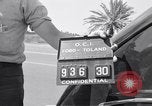
Sentries at buildings, bridges and children enter school warships patrol in Honolulu, Hawaii following Japanese attack.
United States armed sentry at guard post outside military building. Another armed soldier on the roof. Sentry checks soldier entering in a jeep. Numerous school children in an orderly line, entering their school building. Workers using hoes cultivate a pineapple field. Woman placing cloth on barbed wire fence. A formation of U.S. aircraft flying overhead. A building surrounded by barbed wire. Workers loading crates of pineapples onto a truck. Women weaving cloth strips into camouflage netting.Views of mountains and clouds. Hawaiian civilian workers stretching chicken wire over vertical poles. Workers cultivating pineapple plants with hoes. View from vehicle driving toward, and over a bridge guarded by armed sentry. Road signs indicate intersection of U.S. Route 1 and local Route 130. Sign on building reads: "Haleiwa." U.S. Navy sailors walk at Honolulu Harbor past the "Aloha Tower" covered in camouflage paint. (World War II period).
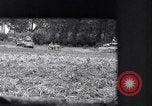
United States 1st Army rolls into St. Quentin, France and crosses over to Belgium, in World War II
U.S. 1st Army troops pass an abandoned German pill box near Cambrai, on their way to the Belgian border, during World War 2. U.S. tanks advancing along road to Saint-Quentin on September 1, 1944.Road sign points toward St. Quentin. Some French civilians watch as troops ride into the city aboard military vehicles. American flag is seen at window of a building.September 2nd, lead elements of the 1st Army pass road sign marking boundary between France and Belgium. A road sign on ground at the old formal border reads "Douane Belge." American tanks speed across Belgian fields in pursuit of retreating German soldiers.US units firing tank guns and machine guns at German positions.Smoke rising.Destroyed and burning German artillery, tanks, halftracks, and other vehicles and equipment along side of road.Destroyed civilian automobile and wagons. American troops entering town where Belgian flags fly. German Army Captain, accompanied by U.S. troops, urges his soldiers to surrender.He steps over wire fencing into a field where German soldier are coming forward. View of numerous German prisoners of war being held in a meadow.
CRITICALPAST.COM: About Us | Contact Us | FAQs - How to Order | License Agreement | My Account | My Lightboxes | Shopping Cart | Advanced Search | Featured Collections | Website Terms & Conditions | Privacy Policy ©2026 CriticalPast LLC.
License Agreement |
Terms & Conditions |
Privacy Policy
©2026 CriticalPast LLC.