


 Francais
 Deutsch
 Italiano
Refine Your Search
US-Gliders- stock footage and images
- Showing 1147 to 1152 of 21920 results more
more Hide
Hide
Diagnosis of U.S. Army men suffering from dengue fever on an island in the South Pacific during World War II.
A film titled 'Breakbone Fever Dengue' shows U.S. Army personnel catching dengue fever on a South Pacific island during World War II. A U.S. Army medical officer reads out an official report on the outbreak of dengue in the South Pacific. U.S. troops on an island in the South Pacific. Men work on aircraft engines. Stationary planes on an airfield. U.S. soldiers on hospital beds and lined up outside a dispensary after catching up dengue fever. A close view of Aedes mosquito on human skin. Dengue casualties on hospital beds. Mosquito breeding places at a U.S. Army base shows water collected in rubbish heaps, fuel drums, coconut shells, cans and bottles and water in tires. A native village shows men walking towards a building in the background. Doctors examine patients in a hospital. The effects of dengue showing patients facing problems with eye movements and back pain. The body temperature chart of a patient. Men shows rash on the chest of a patient. A laboratory report after a diagnosis.
U.S. soldiers being hit by shell fragments and their recovery after surgery in Naples during World War II.
A film titled 'Soft Tissue Wounds' shows U.S. soldiers being hit by shell fragments and their recovery after surgery in Naples during World War II. Bombs stacked on a field. U.S. sailors work around. A battleship's gun firing salvo. Fragments are removed by surgery from battle casualties. Reports of four cases handled in the Italian campaign of January 1944. The first case shows a soldier hit by a shell fragment. U.S. troops carry the soldier hit by the shell fragment in Italy. A truck moves ahead on a road. Wounded being carried into an evacuation hospital tent. A wound just below the buttock of a soldier. Primary infusion is given to the patient. The bleeding is controlled. The wound is dusted. Dressing completes an operation. The healing of the wound after a few weeks of the operation. The patient walks after healing. A U.S. soldier shows a scar under scapula. A U.S. LST (Landing Ship Tank) fires towards Anzio Harbor. [Note: script refers to British Hospital Carrier Leinster (#37) although footage appears to be of (British) Hospital Ship St. David (#27), later sunk by the Germans at Anzio in January, 1944]. A wounded soldier is carried on a stretcher aboard the hospital ship. Surgery is performed on the wounded soldier. The soldier on a bed after the operation. A ship underway at sea. A Red Cross ambulance and a truck transport the wounded soldiers to a hospital in Naples. The wound after one week of injury. The wound margins are refreshed. The wound edges are stitched. Removal of stitches after eight days. The soldier smokes a cigarette after recovering.
Wounded U.S. and German soldiers treated at field hospital after Allied invasion of Normandy during World War II.
View of U.S. Army Field Hospital set up in Normandy, France, following the Allied invasion in World War 2. U.S. DUKW (six-wheel-drive amphibious truck) passes along a road. American wounded being carried on stretchers to hospital tent. Intravenous treatment being administered to a wounded soldier; man standing holds IV bag. American Army nurses and corpsman preparing bandages inside a field hospital tent. Nurses seated near a tent. One drinks coffee from her metal mess cup. Nurses comforting and assisted wounded soldiers. Two German prisoners of war (POWs) pose for camera. It is unusual that two of the German soldiers appear to be of East Asian descent. (It has been reported that there was a Korean man named Yang Kyoungjong who was three times captured and conscripted into the Japanese army, then the Soviet Army, and then the German Wehrmacht during World War 2. He was captured by the U.S. Army during the invasion of Normandy. The identify of the two German soldiers of Asian descent seen in this footage is unknown.) German POWs carrying a wounded comrade toward a treatment tent. A German POW Army doctor and his assistant treating a soldier for shrapnel wounds. The doctor waves toward German POWs to bring their wounded, on a litter, to him. POWs carrying wounded on a litter. Paratrooper of the U.S. 101st Airborne Division, with bandages across his face, carries a wounded buddy to treatment area. Closeup of the trooper smiling in spite of his bandaged face. Ambulatory wounded U.S. soldier being registered by Army nurse. Corpsman of 101st Airborne, on stretcher on the ground.
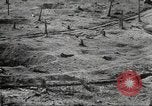
A survey of the damage on the captured island of Munda after U.S. 13th Air Force bombardment during World War II.
Damage at Munda Point, Solomon Islands after U.S. 13th Air Force bombardment during World War II. The damage is surveyed by U.S. officers. Wreckage of Japanese aircraft and installations. Dead bodies of Japanese soldiers are removed by U.S. troops. Gun emplacements are made. Bulldozers level the ground. Heavy construction equipment is operated to level a hill. U.S. bomber aircraft on a flight line at a newly constructed U.S. airfield. A bomber takes off from an airstrip.
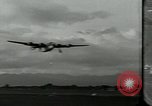
A technical group attends a meeting to carry out investigations for U.S. Army chemical warfare tests on San Jose Island, Panama.
U.S. chemical warfare tests on San Jose Island, Panama during World War II. Close-up view of U.S. 6th Air Force B-25 Mitchell bomber flying low over islands near San Jose Island. More distant shot of formation of B-25 bombers in flight. A field located near San Jose shows a bomb dump. U.S. airmen load bombs on a bomber aircraft. A technical group consisting of U.S. NDRC (National Defense Research Committee) scientists, trained officers of United Kingdom's Army and Navy and U.S. Army Air Force officers attend a meeting in front of a chart.
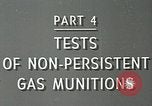
Phosgene and CK gases are tested during U.S. chemical warfare tests on San Jose Island, Panama during World War II.
Tests of non-persistent gas munitions during U.S. chemical warfare tests on San Jose Island, Panama during World War II. U.S. troops advance in a jungle during a simulated chemical warfare. Bombs stacked in a munitions dump. The bombs are loaded on bomber aircraft. Japanese canisters on which Phosgene and CK gases are to be tested. Technicians use gas concentration recording instruments made by U.S. NDRC (National Defense Research Committee). Phosgene and CK gases are tested on goats, mechanical breathers and U.S. and Japanese canisters. CK gas breaks a canister. Gas testing shows bomb blasts in the jungle.
CRITICALPAST.COM: About Us | Contact Us | FAQs - How to Order | License Agreement | My Account | My Lightboxes | Shopping Cart | Advanced Search | Featured Collections | Website Terms & Conditions | Privacy Policy ©2026 CriticalPast LLC.
License Agreement |
Terms & Conditions |
Privacy Policy
©2026 CriticalPast LLC.