


 Francais
 Deutsch
 Italiano
Refine Your Search
US-Gliders- stock footage and images
- Showing 11617 to 11622 of 21913 results more
more Hide
Hide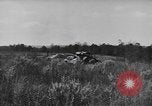
Maneuvers of a tank to escape the enemy fire at a combat course in the United States.
A U.S. Army training film depicts operations and uses of tanks during World War II. Training: A U.S. M4 Sherman medium tank advances in a field in the United States Enemy fire at the tank. Directions for tank combat including firing directions and alertness requirements. A man seated inside the tank firing at enemy positions. The tank takes the advantage of cover. Smoke rises due to the firing. Machine guns and other ammunition should be used. The tank changes its positions as soon as the enemy locates it. The tank continues firing at the enemy positions.
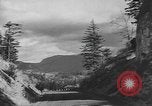
Views of American landscape and western cities; United States soldiers from civil war and later marching in various places.
A film on the history of U.S. soldiers. Various American landscape wide views, some with roads, some with natural features. Plains, deserts, mountains in the United States. A mountainous area in the western United States. A snowcapped mountain in the background. Three elderly United States Civil War veteran soldiers, both Union and Confederate, walking together in a American military cemetery. United States Army soldiers wearing helmets and marching at an Army base or encampment. U.S. soldiers marching on Constitution Avenue in Washington DC during a parade. They hold rifles and a soldier holds the U.S. flag. U.S. Army cavalry unit riding on horses in formation. Elevated view of an American city square with snow capped mountains rising in the background. Other American cities in the west with city center areas, pedestrians, and 1930s and 1940s automobiles on the roads. Cars parked at a large industrial factory with a water tower rising up. Aerial view of an urban, western United States city with a bridge over water in background. Aerial views of various American cities. United States Army infantry soldiers march along a road and then cavalry are seen galloping by on horses. A railroad train approaching the camera and then passing by at high speed, with views of the locomotive, cars, wheels, and railroad tracks. View of the Golden Gate Bridge in San Francisco, California. Point of view shot from front of moving railroad train in Colorado on the edge of gorge near the Rocky Mountains. A river steamboat or paddle steamer with a bridge in the background. Men harvesting sugar cane in Cuba. Lock gates on the Panama Canal opening, as seen from a ship waiting to enter. A World War I memorial sculpture honoring American soldiers.

The recruitment of women as Marines in the United States, during World War II.
A film titled: 'Lady Marines' on the recruitment of women in the United States Marine Corps, during World War 2. Views of Marines engaged in combat. U.S. Naval guns firing. A Marine dive bomber in action. Splashes in water from explosions. Marines in an amphibious assault on the beach. Paramarines making a jump. Tanks moving on the field. U.S. Marines firing machine guns. Paramarines boarding an airplane. Views of U.S. Marines in non-combat assignments in Washington, DC. Exterior of the U.S. Capitol building. Trucks being refueled. Marine mechanics maintaining vehicles. Marines engaged in administrative and logistical wartime support activities. A Marine typing a document on a typewriter. Comments about the need to free trained Marines for combat. A scene of Japanese soldiers celebrating a victory. A poster with the photograph of a woman reads: 'Be a Marine'. On February 13, 1943 the Marine Corps Womens Reserve is formed. Women are recruited to relieve Marines for combat. Women Marines salute.
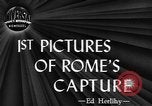
Civilians cheer as the Allied troops enter Rome after liberation from the German army (WW2)
Liberation of Rome, Italy from German forces by Allied troops during World War 2. Opening scenes are of German occupation of Rome earlier in the war during winter campaign, and German forces marching British and American captured allied forces through the streets of Rome. The Roman Colosseum (Piazza del Colosseo, 1, 00184 Roma RM, Italy) seen in background as Allied forces are marched by German armed guards. Buildings along the sides of the street. Damaged buildings and wrecked equipment scattered are seen in the city. German Field Marshall Albert Kesselring looking through field glasses at battlefield. Smoke arises due to firing and bombardment from the Allied and the German army. Heavy artillery is fired including German 280mm cannon. After Germans retreat, the U.S. forces of the 5th Army enter Rome in triumph. U.S. Army General Mark Clark enters with other officers and soldiers in the city. Civilians cheering and applauding. U.S. troops and tanks passing through the city. Bells of Saint Peters basilica ringing. A large crowd gathers in Saint Peters Square (Piazza San Pietro 00120 Città del Vaticano Vatican City) inside the Vatican. Pope Pius XII addressing the crowd. Prince Umberto II of Italy arrives in front of the crowd. Crowd cheering and applauding. American soldiers queue to enjoy real beer served from wooden barrels, made from supplies shipped from the United States. Smiling soldiers fill metal cups with beer. Wrecked railroad marshalling yards in Civitavecchia Italy are seen, as U.S. Army soldiers inspect an abandoned large German Krupp K5 rail gun (Krupp 28-cm-Kanone 5 (E). The gun shown here is either "Robert" or "Leopold" as termed by the Germans, also known by Allied names "Anzio Annie" or "Anzio Express".

World War 2 commuters in Washington DC; views of new Pentagon War Department Building and DC security personnel
A documentary depicts activities of U.S. Department of War workers in the United States during World War 2. Scenes of various 1940's clocks on bedside tables. War department workers wake up with the alarms. They get ready for work. Cars passing on the streets of Washington DC. Buildings along the sides of the street. People lined up waiting for public conveyance. A bus arrives. Bus and car traffic on the "Highway Bridge" over the Potomac River toward Arlington Virginia. (The Highway Bridge, a swing-span through-truss bridge, was part of the 14th Street Bridge complex over the years. It was eventually replaced by the George Mason Memorial Bridge, and in 1967 the Highway Bridge was removed and taken to the Naval Surface Warfare Center in Dahlgren Virginia, to be used for bombing practice). View of the newly built Pentagon War Department building in Arlington Virginia, and views of large parking lots at the Pentagon filled with cars. Workers walking inside the Pentagon building corridors. A line of women seated and working at telephone switchboards in the Pentagon, and consulting an updated telephone directory. A sign at the door of a room reads 'Security Office, Identification Section'. A woman goes inside. Woman named 'Phyllis Hood' gets her identification card and finger prints for her identification in the office. She is seen taking an oath. Hood working at her desk. She files statistical reports. Exteriors of various Washington DC buildings being guarded by United States Army personnel for the Military District of Washington during World War II. A covered anti-aircraft gun installation in Washington DC is shown opening as US Army soldiers take up positions to use the artillery during practice drills. A guard standing outside the White House building.

Manufacture of dynamite and its principle ingredient nitroglycerin in the United States.
A film on manufacture of dynamite in the United States. Nitrate of soda is brought from South America and is used in crystalline form as an ingredient of dynamite. Men working for the manufacture of dynamite. A ship at a port. Men unloading sacks from the ship. Wood pulp is also used as a raw material in the manufacture of dynamite. The other material used is the nitrate of ammonia. Nitrate of soda is converted into nitric acid. It is dumped into huge retorts and is treated with sulphuric acid. Nitric acid vapors are condensed to a liquid in tiers of water-cooled glass pipes. Nitric acid is used to make nitroglycerin which is one of the most powerful explosives. Exterior of a building. Mixed nitric and sulphuric acid is run into a nitrator and refined glycerin is slowly added. The operator watches the thermometer as the chemical reaction releases an enormous amount of heat. An explosion can occur if the heat is not carefully controlled. He also watches the charge through a sight glass. Nitroglycerin and waste acids flow from the nitrator into a lead-lined trough which leads to a separator. The nitroglycerin rises to the top as the mixture settles. Then it is washed and led into storage tanks. It is transported to a dynamite mixing house in a rubber-lined and rubber-tired cart. Men working inside the building. A proper amount of the dry ingredients is poured into a mixing machine. Nitroglycerin is added to it. The mixture is further processed under revolving rubber-shod wheels.
CRITICALPAST.COM: About Us | Contact Us | FAQs - How to Order | License Agreement | My Account | My Lightboxes | Shopping Cart | Advanced Search | Featured Collections | Website Terms & Conditions | Privacy Policy ©2026 CriticalPast LLC.
License Agreement |
Terms & Conditions |
Privacy Policy
©2026 CriticalPast LLC.