


 Francais
 Deutsch
 Italiano
Refine Your Search
US-Gliders- stock footage and images
- Showing 11713 to 11718 of 21917 results more
more Hide
Hide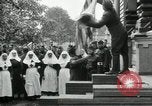
Raising of Red Cross and American flags over a hospital in Archangel, Russia, during World War I
As a contingent of U. S. soldiers presents arms, American Red Cross Captain Wynn and U.S. Army Captain, Hall, raise a United States flag and a Red Cross flag over a hospital in Arkhangelsk (Archangel) Russia during the Allied North Russia Intervention of world War 1. Russian nuns (nurses) who staff the hospital, at Troitsky Avenue, near Olga barracks, take part in the ceremony. View of U.S. Army band marching down a street with their instruments as local children and villagers look on. (Note: This flag-raising constituted an act of defiance by U.S. Red Cross and Army medical personnel, since British medical authorities had opposed starting an American hospital in Archangel. It became the first Red Cross Hospital there, that was jointly staffed by Russian and American Red Cross nurses. Captain Wynn,with the American Red Cross, equipped the hospital, and American Army Captain Hall and Lieutenant Kiley administered it.) (World War I; World War 1; WWI; WW1)
Battle for Leyte Gulf between the Allied naval-air forces and the Japanese naval-air forces in region of Philippine island of Leyte during World War II
Documentary titled 'Battle for Leyte Gulf' depicts the battle fought between the Allied naval-air forces and the Japanese naval-air forces in Pacific waters off the Philippines, in World War 2. Montage of views chronicling the battle, opens with aerial views of pacific islands seen through clouds followed by glimpse of numerous ships maneuvering far below. Port bow views of U.S. New Mexico class battle ship, followed by the USS Pennsylvania (BB-38) of the 7th Fleet. Glimpse of troops on landing craft and charging across an island. Transport ships underway. Cruisers and battleships firing their guns. An Essex class aircraft carrier silhouetted against the horizon. An F6F aircraft comes up on elevator to flight deck next to the island on the USS Enterprise (CV-6). It has white triangle on tail containing its number. An F6F taking off from the Enterprise. Formation of U.S. aircraft in flight overhead. Gun crew firing twin bofors 40mm anti-aircraft cannon. Flak bursts and tracer bullets seen in the sky as a Japanese warplane falls. Gun camera footage of American aircraft strafing Japanese aircraft on ground at an airfield. View, from an aircraft carrier, of a Mahan class destroyer traveling to her port side. Glimpse of two ships close together during refueling operation at sea. Animated map dominates remainder of the film. It illustrates movement of Task Force 38 to Okinawa on 10 October 1944 and launching of aerial attacks. the map shows further maneuvers and activities of the task force. During these activities, Narrator notes that the cruisers USS Canberra and USS Houston are torpedoed and taken in tow. Animated propaganda cartoon depicts Japanese naval commander (speaking accented English) talking about Japanese naval prowess. Glimpse of Japanese sailors cheering. Animated map continues showing maneuvers of U.S. task forces. Narrator notes the Houston is again torpedoed. Animated map continues to illustrate movements and attacks against Luzon and amphibious landings on outpost islands in Leyte Gulf.

Battle off Samar near the island of Leyte in the Philippines, during World War 2.
Shows the Battle off Samar which was the central action of the Battle of Leyte Gulf. It took place in the Philippine Sea off Samar Island near the island of Leyte in the Philippines on October 25th 1944. U.S. air forces launch a counterattack on the enemy's ground forces. Animated map shows heavy battle between Allied naval-air forces and Japanese naval-air forces. Allied AA guns fire at Japanese kamikaze suicide dive bombers. One of the dive bombers strikes USS St Lo (CVE-63). View of U.S. Navy aircraft on carrier deck in flames. Narrator indicates the St. Lo was sunk. Views from some miles away of smoke pouring from U.S. aircraft carrier. The results of the battle shows heavy damage inflicted to the Allied naval fleet.
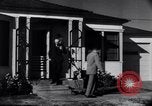
British worker and his American counterpart in labor exchange program visit the Lockheed aircraft plant in Los Angeles, Calfornia
A British guest on labor exchange program visit to the U.S. during World War 2. He leaves the home of his counterpart American host in Los Angeles, California. They leave in the American's car and drive a considerable distance to the Lockheed Aircraft Company facility. View of Honor Roll listing 15, 174 Lockheed affiliated members of the U.S. Armed Forces. The British-American pair walk past a Lockheed Ventura airplane under construction. View of a room filled with P-38 Lightning fighter planes completing final construction, outside the plant. A film clip of the maiden flight of the Lockheed Constellation aircraft (Later designated C-121 by the Army Air Corps) is inserted at this point. It shows the Constellation taking off from the factory airstrip in 1943, and climbing without raising its landing gear. View of aircraft fuselage under construction, where the British worker is inquiring about the manner of its assembly. Next he is seen observing a turntable press operation being run by men and women workers. View of workers using pneumatic hand tools to remove wrinkles from edges of pressed products. A woman punch operator is seen with safety straps on her hands that pull them away each time the punch comes down. Another woman worker demonstrates an electric spot welder. (The observing visitors are required to wear safety goggles in case sparks are created by the process.) Closeup of the aircraft part being spot welded. More workers operating similar machines in the plant, including an African American man and woman. Workers placing a large sheet of aluminum into a machine that fabricates wings for the P-38 fighter plane. Closeup of the British worker and his American counterpart on a balcony overlooking the production line for the Lightning aircraft. View across the production line floor. The two look into the factory first aid station available to workers and also see the transportation section where worker carpools can be formed. Employees are seen obtaining ration books and driver licenses from government clerks working in the plant itself. Employees are seen eating outdoors under foliage camouflage and others gather at an indoor eating site. Next, a section of a B-17 flying fortress wing, is seen moving out of a manufacturing jig. New components are immediately placed into the empty jig for construction. View of final installation area for B-17s, An overhead crane moves a finished wing, including engines, to be mated with its fuselage. Glimpse of numerous B-17s being assembled. A finished B-17 bomber being towed out of the factory.
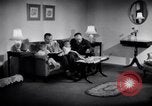
Four British labor exchange visitors return home after several weeks visiting war plants and labor organizations in America (WW2)
A British guest on labor exchange program visit spends his last day as a house guest of his counterpart American's family, in Los Angeles, California. He is seen with the father in their living room with two children, while the mother prepares dinner in the kitchen. The children are sent to bed and the men and the wife, named Ellen sits down to dinner with the two men. The British guest waves goodbye to the family at their doorstep. Scene shifts to another of the British labor exchange visitors leaving the family where he had been hosted in a different city. Next, the four British labor exchange visitors are seen seated opposite representatives of American labor organizations including the American federation of Labor (AFL), the Congress of industrial Organizations (CIO) and the Railroad Brotherhood. They had met them a few weeks ago when they first arrived in the U.S. One of the labor representatives asks them about their impressions of America. They uniformly praise the effectiveness of the U.S war effort, extolling the efficiency and productivity of her war plants. One of the commenters calls for more international unity in the labor union movement. A spokesman for the American labor representatives expresses need to support the United Nations movement. Film closes showing the four British exchange visitors boarding a U.S. Army Air Corps C-54 transport plane to fly them home to England. They are checked in by an airman who wears a leather jacket with the Air Transport Command logo on it. The aircraft is seen taking off and climbing out over hangars at the airfield. (World War II period)
People from all walks of life switch to war work in Dayton,Ohio during World War 2.
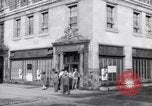
Residents of Dayton Ohio, transfer from ordinary pursuits to perform war-critical work in World War 2. Men and women are seen lined up inside offices of the United States Employment Service (USES) in Dayton, Oho. All prospective male workers are cleared through the USES. Certain occupations are reserved for women only. Women doing needlework in their homes, switch to war work instead. One is seen filing a part in a factory. A soda jerk takes on work in a machine shop. A bootblack shining shoes, ostensibly moves into war work. Back, inside the U.S. Employment Service offices, representatives of defense plants set up tables and hire prospective workers on the spot. Workers leaving a Dayton war plant during a shift change. Cars and pedestrians during regular shopping hours in a local town. View of a downtown commercial district. The Manpower Emergency Committee in a meeting. New Store hours are posted for various businesses. A newspaper announcement of special store night hours for war workers. A company poster listing "Victory Store Hours." Dayton stores and shoppers conducting business after dark on nights when shops were open for war workers. Views of shoppers patronizing various retail stores, including a McCrory 5 and 10 cent store, a market store, and a department store. Late shift workers in line at banks to see bank teller and cash pay checks. A soldier in uniform sitting with a woman shopping for new shoes. Workers in a ladies beauty salon or hair salon, and in a men's barber shop, working during night time hours to serve war production workers. Night time recreation programs for workers show workers with musical instruments standing in line, theatre marquees advertising late night shows and movies, with signs advertising Red Skelton and Eleanor Powell among featured stars. Women bowling at a bowling alley, overhead view of couples dancing the lindy hop while a crowd watches, other scenes of couples dancing on dance floors.
CRITICALPAST.COM: About Us | Contact Us | FAQs - How to Order | License Agreement | My Account | My Lightboxes | Shopping Cart | Advanced Search | Featured Collections | Website Terms & Conditions | Privacy Policy ©2026 CriticalPast LLC.
License Agreement |
Terms & Conditions |
Privacy Policy
©2026 CriticalPast LLC.