


 Francais
 Deutsch
 Italiano
Refine Your Search
US-Gliders- stock footage and images
- Showing 11743 to 11748 of 21917 results more
more Hide
Hide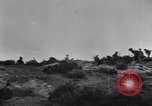
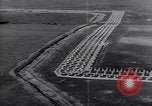
Allied Forces Build up in Algeria to prepare for Spring offensive against German forces in Tunisia during World War II
At start of film, Allied forces are digging in after retreating from counterattacks by German forces in Tunis, during World War 2.. Rains create mud everywhere. A Lockheed P-38 fighter plane parked in foreground. Ground crews use shovels to free nose wheel of a B-24 Liberator bomber with engines running. A truck tows a C-47 transport plane from mud. Army trucks travel over road inundated by running streams. Soldiers standing in a jeep submerged in water. M2 tanks stuck in mud. Airmen huddled around an outdoor fire. P-38 fighter aircraft parked in the background. Soldiers eating around an outdoor fire. Animated map shows Allied battle lines stabilized in Algerian mountains, while German forces occupy the plains in Tunisia. German artillery batteries firing. British troops sheltering in damaged building. Allied wounded being transported atop, as well as inside a field ambulance. Interior of a transport plane configured for evacuation of wounded on litters. U.S. airmen including a woman in leather flying jacket, presumably an Army flight nurse, tend to the wounded aboard the medical evacuation flight. Wounded being transferred from an airplane to an ambulance. British patrols moving through the night. Heavy artillery firing. British soldiers silhouetted at dawn. They return carrying a wounded comrade on a litter. The British soldiers ("Tommies.") trying to clean mud from themselves and their weapons before heading out on patrols again at dusk. Allied soldiers moving on mules in a long line to obtain needed food and supplies. More views of the interminable mud. A British Hawker Hunter fighter plane taking off. A formation of Hawker Hurricanes peeling off to engage German aircraft. Closeup of one rolling over. A German Heinkel 111 bomber being attacked and trailing smoke. Pilot pressing gun firing button in cockpit and a German Dornier Do 17 bomber hit as British fighter plane passes it in cloud of black smoke. The German plane diving to crash in a fireball on the ground. U.S. B-24 Liberator bombers taking off and flying in formation. Formation of American B-17 bombers in flight. The American planes dropping bombs on Italy, Sardinia, and Sicily. Gunners in the bombers firing machine guns at attacking German fighter planes as their bombs keep dropping. Back on land in Algeria, mud still halted any Allied advance. Animated map showing both Allied and German forces building up on their respective sides of the front. Supply lines illustrated all the way back to factories in the United States and Britain. Allied war plants making bombers and munitions. Allied Soldiers assembling Army vehicles at a port. Lockheed lightning fighters being rolled out of a factory. Sign reading "Railroad Equipment Assembly Plant No. 1." Complete trains from locomotives to freight cars being completely assembled, loaded with freight and sent on their way. A formation of P-38 aircraft equipped with long range fuel tanks being ferried in flight from Brazil. It is led by a B-17 flying fortress bomber providing navigation. British Spitfire and Hawker Hunter airplanes heading to the front are seen taking off from an airfield in Gibraltar. A caterpillar tractor moving earth for a new road at the front. Trucks dropping materials for the road bed as soldiers with shovels smooth them on the surface. Soldiers installing Mardsen Matting pierced steel planking for an airfield surface as C-47 transport planes operate on the field. Crates of food supplies being unloaded at a port. War materiel stored in a large yard at a port.
New Guinea natives carry supplies for the Allies and the Allies bombard a Japanese held island in the South Pacific.
War between the Allied Forces and the Axis troops in the South Pacific during World War II. New Guinea Papuan natives carry arms, ammunition and supplies for the Allies in a boat. An overnight camp of the Papuan people. The natives carry the supplies across mountains and makeshift bridges. The Australians inspect a Japanese submarine in Sydney Harbor, Australia. They remove the firing mechanism of the torpedo and the instrument which helps a torpedo to find its way once fired from a submarine. U.S. and Australian naval forces move towards a Japanese held island and bombard it. The sailors load and fire artillery. Smoke rises in distance as the shells hit the targets. U.S. Marines survey the damage. Dead Japanese soldiers. A lone U.S. Marine with captured Japanese prisoners.

Early pictures of General Eisenhower showing his childhood home and his welcome ceremony when he returned home.
'The Big Picture' depicts the life of U.S. General Dwight D Eisenhower. Sergeant Stuart Queen of the U.S. Army stands in front of a map. He gives an introduction of Eisenhower. In 1945 Eisenhower returns to his homeland in Denison, Texas. A banner reads 'Welcome IKE'. People gather on the sides of the streets to welcome him. He waves from an open car at the cheering crowds. People at parade carry the U.S. flags during a ceremony. Eisenhower salutes. D Day, June 6, 1944- Barges carrying American troops land on the shore of Normandy. Eisenhower with another military officer. Eisenhower salutes. Streets of the city Abilene. Exterior of the Eisenhower Museum. Two boys enter the museum. Pictures of Eisenhower in his childhood - during infancy, house in which he was born, Eisenhower with a group of children, Eisenhower with his family, with his baseball and football team. View of Eisenhower's bedroom- scripture readings on the walls and books in the shelves. A truck passes the creamery where Eisenhower worked in his spare time. Pictures of Eisenhower leaving home to join the Military Academy at West Point. Cadets marching at the grounds of the military academy. Graduation Certificate of Eisenhower. Eisenhower with his wife Mamie Geneva Doud. Fight in Western Europe during the World War I. Picture of Eisenhower with other cadets. The certificate of the Distinguished Service Medal presented to Eisenhower for his services for training tank crews in Pennsylvania.
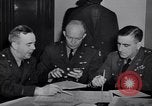
General Dwight D Eisenhower and Allied forces capture North Africa and Sicily, receives the French Legion of Honour medal (WWII)
General Dwight D Eisenhower from the North Africa campaign to the D-Day Normandy landings during World War II. Eisenhower with other military officers in the War Plan Office discusses strategy. A mural covering the west wall of the Eisenhower Museum in Abilene, Kansas. An animated map shows plan to seize key positions in North Africa. Fight in Algiers and Casablanca. Allied troops fire artillery, bombarding a North African coastal town. Troops advancing from beachhead, engage in street fighting with Vichy French troops in Casablanca, Morocco. A flare gun is fired. Unfavorable weather conditions delay the troops advancing towards Tunis and Bizerte. Allied troops fighting at nighttime. Allied soldiers walk through mud, allied military vehicles pass through water on the roads. Troops fire artillery under a canopy, hitting the side of a hill. Thick clouds of smoke cover a hill. U.S. General Omar Bradley and his troops capture Bizerte, Tunisia and the British 1st Army captures Tunis. German and Italian prisoners raise their hands up upon surrender. Animated map shows the surrender of the Axis troops. A ceremony commemorates the victory. North African cavalrymen join the parade. General Eisenhower and Free French Forces General Henri Giraud review a military parade. Henri Giraud bestows to General Eisenhower the French Grand Cross of the Legion of Honor. A mural on a wall of the Eisenhower Museum depicts the Allied invasion of Sicily. Allied troops march into Sicily in 1943.Civilians in the streets to celebrate. A mural on the wall of Eisenhower Museum depicts invasion of Italy. Allied troops land ashore and march into Italy. U.S. General Mark Clark 5th Army at Salerno. A sign reads Napoli. Eisenhower comes out of a tent. U.S. President Roosevelt visits the troops in the combat area with Eisenhower. United States President Roosevelt, British Prime Minister Winston Churchill, and Joseph Stalin in Cairo, Egypt. Another mural on the wall of the Eisenhower Museum. Eisenhower with other officers. Dramatization of German troops guarding and preparing the defenses of Normandy before the Allied landings. Eisenhower reviews training of the troops as they prepare for the invasion of France. Allied troops undergo physical training though obstacle courses. Churchill inspects the troops. Eisenhower reviews the troops on the eve of invasion. Eisenhower speaks to airborne troops wearing blackened camouflage face paint.
Funeral of United States General George Patton and key moments and accomplishments during his life.
On the life of U.S. General George S Patton Junior (with narration by Ronald Reagan). Fight at the Siegfried Line during World War 2. U.S. 3rd Army cross the Siegfried Line. General Patton with his officers. Patton's troops cross the Rhine. American soldiers in the streets of Germany. Patton presents the Medal of Honor to a soldier. Patton sees dead people at a concentration camp in Germany. Patton's army moves towards Denube Valley. Civilians in the streets. Patton with officers. Written on a wall 'Hitler is kaput'. Trucks loaded with soldiers. A gun thrown on a pile of guns on the ground. Patton in a barge. A welcome ceremony for General Patton on his return to US: A parade along Broadway in Los Angeles on June 9, 1945, as over 1 million citizens welcome General Patton home and cheer. Shops and offices on Broadway in Los Angeles. Patton waves at the people from an open jeep. Patton and General Doolittle in Los Angeles. General Doolittle makes a speech at a ceremony and introduces General Patton. Patton addresses the gathering and talks about the war and the accomplishments of the Third Army. He notes that from aerial view, Germany and Austria "look like hell from the top." And "that's what any place that the 8th Air Force and the Third Army worked on looks like." Also Patton says, "You must remember this. That from Brest, to various towns in southern Germany and Austria whose names I can't pronounce, but whose places I have removed," (laughter in crowd), "the trail of the Third Army and the 19th Tactical Air Command and the 8th Air Force is marked by more than forty thousand white crosses; forty thousand dead Americans." View of a military cemetery graveyard. General Patton lays flowers at the grave of one of his soldiers. Patton watches a race at Soldiers Field Academy. He shakes hands with the winners. Soldiers carry Patton's coffin wrapped in American flag. Patton's grave with flowers on it. Two soldiers stand beside it. Patton's statue at the West Point Military Academy.
Vietnamese workers construct buildings to expand the 3rd Field Military Hospital facility in Saigon, Vietnam.
Construction work at the 3rd Field Military Hospital in Saigon, Vietnam. A hospital building under construction. Three ambulances parked in the premises. Construction in progress. Traffic moving along busy street on the right. Several vehicles in the foreground. Vietnamese workers wearing typical conical hats (“Non la”) and several in hard hats, work within the foundation of the hospital under construction. A worker uses a hand saw to rip a 2 X 4 piece of wood. A Vietnamese worker smooths cement on a masonry wall. '3rd field hospital' written on a building. A U.S. Army sentry with a rifle guards the entrance. (Note: Expansion of the hospital, which included a modern emergency facility and surgery suite, among other things, was managed by U.S. contractor, Pacific Architects and Engineers. Most of the construction workers on the project were Vietnamese.) (Vietnam War period).
CRITICALPAST.COM: About Us | Contact Us | FAQs - How to Order | License Agreement | My Account | My Lightboxes | Shopping Cart | Advanced Search | Featured Collections | Website Terms & Conditions | Privacy Policy ©2026 CriticalPast LLC.
License Agreement |
Terms & Conditions |
Privacy Policy
©2026 CriticalPast LLC.