


 Francais
 Deutsch
 Italiano
Refine Your Search
US-Gliders- stock footage and images
- Showing 1171 to 1176 of 21920 results more
more Hide
Hide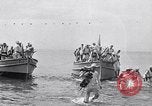
U.S. Navy battle fleet engaged in Fleet Problem maneuvers in the Pacific Ocean
The U.S. Navy battle fleet engaged in Fleet Problem (number 5) in 1925. Armed U.S. sailors wade ashore from whale boats. They assemble and march from the beach carrying the colors. Sailors and marines charge across a beach area and fire their rifles at targets from prone positions. They jump up en masse and repeat the process closer to the targets. U.S. warships anchored (possibly at Pearl Harbor).Martin SC-1 float planes take off on scouting mission. A formation of Martin SC-1s in flight. U.S. Submarine (SS-44) glides abeam a battleship. A line of submarines moving on the surface past a battleship in the background. A pair of light cruisers underway.
U.S. Army Air Force pilots fly P-40 airplanes from the USS Ranger, to Casablanca, Morocco, during World War II
U.S. Navy provides aircraft carrier ferry service for the U.S. Army Air Corps during World War 2. View of the USS Ranger (CV-4) at sea with sunset and clouds in background. Scene shifts to the ship's company, turned out on deck in dress whites. An accompanying contingent of U.S. marines, is also seen presenting arms. Next. Rear Admiral, Ernest D. McWhorter,Commander Task Force 22, is seen conversing with Captain C. T. Durgin, Captain of the USS Ranger. Scene shifts to flight deck of the Ranger, where deck crews are readying Curtiss P-40L airplanes for flight to the former Vichy French Anfa Airport near Casablance (captured by the Allies in Operation Torch). One P-40 is named "Regina IV." U.S. Army Air Force 57th Fighter Group commander, Colonel Frank H. Mears, shakes hands with a navy officer, from the cockpit of his P-40. He then takes off. More P-40s follow. Closeup of an Army pilot in cockpit of a P-40, giving a thumbs up. P-40s forming up in flight overhead. Navy officers and sailors watch the departing P-40s and give thumbs up for approval. P-40s buzz the carrier as they depart for Casablanca, Morocco.
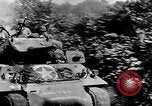
United States infantry and tank units in France; focus on U.S. tanks, camouflage techniques, and mine detection and demolition
United States tanks on a road in France during World War 2. United States infantry and tank units in France. Sand bags are packed tight around a tank to fortify and dampen effect of enemy fire. U.S. tanks camouflaged, first with painting (a tank with lettering 'Warhawk" on the side is shown); then with branches over top to help conceal it. Nets and haystacks used for covering and obscuring tanks. Snow covered fields near St Vith. Tanks painted white with a whitewash to camouflage for winter battle. Tanks with lettering on side, "Kathleen", is whitewashed. A tank hits mines and explodes. A British tank outfitted with flails is used to find and detonate land mines. An explosive 'Snake' deployed in a field and used for demolition of enemy mines.

U.S. Army Sixth Armored Division drives through Altenburg Germany
Sixth Armored Division of United States Army drives through Altenburg in Germany. Armored vehicles move through town past civilians. Houses in the background. Town burns in the foreground. Smoke rises up in the sky. U.S. tanks move across open field. Two U.S. soldiers discover a very young German soldier in a foxhole. The young German soldier surrenders. U.S. soldiers on the tanks. German prisoners march along road past U.S. vehicles. (World War II period).
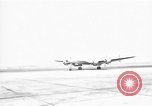
John Foster Dulles, U.S. Secretary of State, returns from European trip to Washington National Airport on a C-121 USAF aircraft
U.S. Air Force C-121(Lockheed Constellation) aircraft taxis to ramp after landing at Washington National Airport. U.S. Secretary of State, John Foster Dulles, descends steps from aircraft and is met by officials and well wishers. He stops to greet woman with small children. Dulles makes a few brief remarks to a large gathering of reporters and photographers. He is in a hurry because he must get to the White House to report to the President. He also notes that the next day he must report to the U.S. House of Representatives and to the U.S. Senate. Secretary Dulles comments about diplomatic events of the trip related to entry of Germany into NATO; movement toward formation of a European Union; signing of the Austrian State Treaty; and invitation from the Soviet Union for 4-power talks.
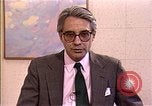
Secretary of State, George Shultz talks about U.S. governmental policies with regard to the Strategic Defense Initiative.
A briefing on the Strategic Defense Initiative in Washington DC. U.S. Assistant Secretary of State European and Canadian Affairs Richard Burt discusses U.S. government policy with regard to the Strategic Defense Initiative. U.S. Secretary of State, George Shultz in his speech talks about U.S. President Ronald Reagan's Strategic Defense Initiative. President Ronald Reagan speaks about the Defense Budget of the United States.
CRITICALPAST.COM: About Us | Contact Us | FAQs - How to Order | License Agreement | My Account | My Lightboxes | Shopping Cart | Advanced Search | Featured Collections | Website Terms & Conditions | Privacy Policy ©2026 CriticalPast LLC.
License Agreement |
Terms & Conditions |
Privacy Policy
©2026 CriticalPast LLC.