


 Francais
 Deutsch
 Italiano
Refine Your Search
US-Gliders- stock footage and images
- Showing 11773 to 11778 of 21917 results more
more Hide
Hide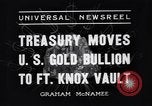
Workers at Mint gold refractory in Philadelphia cast government gold into bars to transfer it to Fort Knox Vault in Kentucky.
U.S. Treasury prepares to move United States gold bullion to Fort Knox Vault in Kentucky. External view of U.S. Mint building in Philadelphia with cars passing by North entrance. Workers at the Mint's gold refractory in Philadelphia cast huge quantity of government gold into gold bars. Workers working at kiln to manufacture gold bars. 28th Director of the Mint, Nellie Tayloe Ross, signs paperwork while seated at a desk, flanked by other U.S. Mint officials. View of gold bars to be transferred to Fort Knox Vault in Kentucky.
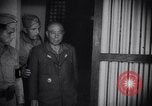
American post War II occupation of Japan.
Documentary depicts job of United States occupation forces in Japan. Opening scene shows Japanese General Tomoyuki Yamashita being escorted by armed American military officer to a room. A woman at an outdoor stand, passing out leaflets to Japanese people during the U.S. postwar occupation of Japan. Camera pans across exterior of prison where Japanese wartime leaders are incarcerated. Japanese read information posted on a telephone pole. Newspaper in English reporting that Emperor Hirohito says he is not a Diety and the Japanese are not a master race. A Japanese broadcaster spreading the new concepts. Loud speakers on city streets carry the news. People visiting news stands, including many Japanese soldiers in uniforms. Several Japanese citizens gathered by a bulletin board to read the latest information. Japanese workers shoveling up debris from bombing during World War 2. View of vast destruction in a Japanese city, where only several concrete and steel buildings can be seen standing. Japanese people going about their normal affairs, walking on paths cleared through the detritus of war. U.S. troops monitoring Japanese travelers boarding a railroad train. A U.S. soldier standing with a Japanese policeman, searches a Japanese cyclist for contraband. Views of the Pacific Ocean, with waves crashing on the shore. Dead American soldiers in the waters at the coasts of various scenes of combat against Japanese forces during World War II. Views of American soldiers helping and tending to wounded during the war. A huge formation of American soldiers marching. The Liberty bell. A closing slate reading: "Our Job in Japan". Music: Beethoven's 9th Symphony is heard.
Images showing interests, culture, lifestyle and events involving Americans, including World War 1, in the period 1915 -1918
America in the World War 1 years, before and during the U.S. involvement in the war. View of Woodrow Wilson in academic robe and cap, as President of Princeton University. Steel mill with stacks belching smoke. Workers tap an open hearth furnace in steel mill. Children on a city street dancing and being sprayed with a fire hose to keep cool in summer. Boy hopping over the backs of his friends. Boys seated on a bench. Scenes from early motion pictures, interposed with images of Uncle Sam from Army recruiting poster: They are rapid montage comedy and stunt scenes, including Keystone Cops chasing fugitive; cars racing, gangster shootouts from cars; automobile hijinks; men raising barrier at railroad level crossing while a woman is left dangling from the raised crossing gate; car races and crosses railroad track in front of rapidly approaching locomotive; comic car chase down; line of 3 open top cars racing over an edge into a deep ditch, a motorcycle taking flight off of a road and into a river; a man waving warning flag frantically at a blasting site; The Cunard Ocean Liner ship, RMS Lusitania, underway; Newspaper front page about torpedoing of the Lusitania. American soldiers boarding troop ship for France in World War 1; View of the troop ship deck filled with U.S. soldiers. Various scenes of U.S. troops in the American Expeditionary Forces (AEF) in France during World War I: amid war torn ruins and destroyed buildings in France; firing French 75s and heavier artillery; soldiers charging across no-man's land; French and American soldiers caring for wounded behind the lines and in trenches of the battlefields; soldiers placing helmets and identification cards of fallen soldiers on rifles that are inverted, bayonet into ground.
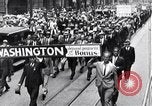
The 1930s Great Depression and the administrations of Presidents Herbert Hoover and Franklin Roosevelt, in the United States
Hard times in the Great Depression led to formation of The Bonus Army. American veterans of World War 1 march on streets of Washington DC, carrying a large poster demanding immediate cash redemption their "bonus" service certificates awarded by Congress in 1924 (but not lawfully payable until 1945). Army Chief of Staff, General Douglas MacArthur, ordered by President Hoover, to clear the Bonus Army encampments, is seen standing in a street surrounded by several U.S. Army troops. People watch from sidewalks as a contingent of U.S. Army cavalry rides down the street. U.S. Army M-1917 tanks roll down Pennsylvania Avenue in July 1932. Bonus marchers and others watch from Lafayette Park in background. Scene shifts to the 1932 Democratic Party Convention in Chicago Stadium, Chicago, where delegates cheer after nominating Franklin D. Roosevelt as their Presidential candidate. Roosevelt seen waving from the podium. Migrant farm workers seen at temporary, dilapidated dwellings in close quarters, and sitting at a campfire, some with sad and desperate faces. Migrant farm workers' cars on the road, piled high with family belongings during westward migration. Migrants riding atop an open railroad freight car. Two men share a copy of the "Epic News" newspaper (published by supporters of Upton Sinclair and the End Poverty Movement in Los Angeles and central California). Narrator describes programs of the Works Progress Administration (WPA) and the Civilian Conservation Corps (CCC). Construction workers ignite demolition charges during construction of Boulder Dam (aka Hoover Dam and officially so-named in 1947). Glimpse of President Roosevelt at the site in an open car, for its dedication on September 30, 1935. Construction workers engaged in building the dam. Another shot of President Roosevelt in his open car. Towers being erected to carry electric power from the dam's hydroelectric generators. President Franklin D. Roosevelt smiling broadly at the formal dedication ceremony, September 30, 1935. Controlled discharges of water through the dam. Views of the Boulder Dam hydroelectric generating station. Oil well rigs or oil derricks at work during construction at night. People at work in fabric mills or textile mills, and in a print shop
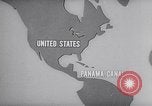
Mutual aids to one another by Allied nations under the lend lease program, fighting against Axis powers during World War II.
Charles Winninger narrates facts about the lend-lease and mutuals aids by Allied nations fighting against the Axis powers during World War II. Animated map shows Japanese threaten eastern coast of United States. British aid under the lend lease flies to U.S. German attack on Suez canal countered by British and U.S. Armies. Map shows timely aids allowed munition factories at work and new recruits joining the military. Australia and New Zealand aid the fighting Allied nations. U.S. warships to Russia in return to graves of German. Aid to China in return to the death of Japanese. Animation shows dropping of atom bomb and unconditional surrender of Axis nations.
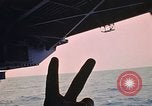
Vice Admiral William F. Bringle and Lieutenant General Nguyan Van VY present awards to United States Servicemen on USS America.
Vietnamese awards to United States Servicemen on the United States Ship America (CVA-66). Deck edge elevator lowered to the hanger. On the elevator some U.S. Navy commanders and officers salute. Vice Admiral William F. Bringle and Lieutenant General Nguyan Van VY proceed to hanger over red carpet. Marines and ship band plays. Vice Admiral Bringle addresses from the speaker's stand. Other division officers on stage. Medals and awards to be presented. Lieutenant General Van VY addresses. Commodore Tran Van Chon seated between two U.S. Navy Admirals. Vietnamese officer reads names from a list as a U.S. Navy officer watches.
CRITICALPAST.COM: About Us | Contact Us | FAQs - How to Order | License Agreement | My Account | My Lightboxes | Shopping Cart | Advanced Search | Featured Collections | Website Terms & Conditions | Privacy Policy ©2026 CriticalPast LLC.
License Agreement |
Terms & Conditions |
Privacy Policy
©2026 CriticalPast LLC.