


 Francais
 Deutsch
 Italiano
Refine Your Search
US-Gliders- stock footage and images
- Showing 11947 to 11952 of 21917 results more
more Hide
Hide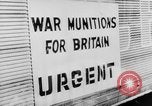
Prewar and wartime conditions of British, exchange of war material via lend lease, supplies rationed in Great Britain.
Prewar and early World War 2 conditions of the British in Great Britain. War ammunition for Britain transported from the United States to Britain as part of lend lease plan. Also war materiel sent the other way around from the United Kingdom to the United States, as the war progressed. A map showing the path between the United States and Great Britain through the Atlantic Ocean. Tanks for Russia from Britain. Aircraft and guns for the United States by Lend Lease. Tons of food and clothing in large containers for troops in Britain. Clusters of houses and buildings. Two men on a bridge. A lane in Britain. People in the lane. Tanks prepare for war. British soldiers in uniform. A woman seated at a vanity putting on lipstick makeup. Men and women in the streets in England. A man turns to notice the legs of a woman as she walks by. View of legs of many women walking by, not wearing stockings due to rationing. Brief shot of driver in a car in the United States as he hands his gas ration ticket to the gas station attendant. Back in England, scene as a man goes to a pub for whiskey. The pub keeper laughs at him as there is none. Men in a field harvesting grains for making industrial alcohol. Soldier painting word "Hitler" onto a bomb shell. Cartons of whiskey being transported to the United States as pay for the material that comes in to Britain. A man opens cartons from the U.S. with 'Made in U.S.A.' painted on it. Images of American made industrial machine goods purchased by the British, including machinery signs for "Cincinnati Bickford", "The Ohio Machine Tool Company", "Niles Tool Works, Hamilton Ohio", "The Cincinnati Planer Co.", "American Hole Wizard", and "Barnes Drill Company, Rockford, Illinois" A woman worker moves a large planer or drill press into position. Crane at a ship dock is seen moving a large wooden crate with "Ford" label on it. A man goes to buy cigarettes. A 'No cigarettes today' board. If there were cigarettes he would have paid the cost of the cigarettes and the tax to the shopkeeper. Close up view of coins on a table and large portion going to British taxes to pay for war. A newspaper headline which says "Britain spends 49,000,000 per day on war." Several industrial plants in Britain, with smoke and pollution rising from chimneys and stacks during high output war effort. Laborers working at a construction site, including brick layers, who pay 29% tax. Rich men who pay 97½ % tax: A man in a nice car parked in front of a church. He leads a bride in a wedding gown and possibly the Bride's father toward the doors of the church. Various views of British workers and workmen walking in and out of factories. British citizens in ration lines. Sheep being herded on pasture land in Australia. Vessels in ocean used by the British for supplies to Russia. Aircraft from the U.S. on board a ship, and British troops arriving on a ship dock.
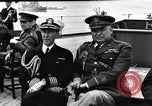
Dignitaries present during the Atlantic Conference aboard HMS Prince of Wales in the Atlantic Ocean.
Dignitaries during the Atlantic Conference aboard HMS Prince of Wales in the Atlantic Ocean. US Navy Admiral Ernest J. King seated with British Permanent Under Secretary of State for Foreign Affairs Sir Alexander Cadogan. Other dignitaries seated beside. U.S. Navy Admiral Harold Raynsford Stark, Chief of Naval Operations seated with a senior officer. Admiral Ernest J. King, Sir Alexander Cadogan, Royal Navy Admiral Dudley Pound and First Lord of the British Admiralty and Rear Admiral Ross McIntire seated in a row. British Army Field Marshal Sir John Dill talks to an officer. Two officers in uniform. An officer records the events using a film camera. Another officer in uniform. Ernest J. King talks to an officer on the deck of the ship.
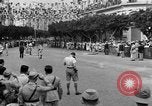
General Charles De Gaulle reviews Bastille Day Parade in which American and French troops take part in Algiers, Algeria.
The Bastille Day Parade being witnessed by leader of Free French Forces General Charles De Gaulle in Algiers, Algeria during World War II. The officers salute on the side of the road. A man with a camera takes pictures. French naval officers in white uniform and other officers on the side of the road. The U.S. Army band marches on the road. Trees on the side path. The man with camera on the road. U.S. guards with rifles march. Man with U.S. flag in the front. Man with a flag follows. A cadet salutes in the front. Guards with rifles follow. The crowd on the side of the road watch. The French Army band follows. The French troops holding rifles march behind the band. Children, men and women look on from the side of the road as the guards march. Officers salute as they stand in front of the children. Men with flags and rifles march. General De Gaulle with other French officers and dignitaries on the other side of the road. General De Gaulle salutes as troops pass. French troops wearing American uniform ride in tanks and other American equipment. Crowd on either side of the road watch.
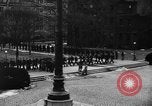
Sir John Dill receives the Howland Memorial Prize from Yale University, New Haven, Connecticut, United States
U.S. Military Officers march across the snowy campus of Yale University, to an auditorium, to witness the award of Yale's Howland Memorial Prize to British Field Marshal Sir John Dill. U.S. Chief of Naval operations, Admiral King, and U.S. Army Chief of Staff , General George C. Marshall, take part in academic procession with Sir John Dill, and are seated on the stage during the presentation. Sir John speaks, followed by General Marshall, who remarks about the accord between American and British Forces.
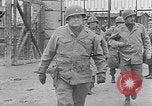
Officials tour Ohrdruf Concentration Camp in Germany after its liberation. Evidence of torture, abuse, genocide is seen.
U.S. General Dwight Eisenhower, Archbishop of Canterbury, and Allied Investigation Committee members tour Ohrdruf concentration camp in Germany after its liberation near the end of World War 2 in Europe. U.S. military officials enter the gates of the Ohrdruf concentration camp. The officials walk on a path inside the camp. U.S. General Dwight Eisenhower with other officials inside the camp. Inmates demonstrate a torture device. General Eisenhower and officials look on. Dead victims of concentration camp. Bodies piled. Archbishop of Canterbury and other church dignitaries visit the camp and review the horror. The civilians of the Allied Investigation Commission inspect the camp. The officers walk in front of the camp. Bunk area with sign "5 men with operations in each box" is seen. Crematories, furnaces, and dead bodies piled up. A group of officials look on. The officials inside the dungeons with piles of dead bodies of human beings. The remains of burned bodies.
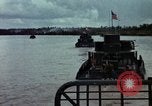
Riverine warfare in Mekong Delta, Vietnam. Barracks ship; Armored Transport ship;
Riverine warfare in the Mekong Delta region of Vietnam. U.S. Riverine Afloat Force consisting of one Brigade of the Army's Ninth Division, and the U.S. Navy's River Flotilla One, supported by special Navy ships. Seen are: Barracks ship; Armored and armed transport ship, with river vessels alongside and helicopter landing on deck. An armor-plated and armed 60-foot "Monitor" river craft underway and firing from its gun turret. U.S. soldiers firing a howitzer on board a barge. An F-100 Supersabre tactical jet fighter aircraft flies over river and drops ordnance on riverbank. American troops make amphibious assault on riverbank. (Vietnam War period).
CRITICALPAST.COM: About Us | Contact Us | FAQs - How to Order | License Agreement | My Account | My Lightboxes | Shopping Cart | Advanced Search | Featured Collections | Website Terms & Conditions | Privacy Policy ©2026 CriticalPast LLC.
License Agreement |
Terms & Conditions |
Privacy Policy
©2026 CriticalPast LLC.