


 Francais
 Deutsch
 Italiano
Refine Your Search
US-Gliders- stock footage and images
- Showing 12007 to 12012 of 21917 results more
more Hide
Hide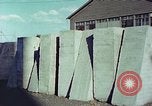
Protective measures taken to protect machinery at Japan Iron and Steel Works, Yawata from incendiary attacks of World War II.
Protective measures taken at the Japan Iron and Steel Works, Yawata (also called Yawata Steel Works) to face the incendiary attacks during World War II. Heavy reinforced concrete portable blocks used at the Japan Iron and Steel Works to protect machinery. The building opposite the river from Tokyo Electric building where gel incendiary bomb landed at an angle onto the front face of tile work. A black smudge left by the bomb. Concrete revetments used to protect transformers from blast and fragmentation at the Japan Iron and Steel at Yawata. Sand filled heavy plank walls used to protect transformers.
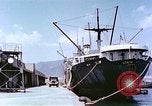
Japanese surveyors do a survey in Kobe, Japan after the bombings of World War II.
A survey of incendiary bomb damages inflicted upon Kobe, Japan during World War II. A U.S. freighter tied at a dock. American grain is unloaded into a U.S. Army vehicle. A U.S. truck as it pulls away from the ship. The ship's boom lowers a load of wheat into the truck. Japanese surveyors at work in Kobe. A surveyor makes a note on a map stand. The surveyors at work in a street. Pedestrian traffic moves about. A closer view of a surveyor and his instruments.
Commander of the 376th Bomb Group Libya, North Africa, briefs air crews for mission against Nazi aircraft production complex, WW2.
U.S. Army Colonel Keith K. Compton, commander of the 376th Bomb Group in Libya, North Africa briefs his Army Air Force aircraft crews for the first Allied bombing mission against the Nazi German ME-109 (Messerschmitt Bf 109) aircraft manufacturing plant south of Vienna at Wiener-Neustadt, Austria, in World War 2. The map that Colonel Compton is using shows the air routes to and from the target. The mission will commence early the next day, on 13 August 1943. An unrelated scene shows U.S. Army and Army Air Force men conversing with an Australian soldier in a summer uniform.
Formations of Japanese bombers over the island of Oahu and Pearl Harbor in Honolulu, Hawaii during World War II.
A film dramatizes the Japanese attack on Pearl Harbor in Honolulu, Hawaii during World War II. A Pvt. (Private) soldier operates the controls on a panel at an aircraft warning station at Pearl Harbor. He calls up an information center and informs a U.S. Army Lieutenant that he has detected a line of unidentified aircraft approaching the island of Oahu. The Aloha Tower in Honolulu. Airmen around U.S. aircraft parked at a U.S. air base look at formations of Japanese aircraft in the sky. Exterior of a building in Washington DC. A door sign reads 'Secretary of State'. Formation of Japanese aircraft over clouds and island of Oahu. The aircraft over Waikiki Beach. They drop first load of bombs at Hickam Field which borders Pearl Harbor. Air base installations at Hickam Field burn.
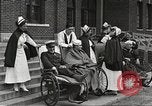
Activities of United States Navy personnel at Norfolk Naval Shipyard in Portsmouth, Virginia.
U.S. Navy personnel at Norfolk Naval Shipyard in Portsmouth, Virginia. Women of U.S. Navy Nurse Corps stand around sailors and navy officers seated in wheelchairs. Men play tennis. Sailors sit and watch the game. A road alongside barracks. U.S. Navy officers descend the steps of a building.
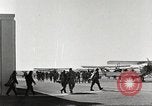
Cadets and Stearman (Boeing) training planes. Pilots of 8th Pursuit Group in P-36 Hawk aircraft
U.S. Army Air Corps flying cadets and instructors proceeding to a line of Stearman (Boeing) Model 75 airplanes at a training base in the U.S. A change of scene shows U.S. Army Air Corps pilots of the 8th Pursuit Group at Langley Field, Virginia, proceeding to a line of Curtiss P-36 Hawk airplanes. They start engines and begin to taxi out on the ramp. Unit insignia of the 33rd, 35th and 36th Pursuit Squadrons,respectively, are painted on the fuselages of the aircraft. They perform a mass takeoff and later fly over the field in formation.
CRITICALPAST.COM: About Us | Contact Us | FAQs - How to Order | License Agreement | My Account | My Lightboxes | Shopping Cart | Advanced Search | Featured Collections | Website Terms & Conditions | Privacy Policy ©2026 CriticalPast LLC.
License Agreement |
Terms & Conditions |
Privacy Policy
©2026 CriticalPast LLC.