


 Francais
 Deutsch
 Italiano
Refine Your Search
US-Gliders- stock footage and images
- Showing 12091 to 12096 of 21917 results more
more Hide
Hide
Men throw oil abatement product on water with flammable products and move on the deck of USS Compton offshore Newport.
The oil abatement product on the surface of water with more being sprayed. Crewmen dump bags of the abatement product into the hopper of the machine. Crewmen on the fantail. The product being sprayed on water. Life lines in the foreground. Two men stand by ready to use a flame thrower in an attempt to light the oil. The flame thrower is turned on. It throws flames over the water surface with no effect. Officers and men talk over the fantail of the destroyer. Two crewmen work around gear in card board boxes on the deck. Four crewmen on the deck of USS Compton. A man with a bucket which is used to dump kerosene over side. A man with a bag of the oil abatement product pouring it out over the ship's side. Men pour the product over the side. Military people and civilians near the life lines. Smoke on the water in the background. An officer lights a torch using a piece of wood and throws it over the side to float on water. A flare floats on the surface and burns. The flare burns in the midst of the oil abatement product on the surface with an attempt to set the product on fire along with the oil. An officer throws an object on water. An officer along the deck edge. An orange flare in the hand of an officer. Men on focsle of USS Compton. The flare burns on water as men continue to light the oil abatement product and oil. A man at the deck edge plays a flame thrower down over the water surface. Officers enter. A man holding a flame thrower looks over the side.
Soldiers stretch a camouflage net and fold it as instructed by an officer in the United States.
A U.S. military film about use of flat camouflage net to avoid enemy detection during World War 2. U.S. Army soldiers stretch a camouflage net flat and taut before folding it. Men fold the net in a standard fashion, as a team, to ensure that the net is properly stored and ready for setup when needed. An officer gives command to the soldiers working as a team to fold the net. Men fold the net as a team. The camouflage net is rolled and tied.
Troops make amphibious landings and injured soldiers are treated on a Pacific island.
Amphibious attack by the U.S. forces on an island in the Pacific during World War II. A U.S. battleship underway in the Pacific Ocean. Naval guns firing at Japanese positions. Landing crafts loaded with soldiers approach the island. Aircraft in flight drop bombs. An armored vehicle drives into a beach. U.S. troops wade inland during combat. Marines ducking behind bushes before an explosion takes place on the beach. Dead Japanese soldiers’ bodies lying on the ground. A firing rocket launcher on USMC M-2-4 1-ton cargo truck. Vehicles driven inland. A soldier fires a gun. Soldiers filing out of grass. They carry ammunition. Flames come out of a Flamethrower. The soldiers sit in a trench. Injured soldiers are treated in the jungle. Medics carry a patient on a stretcher. A jeep is driven away. Tanks move in a line. Soldiers on a battlefield.
Nieuport aircraft and Fokker D VII aircraft make low passes over a runway in the United States.
Evolution of United States Air Force uniforms in the United States. A pilot in a 1927 U.S. Army Air Corps uniform in the front cockpit of a trainer. Another pilot in a 1927 U.S. Army Air Corps uniform in the cockpit. A pilot in a 1927 U.S. Army Air Corps uniform takes off his officers' hat and puts on a helmet. He climbs into the cockpit of the aircraft. A French Nieuport fighter aircraft takes off. A German Fokker D VII fighter aircraft takes off. The Nieuport aircraft and the Fokker D VII aircraft make low passes over a runway.
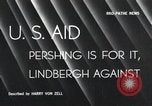
Retired General Pershing supports destroyers for bases deal; Charles Lindbergh supports U.S.neutrality in World War 2.
Prominent Americans with opposing pro-war versus anti-war messages early in World War 2. Retired U.S. General of the Army, John J. Pershing and Colonel Charles A. Lindbergh, express opposing sentiments in public statements. The 79 years old U.S. Army officer General John J. Pershing seated at a desk and speaks into a microphone. He speaks in support of the so-called "Destroyers for Bases" initiative of the Roosevelt administration (without using that term). Among his opening remarks, he states,"With democracy and liberty overthrown on the Continent of Europe, only the British are left to defend democracy and liberty ...." In contrast, speaking at a rally at Soldier Field in Chicago, sponsored by the "Committee to Keep America Out of War," Colonel Charles A. Lindbergh argues against American involvement in World War II.
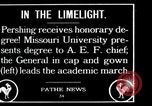
General John J. Perishing and Enoch Herbert Crowder receive LL D degree at University of Missouri, United States.
LL D awarded to U.S. General John J. Pershing and General Crowder at the University of Missouri, United States. During 1920 commencement exercises at the University of Missouri, U.S. Army officer General John J. Perishing receives an honorary degree. President Hill of the University of Missouri awards LLD degree to General Pershing and also to U.S. Military officer Enoch Herbert Crowder who had been instrumental in the draft for World War I. General Pershing wears a cap and gown after receiving his degree. A finger points to Pershing's name on diploma.
CRITICALPAST.COM: About Us | Contact Us | FAQs - How to Order | License Agreement | My Account | My Lightboxes | Shopping Cart | Advanced Search | Featured Collections | Website Terms & Conditions | Privacy Policy ©2026 CriticalPast LLC.
License Agreement |
Terms & Conditions |
Privacy Policy
©2026 CriticalPast LLC.