


 Francais
 Deutsch
 Italiano
Refine Your Search
US-Gliders- stock footage and images
- Showing 12121 to 12126 of 21917 results more
more Hide
Hide
German factory workers manufacturing arms including rifles, artillery, shells, aircraft, and tanks during World War II
Manufacturing of German weapons in Germany during World War 2. Opening scene shows steam and smoke rising from a German industrial complex in 1941. Inside the plant, men and women are at work in arms manufacture. A woman rides on a traveling crane, moving a large steel wheel suspended by a chain. Another woman operates a grinder from which sparks fly. A woman welder uses a torch on slabs of steel and another removes parts from a machine press. An array of new rifles moves past the camera, revealing men fitting barrels into rifle stocks. Closeup of a worker examining a rifle stock for symmetry. A man in protective clothing uses a long pole near a steel furnace. Bessemer-type furnaces emit flames as they are charged with oxygen. Caldrons filled with molten steel move while suspended below an overhead conveyer. A machinist turns the nose section of a large shell. A man uses white tape to tie finished munitions for shipment. Men working on several 122mm field pieces and others working on a line of 88mm anti-aircraft guns. Camera pans over assortment of shiny finished artillery shells. A container is raised up from an annealing operation. Men tend others where flame can be seen. Many workers walk in unison to a row of Junkers JU-88 aircraft fuselages. A 1,340 Junkers Jumo 211J twelve-cylinder engine for one is seen moving on an overhead conveyer. Assembled and painted Ju-88s are rolled through a hangar. One sits at the door of the hangar. A production line of Panzer tanks in various stages of completion. One moves through the plant on an overhead conveyer.

Iron Whip, James Eagle and Drags Wolf speak in the Indian sign language in Montana.
A documentary shows U.S. Army Major General Hugh L. Scott and U.S. Representative from Montana Scott Leavitt meeting Indian chieftains at Fort Browning in Montana to evolve methods of perpetuating the Native American Indian sign language in 1930. The Indian chieftains seated in a Piegan council lodge for a council. Drags Wolf, the chief of the Hidatsa tribe, speaks using the Indian sign language. General Scott translates it simultaneously. Iron Whip of the Sioux tribe speaks in his sign language. General Scott translates. Deer Nose of the Crow tribe and James Eagle of the Arickaree tribe speak in their sign languages.

Bitter Root Jim, a Flathead tribal, presents his bear story in sign language in Montana, United States.
A documentary shows U.S. Army Major General Hugh L. Scott and U.S. Representative from Montana Scott Leavitt meeting Indian chieftains at Fort Browning in Montana to evolve methods of perpetuating the Indian sign language in 1930. The Indian chiefs seated in a Piegan council lodge for a council. Bitter Root Jim, a Flathead tribal, presents his bear story in Native American Indian sign language. The Indian chieftains seated together. Bitter Root Jim gets up and stands in the center to share his bear story with the chieftains seated. Using signs he explains what happened to him. The seated tribal chiefs look at him carefully.

Allied amphibious forces loading onto ships in preparation for the invasion of Normandy in World War II
Allied troops and equipment being loaded on ships in preparation for the D-Day invasion of Normandy, during World War 2. U.S. soldiers riding in landing craft as they position in the Harbor,Portland, England. Troops wave to the camera. U.S. Coast guardsman at the helm of a landing craft. Landing craft being hoisted aboard a transport ship. U.S. Army halftracks backing onto a Landing Craft Tank (LCT), alongside Stone pier,Castletown, Portland, England. One halftrack has some difficulty , but makes it OK.
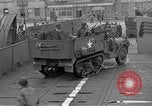
Allied amphibious force assembling in England, prior to D-Day invasion of Normandy, in World War II
Allied amphibious forces assembling in Weymouth Harbor and Portland Harbor, England, in preparation for the invasion of Normandy, France during World War 2. U.S. Army halftrack backing onto a Landing Craft Tank ( LCT), alongside Stone pier, Castletown, Portland, England. Closeup of a young soldier silhouetted against sky during loading operations. A soldier looking from his ship at the transport ship USS Barnett (AP-11) anchored nearby. Higgins boat shuttling away from the USS Barnett. Several of her Higgins boats are tied alongside, and one is on a hoist. View of the Submarine Chaser, USS PC-617, tied up alongside the Barnett. Scene shifts to portside view of the USS Dorothea L. Dix (AP-67) at anchor. View from the water, of LCLs(L)540 and 542 docked next to each other. U.S. Landing Craft Tank LC(T)-636, along with others moored to buoys. U.S. Landing ships Tank (LSTs 300 and 350) are seen anchored next to one another. Closeup of LST-134 with Higgins boats nearby. Landing Craft Tank-157 with barge tied up aside, full of trucks, DUKWs, a tractor, and other cargo. Closeup of LCT-213 underway past the camera boat.
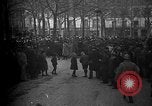
Newton Diehl Baker and General James Guthrie Harbord inspect German prisoners in Tours, France.
U.S. Secretary of War Newton Diehl Baker and U.S. Army General John Joseph Pershing arrive at SOS Headquarters in Tours, France during World War I. People crowd in streets. Newton Diehl Baker and John Joseph Pershing get off from a car. Baker and Pershing are escorted by officers. They talk to the officers in front of a building. Jeeps being parked in the background. Baker, Pershing stand with other officers on the steps of the building and pose. German prisoners stand in formation. Baker and U.S. Army General James Guthrie Harbord inspect German prisoners. Buildings in the background. Harbord and Baker leave after the inspection. The soldiers stand in a group. An officer in a jeep reads from a paper. A close up of a dignitary. The officers stand in a group. Two officers pose.
CRITICALPAST.COM: About Us | Contact Us | FAQs - How to Order | License Agreement | My Account | My Lightboxes | Shopping Cart | Advanced Search | Featured Collections | Website Terms & Conditions | Privacy Policy ©2026 CriticalPast LLC.
License Agreement |
Terms & Conditions |
Privacy Policy
©2026 CriticalPast LLC.