


 Francais
 Deutsch
 Italiano
Refine Your Search
US-Gliders- stock footage and images
- Showing 12199 to 12204 of 21917 results more
more Hide
Hide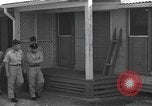
Flyers of a USAF 59th Weather Reconnaissance Flight crew plan a mission
Flight crew of the U.S. Air Force 59th Weather Reconnaissance Flight (Hurricane Hunters) at Kindley Air Force Base, walk to their operations office. A Captain and a Lieutenant prepare a flight plan. The Lieutenant uses a Weems plotter on a map, while the Captain uses a large E6B computer to calculate course headings,taking wind into account. The Lieutenant writes the headings on their flight plan. When finished,they place the map and flight plan into a briefcase.
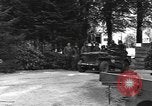
American forces pushing deep into Germany about a month before the end of World War II in Europe
U.S. armor and infantry advancing in Germany during final days of World War 2, in Europe. American soldiers riding atop an M5A1 Stuart light tank move slowly along a dirt path in war-torn area of Germany. They follow another Stuart tank, loaded down with equipment and supplies. The tanks raise dust as they proceed. Scene shifts to U.S. infantrymen walking along a dirt road surrounded by damaged and destroyed buildings. A German civilian man passes them headed in the opposite direction. A U.S. soldier guards two German prisoners of war, as they walk with hands on their heads, past am M5A1 Stuart tank parked near a building. Change of scene shows several Stuart tanks parked at the side of a road in a town. A white surrender flag is displayed on a building in the foreground. A Stuart tank pulls out of position and passes the line of parked tanks. It is followed by a jeep and another tank. Another scene shows infantrymen climbing aboard a Stuart tank for a ride forward.
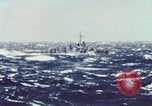
Preventive measures undertaken by ships and consideration of safe havens before getting underway in the Pacific Ocean.
A documentary on the occurrence of tropical cyclones. US Navy warship underway in the Pacific Ocean. View of U.S. Navy Destroyer USS Charles R. Ware (DD-865) advancing in heavy seas, with waves crashing over deck. Next scene shows Destroyer USS Tuner (DD-834) also in heavy seas. View of LST USS Walworth County (LST-1164 at port with a tug boat pushing her away from docks toward open sea. Various U.S. Navy warships in a calm harbor. USS Frederick (LST 1184) moving out of harbor. Preventive measures taken by ship's crew require analysis of: tropical cyclone forecasted danger area, measure of the harbor, and the type of vessel involved. Safe havens should be known. Books related to typhoon safety measures on a table. Sasebo Harbor in Japan is one of the safe havens. A map locates the Sasebo harbor. Hills and mountains in the background. The harbor is well equipped with repair and service facilities. Ships anchored in the Sasebo harbor.

Men fix dynamite for the deepening of the Hell Gate Channel in New York, United States.
A film on use of dynamite in the United States. The deepening of the Hell Gate Channel in New York by using gelatin dynamite. Men working and fixing dynamites. A splash in water due to an explosion. Mining of coal and metals is made possible by using dynamite.
Medics treat injured soldiers at 376th Field Unit hospital on the outskirts of Nijmegen, Holland in World War II.
U.S. soldiers in Holland during World War 2. Soldiers aboard a jeep passing on a street. Trees in the area. 376th Field Unit hospital on the outskirts of Nijmegen. Two U.S. soldiers carry a tank of blood into the building. American soldiers standing among wounded German prisoners of war lying on litters outside the building and mingling with ambulatory wounded German soldiers in a garden. Closups of several German wounded on stretchers. Local civilians including a nurse in white, helping the wounded. Red Cross corpsman making out identification tags for wounded. Ambulatory wounded standing and walking about in front of the building. U.S. wounded soldiers being transported by jeep and removed from field ambulances. One being carried by a single soldier, into a building and others following on litters. (Note: The gentleman in white coat, at TC: 00:56 to 00:59, has been identified, by his son, as J. Th. van der Schoot, then 35 years old, who worked at the Canisius hospital in Nijmegen, and lived across the street from the 376th Field Unit hospital at Houtlaan nr.19, Nijmegen.)
American paratroopers engage in practice maneuvers in England during World War II
Group of U.S. World War 2 paratroopers being briefed by one of their officers (US Army Captain) who points, on a large scale relief map, to landing zones for practice maneuvers. The troopers wear early version of the Parachute Infantry patch on their overseas caps. Troopers wearing their parachutes are briefed by another officer. Groups of paratroopers file out to U.S. Army Air Forces C-47 transport airplanes and board them. Officer inspects individual troopers and their chutes, as they prepare to climb aboard an airplane. the C-47s taxi out and take off. The C-47s join up in a large formation and fly low over the field. View from copilot's window of the formation flying over English farmland and a village. Aerial view of C-47s in formation with their fuselage doors open. Several aerial views of the formations. Paratroopers seated inside a C-47. Several smoke cigarettes. The name: "Rouby" stenciled on paratrooper's helmet. One trooper smokes a cigar. A trooper walks along passing out cigarettes to others, and lighting them. The troopers all stand up and hook their rip cords to a static line. Aerial view of troopers parachuting from their airplanes, near smoke-marked fields.
CRITICALPAST.COM: About Us | Contact Us | FAQs - How to Order | License Agreement | My Account | My Lightboxes | Shopping Cart | Advanced Search | Featured Collections | Website Terms & Conditions | Privacy Policy ©2026 CriticalPast LLC.
License Agreement |
Terms & Conditions |
Privacy Policy
©2026 CriticalPast LLC.