


 Francais
 Deutsch
 Italiano
Refine Your Search
US-Gliders- stock footage and images
- Showing 12283 to 12288 of 21917 results more
more Hide
Hide
General Doolittle and General Spaatz honor the USAAF389th Bombardment Group for completing 200 heavy bombardment missions during World War II in Europe
Ceremony honoring the USAAF 389th Bombardment Group, on completion of 200 missions in the European theater during World War 2. U.S. Lieutenant Generals Carl A. Spatz, Commander of the U.S. Strategic Air Forces in Europe, and James Doolittle, who is about to assume command the 8th Air Force, stand together with officers representing several World War 2 Allied nations. A large formation of B-24 Liberator bombers flies overhead. Closeup of two soldiers looking up at the formation. Aerial view of the B-24 formation, from an accompanying aircraft. A color guard with the American flag. Representatives of various Bombardment Squadrons stand holding their unit flags. General Doolittle makes brief remarks on the merits of the 389th Group, which draw chuckles from the audience, including a smiling Soviet officer, Standing to the far left in the picture, behind Doolittle. (He has been identified as Major Timofey Samarin, assigned as Air Force assistant to the Soviet Ambassador, and also as Military Attache to the United Kingdom.)
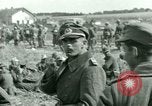
German prisoners taken to a compound in Bizerte and prisoners in vehicles during Tunisian Campaign in Tunisia.
German prisoners taken to Bizerte and vehicles loaded with prisoners during the Tunisian Campaign in World War 2. Faces of German prisoners many of them stand and seated. German prisoners along with their luggage move into the compound. Around 2000 Prisoners of War taken or voluntarily having turned themselves into Military Police (MP). Prisoners relax themselves and talk. After a break they march forward. Roads filled with vehicles loaded with German prisoners. Prisoners on car, jeeps and trucks. A U.S. vehicle reads 'Hell's-half Acre'. Vehicles loaded with German prisoners. U.S. officer keeps a watch on the prisoners. Officer drinks.
Prisoners reach a surrender junction in different vehicles, all supplies confiscated and taken to Britain.
German Prisoners of war in France in World War 2. They come to surrender to American forces at a junction set up tor the purpose. They arrive on all kind of vehicles, including supply trucks, command cars, fuel trucks, horse wagons and bicycles. Enemy war materiel and assets, including livestock and other supplies, are confiscated. Some prisoners are marched to locations. At one outdoor enclosure, a sign reads 'German Enlisted Men.' Documents and weapons are confiscated. A stack of rifles. German POWs stand disarmed. Prisoner discusses map of American and German positions with a U.S. Army Sergeant. Prisoners are questioned and searched. Some wounded German prisoners are carried by other German soldiers. Others are transported by Americans. A wounded prisoner lies on a stretcher. A jeep with Red Cross flag carries wounded. Group of German prisoners of war eating a hot meal. Others eating regular U.S. rations.
196th Light Infantry Brigade company disassembles and burns NVA huts in Vietnam.
United States Army soldiers of B Company, 196th Light Infantry Brigade during Vietnam War. Soldiers patrol through an area of damaged trees. Two soldiers examine an entrance hold at a tunnel. A soldier hands another soldier a white canister that the latter puts down into the hole. A soldier smokes a cigarette and looks at the leaves. U.S. Army Soldiers disassemble partially standing huts (which had been used by North Vietnamese Army NVA 2nd Regiment), pile up wood and straw of huts that they tore down, and set it on fire. A soldier operates a 16mm movie camera and films the event. Smoke rises from the pile of huts and materials set on fire.
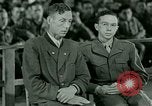
Testimony of Franz Strasser, questioning by prosecutor, and sentence given during military commission trial in Dachau, Germany.
Nazi Kreisleiter Franz Strasser on trial in Dachau, Germany, before a U.S. Army military commission, for the shooting of unarmed United States Army Air Force flyer prisoners on December 9, 1945. Other officers and soldiers in the courtroom. Defendant Franz Strasser is questioned about landing of an American plane, call to the police, the American flyers in custody of Police Chief Lindemeyer, and Strasser's knowledge of whether the flyers were unarmed. Frans Strasser answers the questions through an interpreter. Commission officers and United States flag seen on stage. U.S. Army commission judge delivers the commission verdict of guilty, and states that Strasser is sentenced to death by hanging. The interpreter reads aloud in German the verdict and sentence to Strasser. (World War II period).

Mid 1940's New York City; also John C Campbell Folk School in Brasstown North Carolina helps farmer to develop creative ideas
Credits for the documentary titled 'Creative Hands' about mountain handicrafts in North Carolina. Background info about earlier handicrafts as an important part of civilization. Hands of a woman working on a wooden hand loom. An artisan sculpting a swan in clay. A person working clay on a potter's wheel. Scene change to New York City and busy areas of Manhattan, with pedestrians outside the Rockefeller Center in New York watching ice skaters. Women do window shopping. Crowd of people in a line outside a broadcast studio entrance in the RCA building. Marquee on the building advertises "Invasion Preview" and "Robert Benchley". Scene change again to farming areas in the mountains of southwest North Carolina. Animated map of United States. Wide views of farmland and a house in Brasstown North Carolina. Men cut a tree for lumber using a two man saw. Teacher at John C Campbell Folk School in Brasstown helps farmer to develop creative ideas using local materials. A sign reads "John C Campbell Folk School Handcrafts." Farmers walk with their materials and are seen seated at a table of the school showing some of their handicrafts. They are taught creative ideas by the teacher.
CRITICALPAST.COM: About Us | Contact Us | FAQs - How to Order | License Agreement | My Account | My Lightboxes | Shopping Cart | Advanced Search | Featured Collections | Website Terms & Conditions | Privacy Policy ©2026 CriticalPast LLC.
License Agreement |
Terms & Conditions |
Privacy Policy
©2026 CriticalPast LLC.