


 Francais
 Deutsch
 Italiano
Refine Your Search
US-Gliders- stock footage and images
- Showing 12373 to 12378 of 21917 results more
more Hide
Hide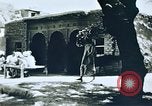
USIA film explaining its mission, inter alia, to correct misconceptions that people in foreign countries may have about America
Opening scenes shows men in in a South Asian village having intense discussions. (USIA wishes to inform such discussions.) The free world also has practical interests throughout the globe. Film shows two geologists holding up what appear to be sheets of mica. Women at work in a factory. Narrator suggests they are using scarce industrial materials (like tungsten). Men in a factory cutting mica. A man shoveling an agricultural product. Men carrying hemp and placing it on poles to dry. Impoverished Asian families. A man (ostensibly Communist agitator) speaking to Arabs. Marchers carrying large cartoon signs in Arabic, depicting "workers" striking down Uncle Sam and other Western powers. Narrator says deeds are more important than words. An American agricultural adviser is shown in a field with a native farmer. President Dwight D. Eisenhower seen standing with him, while Theodore Streibert is sworn in as first Director of the new U.S. Information Agency. Chart shows USIA absorbing information programs formerly administered by the Mutual Security Agency and State Department. Chart stating USIA mission is to: 1. Unite the free world; 2. Get the facts to people behind the iron Curtain; 3. Bring hope to captive peoples.
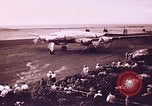
USIA film clip from Dr. Milton Eisenhower's good will tour of South America in 1953
A U.S. Air Force C-121 (Lockheed Constellation) aircraft of the Military Air Transport Service, carrying Dr. Milton Eisenhower, taxis after landing at an airport in South America. (Milton Eisenhower, President of Pennsylvania State University, brother, and advisor to President Dwight D. Eisenhower,is on a good will tour of South America during June 23 through July 29, 1953.) He is seen doffing his black hat, while being escorted by welcomers. Next scene is a view from behind Eisenhower escorted by a large group of people, visiting a construction site. It is followed by closeup from the front showing Dr. Eisenhower, walking with W. Tapley Bennett, Jr., Deputy Director of the Office of South American Affairs, U.S. Department of State. They are accompanied by host country officials, including a military officer. More closeups show Eisenhower and Bennett (in shirtsleeves and sunglasses) talking amiably with workmen at the construction site.
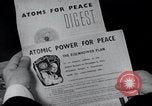
Voice of America broadcasts President's speech and USIS "Atoms for Peace" exhibits are presented worldwide
President Eisenhower of the United States addresses United Nations on December 8, 1953 about atomic bomb and atomic weapon dilemma in the nuclear age (part of Atoms for Peace initiative). Operators in radio transmission control rooms note down readings. View of time clocks of various places in the world including Honolulu, New York, London, Moscow, Calcutta, Bangkok and Tokyo displayed. The Voice of America broadcasts program in different languages by announcers. Scene of a family sitting in a living room as they listen to the president's speech on a console radio. People work at typing, printing, and translating the speech. USIA motion pictures service prepare newsreel of president's speech. A man views air mail of USIA films. Exterior views of several different United States embassy buildings worldwide. A guard standing outside the building. A Public Affairs Officer at the U.S. embassy in Japan, in Tokyo, meets with U.S. Ambassador to Japan Robert Murphy. USIA members seated around table for meeting, and, in Washington DC, creating publications about the Atoms for Peace program. People seated in a USIA library in Brazil read books and various USIA materials. Architects design 30 foot high Atoms for Peace exhibits. An exhibit being setup in a foreign country (possibly in North Africa). Exterior and interior views of the West Berlin, Germany Atoms for Peace exhibit. Prime Minister Jawahar Lal Nehru in India is seen arriving in a jeep to view the Atoms for Peace exhibit in India. Prime Minister Nehru inside the exhibit hall watching a presentation. In Japan, a woman operates remote-controlled robotic hands to hold radioactive materials, at a demonstration for Japanese citizens. In a city in Italy, a view of a mobile van unit carrying an Atoms for Peace exhibit. Scenes from a film "A is for Atom" that was translated into 30 languages and shown all over the world. Wide view of the Kremlin in Moscow, Russia, Soviet Union. A Russian radio commentator speaking at a microphone. Propaganda dramatization showing the Russian announcer attacking American plans for Atoms for Peace.
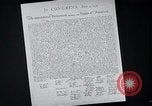
USIA tells the story of America, its democracy and diplomacy through ideas, people and pictures.
USIA tells the story of America. The Unanimous Declaration for the States of America by the Congress on July 4, 1776. The Statue of Liberty in New York. Atomic bomb explodes in Japan during the world war. U.S. troops prepare to defend America. U.S. State diplomats sign documents as they deal with Diplomacy. United States information Agency (USIA) tells the story of America through various means dealing with ideas, people and pictures. A person reads a book, announcers broadcast over radio, and cameramen record events. The USIA seal.
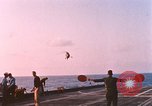
Marine helicopter makes rapid approach and lands on deck of USS Spiegel Grove (LSD-32)
U.S. Marine Corp UH 34D helicopter rapidly approaches stern of the USS Spiegel Grove (LSD 32) for landing, while underway in Atlantic supporting NASA Mercury-Atlas 7 orbital mission. Landing Signal Officer uses paddles to guide pilot during landing.

340th bomb group raid over Potenza in Italy; view of B-25 "Snow White 2" landing, and positioning of B-25 near German revetment
340th bomb group raid over Potenza, Italy during World War II. Aerial view of Potenza. Bomb bay doors open on U.S. Army Air Forces aircraft and bombs are released and descend toward target at Potenza. View of American Mitchell B-25 bomber "Snow White II" landing after a mission. U.S. Army crew repositions the B-25 bomber in front of a German revetment wall. (World War II period).
CRITICALPAST.COM: About Us | Contact Us | FAQs - How to Order | License Agreement | My Account | My Lightboxes | Shopping Cart | Advanced Search | Featured Collections | Website Terms & Conditions | Privacy Policy ©2026 CriticalPast LLC.
License Agreement |
Terms & Conditions |
Privacy Policy
©2026 CriticalPast LLC.