


 Francais
 Deutsch
 Italiano
Refine Your Search
US-Gliders- stock footage and images
- Showing 12445 to 12450 of 21917 results more
more Hide
Hide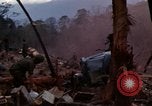
Scenes from Operation Delaware by 1st Air Cavalry Division in the A Shau Valley during Vietnam War
Scenes from massive offensive by 1st Air Cavalry Division against the People's Army of Vietnam (PAVN) in A Shau Valley, during the Vietnam War. Film opens showing scattered wreckage of a U.S. Army UH-1H helicoptor damaged by enemy fire or by collision with obstacles during landing. As troops work to clear wreckage, another UH-1 lands precariously in the midst of debris. United States Army soldiers dismount. Other soldiers work around the crash site. Nearby, a contingent of troops is busy carving out a proper landing zone, using small tools and a number of chain saws. Two of them pass close by the camera, carrying a huge tree trunk. Troops employ chain saws close to one another as they work on the tangled underbrush and trees. In the background, one soldier chops smaller brush with a machete. (Note: It has been reported that these scenes depict elements of B Company, 227th Assault Helicopter battalion, at LZ Pepper, and the UH-1H seen landing might be from the 1st/9th "Head Hunters.")
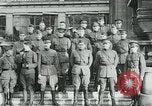
Events during Paris Peace Conference in 1919.
Group of United States military officers. Colonel Edward Mandell House, American diplomat and politician, sharing information. Georges Benjamin Clemenceau, Prime minister of France and Ferninand Foch, Marshal of France leaving a building in Paris. View of Hotel Elysees Palace and Hotel Crillon (6 Pl. de la Concorde, 75008 Paris, France). Arrival and departure of guests at Hotel Crillon. Admiral William S. Benson, Chief of U.S. Naval Operations and Henry white, a prominent U.S. diplomat leaving Hotel Crillon.
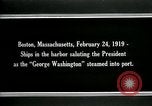
USS George Washington entering Boston in Massachusetts on its return from France.
American delegation return back from the Paris Peace Conference following World War 1 armistice. US Navy ship USS George Washington entering the harbor at Boston. The ship is decorated with U.S. flags all over. USS George Washington welcomed by other battleships as she steams towards the harbor. View of ship's guns and the Navy crew men on USS George Washington.
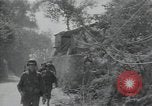
American soldiers walk through a demolished Italian village and take some prisoners with them.
World War II. U.S. Soldiers walk through a demolished Italian village. Other soldiers escort some Italian prisoners . They approach a pontoon bridge over which a U.S. military armored half-track vehicle is crossing toward them. The half-track passes by and the prisoners and their guards walk across the pontoon bridge.
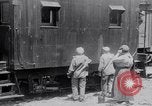
British women take on men's jobs on the homefront during World War I
Women in the industrial workforce on the homefront in Britain during World War 1. Opening scene shows several British women in working garb painting a railroad car. Other women perform manual labor alongside railroad box cars in a rail yard near a factory, as two women pass them pushing a small flatbed rail car loaded with steel rail parts. Change of scene to outdoors, where women are felling trees. Two in foreground are using a grinding wheel to sharpen an axe, while behind them, two push on a tree while two others use a long two-handled saw near its base. They jump clear as the tree falls. Women wielding axes to cut trees, elswehere in the woods. Two women with a two-handled saw, making final cuts on a standing tree, and stepping out of the way as it falls. A woman painter on a scaffold supported by block and tackle rigging four stories high on the side of a city building.
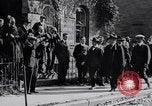
President Wilson votes in 1916 election. American soldiers cast ballots at army camp. British women work in industry to help during World War I
President Woodrow Wilson voting in the Presidential election on November 7, 1916, in Princeton, New Jersey. He is seen walking with an entourage, along the sidewalks of Chambers Street, past the entrance to G.A. Rule Real Estate offices, where men on the steps, remove their hats in acknowledgement and respect. The President and his party continue on to the old firehouse, that has been set up as a polling place. After greeting people there, President Wilson enters to vote. He comes out of the building after casting his ballot and doffs his hat to the camera and people in the vicinity. The scene shows American soldiers at an army camp casting their ballots in the election. They huddle around tables where there names are checked on voter lists and they receive ballots. One soldier is seen sealing his ballot before depositing it in a ballot box. Camera focuses on a ballot table with soldiers crowded around it. The final segment of the film contains completely unrelated footage of British women in the United Kingdom working in an industrial operation during World War 1. Some are seen at a railroad siding, clearing up scrap beside open rail cars. They use wooden wheel barrows with wooden wheels. Two women push a load of steel rail parts on a small flat rail car. In another location at the plant, women push a flat rail car loaded with lumber to a spot where several other women remove and stack it. Many steel railroad wheels are lined up in the background. The camera focuses on women pushing railroad axles, assembled with wheels, along tracks, toward a building in the rail yard. Two women touch-up paint on the side of a railroad car, as another woman (supervisor) watches. Back at the area of stacked lumber, two women fabricate something using a saw and hammer and nails on lumber placed atop wooden saw horses. Another woman wields a hammer in the background.
CRITICALPAST.COM: About Us | Contact Us | FAQs - How to Order | License Agreement | My Account | My Lightboxes | Shopping Cart | Advanced Search | Featured Collections | Website Terms & Conditions | Privacy Policy ©2026 CriticalPast LLC.
License Agreement |
Terms & Conditions |
Privacy Policy
©2026 CriticalPast LLC.