


 Francais
 Deutsch
 Italiano
Refine Your Search
US-Gliders- stock footage and images
- Showing 1243 to 1248 of 21920 results more
more Hide
Hide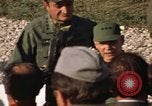
U.S. Army generals and officers of other countries hold a press conference in Panzing, Germany during REFORGER III.
U.S. 1st infantry Division during exercise Return of forces to Germany III (REFORGER) in Panzing, Germany. U.S. Army General Michael Shannon Davison, Commander in Chief, U.S. Army Europe, addresses a press conference. He states about maneuver of testing and purpose of this exercise. He speaks about planning of Reforger IV. Lieutenant General Charles W. Eifeler, U.S. theater Army Support Command talks to press and spectators. Canadian Brigadier Chinon speaks. German Colonel Ruprecht Von Butler speaks. Generals answer questions about the purpose of exercise and allied formation. They talk about position and process of this exercise. Colonel Ruprecht talks about German view about this exercise. He says that it should be seen totally in military view. Journalists ask about the effectiveness of this exercise in limited terrain and simulated situation. Generals respond and say that this exercise is worthy enough. Colonel Ruprecht talks about political decisions, reduction of forces and balance.
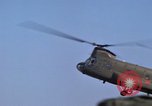
U.S. CH-47 Chinook helicopter in operation during Return of forces to Germany III (REFORGER) exercise in Germany.
Return of forces to Germany III (REFORGER III) exercise in Germany. U.S. Lieutenant General Fillmore K. Mearns, Commanding General U.S. 7th Corps, briefs spectators. U.S. Army CH-47 Chinook helicopter land at a bridge site. Friendly forces repair bridge. U.S. Army CH-54 helicopter lower section of a bridge. Friendly force scatter along hillside in defensive positions with rifles at the ready.
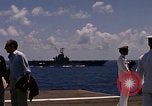
U.S. high ranked naval officers and VIPs watch air show and display of navy weaponry aboard CV-62 in the Mediterranean Sea
Air show in the Mediterranean Sea. Starboard beam view of the USS Shangri La (CV-8) as seen from USS Independence (CVA-62). Officers and newsmen on the deck in the foreground. Dignitaries aboard the ship. High ranked VIPs seated in chairs to watch the air show. Two newsmen one with a camera, one with ear phones and High ranked officers seated in the middle. Officers seated in chairs on the flight deck which includes U.S. Navy Admiral John Sidney McCain Jr. (father of John S. McCain III). The mast of the ship and a flag of the United States on it. Us Navy E-1B Tracer on fly by in the background. The flight deck filled with VIPs and flight deck personnel as they look upwards. High ranked officers and U.S. Navy Captain Douglas Fairbanks Jr. looks up. U.S. Navy Vice Admiral William I. Martin, Commander of the Sixth Fleet, is seen. Splashes in the water from the boom hits. Smoke makers in flight. High ranked officers look skyward. Large plash in the water, throws up smoke from a hit during the demonstration. Two unidentified aircraft in formation on fly-by. The water shows multiple explosions. A long string of explosions on the water. Strafing and explosions on the surface of the water. CBUs go off in a long column on the water, throws and strikes the water. Small explosion occurs, followed by second one. Aircraft move to a position for over the shoulder bombing. High ranked officers with their heads turning to right, as they follow an aircraft. Captain Fairbanks in the foreground. Captain Fairbanks, Vice Admiral Martin, Admiral McCain, and several Foreign Officers seated in the front row. Two F-4J Phantom II aircraft on fly-by. Three flares burn in the sky. Two aircraft come into the scene from the right and fly towards the flares. Aircraft continues to move towards the flares. Aircraft fire missiles striking the flares in sky. Several personnel on the flight deck. Aircraft in the sky. Three flares burn in sky, two aircraft fly-by the flares as a streak of smoke pass through the three flares. Civilians and newsmen on the flight deck. Newsmen work with their cameras.
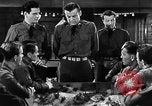
A Rifle Squad officer briefs the Sergeants about the Squad Column, Skirmish Line and Open Squad Formation in U.S. (WW2)
The advantages of the battle formations during World War II. The U.S. Army Sergeants seated at a desk and discuss the model. A Rifle Squad officer talks about the Battle Formations made by the smallest unit the Rifle Squad. He holds a stick in his hand. The model shows the two basic formations first the Squad Column and second the Skirmish Line. The officer also talks about Squad Wedge formation. He speaks about the usage of different formations. The officer explains the details of the formations that is how and when they are used. He first talks about the Squad Column which is the basic and easiest way of formation to control the fire. The troops hold each other's belt during the squad formation. He also speaks that always use Squad Column at night. Next is the Open Squad Column which is useful in crossing the open terrain where there is no cover. The Rifle platoon during the Open Squad Column formation. The officer asks the Sergeant about the questions regarding the Squad Column. The Squad Wedge which can form a Skirmish Line and is faster then the Squad Column. The Sergeant listen to him as he talks about the responsibility of Squad Leader during the formation. A model depicts the formations of Wedge. A Sergeant asks question related to the difference between the Open Squad Column and Wedge and the officer answers. Last formation the Skirmish Line. A model depicts the Skirmish Line formation by the Rifle Squad and usage of it to start the attack. The model shows the troops advancing for attack. The officer sums up in short three of the formations. He also speaks about the other formation and gives example.
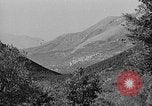
U.S. soldiers fire at an Italian town with 240-mm howitzer, rifles and tanks during the war (WW2)
A documentary depicts the importance of good guns during World War II. A town in a valley. A U.S. soldier speaks on a radio and other soldiers around him. They fire an artillery. A 240-mm howitzer being pulled by two armored tractors. Howitzer is emplaced and shells being loaded. It fires at an Italian town. A soldier looks through binoculars. They are on the radio. A view of the town in the valley. Infantry follow U.S. tanks into the valley. Smoke arises due to firing. They fire a mortar The shells of the mortar. Civilians of the town. The troops enter the town. Mine detectors being used and fighting in the streets. Damaged building in the town. Civilians leave cave to welcome U.S. troops and receive food.
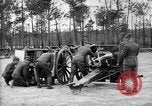
U.S. Army artillery training during World War I
U.S. Army artillerymen training with a French 75 field piece and caisson during World War 1. A supervisor makes notes as artillery gunners in training prepare to arm and fire the field gun. A soldier quickly takes a shell from the caisson and places it into the gun breech. Some distance away, a soldier with an optical director instrument gives hand signals to the gun crew. Closeup of the instrument. Gunner making adjustments to aiming apparatus on the gun and then using mechanical measuring device to set elevation on gun barrel. Instrument in gunner's hand. A telescope being set up by a gunner. Periscopic binoculars being used. A soldier using a range finder. (World War I; World War 1; WWI; WW1)
CRITICALPAST.COM: About Us | Contact Us | FAQs - How to Order | License Agreement | My Account | My Lightboxes | Shopping Cart | Advanced Search | Featured Collections | Website Terms & Conditions | Privacy Policy ©2026 CriticalPast LLC.
License Agreement |
Terms & Conditions |
Privacy Policy
©2026 CriticalPast LLC.