


 Francais
 Deutsch
 Italiano
Refine Your Search
US-Gliders- stock footage and images
- Showing 12505 to 12510 of 21917 results more
more Hide
Hide
Recap of slavery, the Civil War, and job integration in the United States, in the context of the civil rights movement.
African American and white children swim and play in an integrated swimming pool in the United States in the 1960's. A black man beside a white man working on an integrated engine car assembly line. A black shoe shine man. A black street sweeper. Narrator indicates that African American workers are in increasingly skilled jobs and supervisory positions. A black draftsman in an officer environment. A black bank manager gives an application to a black woman. Huey Newton leads the Black Panthers in a protest. Stills portray trade and transport of African American slaves. Stills show the Civil War in the United States, and aftermath of war showing blacks voting and as politicians during reconstruction. Footage of African American people working on farms in cotton fields picking cotton, including boy and girl child laborers picking cotton. Footage of a Rust Cotton Picker machine in operation as African American workers watch. American troops, including African American soldiers of the U.S. Army 369th Infantry "Harlem Hellfighters", marching in victory parade in the United States after returning from World War 1. View of segregated African American soldiers in the parade in New York City cheered by parade attendees. Brief scene with Henry Johnson on the side of the parade route being congratulated by civilians. (Johnson and Needham Roberts received the Croix de Guerre for exceptional heroism). Black and white workers entering or exiting a factory during World War 2. Black American troops and Tuskegee Airmen pilots in segregated units during World War 2. The Tuskegee pilots in uniform gathered together during a briefing on an airfield. View of U.S. military forces comprised of white and black personnel, integrated beginning in 1947. A white officer gives binoculars to a black soldiers.

Four British working men and four American counterparts visit officials concerned with war production, in New York City and Washington DC (WW2)
A British film entitled, "People to People." Four British working men, visiting America, are seen in overcoats on the deck of a ship passing the Statue of Liberty in New York Harbor during World War II. They are accompanied by four American workers who were returning on the same ship, from a similar visit to England. Closeup of the eight men, named by the narrator, who calls them trade unionists on an exchange visit. Brief view of Chiang Kai-Shek, Franklin D. Roosevelt, and Winston Churchill at the Cairo Conference in 1943.Camera pans closeup over Roosevelt and Chiang Kai-Shek. Brief views of Roosevelt, Churchill, and Joseph Stalin at the Tehran Conference in 1943. Closeup of Roosevelt and Churchill, with Anthony Eden standing immediately behind them. Closeup of Stalin and Roosevelt, with U.S. Army Air Force Chief, General Henry H.(Hap) Arnold and British General Alan Brooke, Chief of the Imperial General Staff, conversing behind them. Scene shifts back to the men aboard the ship in New York harbor, with the New York City Manhattan skyline of buildings in the background. Next, the eight men are seen climbing steps to New York City Hall. Inside they are welcomed by New York City Mayor Fiorello LaGuardia. The group is then seen entering a building in Washington, DC, where they sit down at a table with Donald Nelson, Head of the U.S. War Production Board. In the Department of Labor building they meet William Hammatt Davis, Head of the War Labor Board, and also the Secretary of Labor, Frances Perkins. After that they are seen heading into the White House, where they are met by Mrs. Eleanor Roosevelt, who comes out of the White House to greet them on the porch. (Narrator says she later invited them inside for tea.) The men are next seen climbing the Capitol steps. Vice President Henry A. Wallace comes out to greet them and comments about industrial production not only during the war, but in the time of peace to follow.
Dayton, Ohio plans to increase the number of persons employed in its war plants (WW2)
Film opens showing large factory building with all its lights on at night. Smoke stacks at industrial plant emitting white smoke against dark sky. Sparks flying outdoors from a steel plant at night. War production workers inside a fabricating plant drawing a ribbon of hot steel from a roller and dragging a newly made sheet of metal across the floor. Two men with shovels stoking a furnace. Men shaping parts on forging machines. A group of men using sledge hammers to drive down pipe supports under a large piece of sheet metal. Women employees at work inspecting U.S. Army helmets on an assembly line. Workers in a crowded machine shop. A sign reading: "500 workers needed NOW Training on the job." A display of job recruitment announcements in newspapers. A room full of idle manufacturing machinery (ostensibly due to labor shortages). Sign on iron fence outside a building, reads: "Essential WAR WORK Day or Night Men and Women" and "We have a war job for you. Apply here." Some more similar signs. Animated chart of Labor Needs with Labor supply lagging behind, superimposed on a drawing of a defense plant. Map of the USA highlighting areas of industrial might where labor shortages exist. Camera zooms in on Dayton, Ohio on the map. Aerial views all over the city of Dayton, Ohio. View from a tall building overlooking a major Dayton commercial street. The Gem City Savings building, with clock tower on top, at the corner of Third and Main streets. On April 7, 1943, two hundred leading citizens of Dayton are seen attending a meeting at which Stanley C. Allyn, President of the National Cash Register Company, is speaking. He speaks about the danger of Dayton falling behind its war production goals because of manpower difficulties. View of the audience, which includes several military officers in uniform. Allyn speaks of the potential for war work being moved elsewhere because of this, and challenges Dayton's leaders to solve the problem without requiring action from Washington. Next, an emergency committee of community leaders is seen around a table. Camera pans over attendees, including labor leaders from AF of L and CIO; Government officials present, including Area Director and Deputy Regional Director of the War Manpower Commission, and Chief of Program Requirements for the Region; leading industrialists and retailers are shown. Local officials seen include the Mayor of Dayton and Secretary of the Chamber of Commerce as well as the Commanding Army Air Forces Generals of Wright Field and Patterson field. In final scene, Stanley Allyn is seen at the head of the table, speaking to the group. He outlines three ways to obtain more war workers from the Dayton population during World War II.
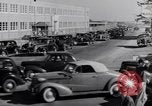
City of Dayton Ohio takes numerous measures to improve transportation and amenities for war workers during World War II
Opening scene shows workers arriving for a shift at a war plant in Dayton, Ohio, during World War 2. The arrive in cars and public transport (not seen) to stream across the road in front of the defense plant, as they enter. Others are seen leaving defense plants, in large numbers as their shifts end. A sign at a war plant advocating ride sharing or car pooling to conserve resources shows a cartoon of Adolf Hitler riding in the empty back seat of a man's car. It reads, "Hitler rides in the empty seat. Double Up!" Men and women are seen standing at a designated Transportation Center to arrange for sharing rides with others. A man steps from a sidewalk, in town, to get into a car that stops to pick him up as part of that activity. People gathering for buses under newly built shelters. A sign on a bus reads: We deliver the war workers. They deliver the goods." Buses moving through the city. One stops and many workers exit, in a town center. Other workers are seen lined up to board rail road trains. Workers entering their private cars in a crowded parking lot at a war plant. Workers crowd into the entrances of a defense plant, where their identification badges are evident on their work clothes. Large numbers of workers leave at the same time others arrive when a shift change occurs. Plant managers discuss ways to minimize absenteeism. View of workers in a crowded cafeteria providing hot meals. A sign reading: "Ladies Dining Room." outside a room filled with women workers having a meal. Men at work in a National Cash Register (NCR) factory assembling 60 pound magazines for 20mm Oerlikon anti-aircraft guns, used by the U.S. Navy, and built by National Cash Register in Dayton Ohio. A factory steam whistle blows, signaling a rest period, as workers take a break for a snack or a smoke. Worker eats an apple and other smoke cigarettes. Narrator describes health and logistical services offered on-site at production plants for workers to minimize time away from work. A sign on a door identifies the "Ladies Health Department." Hours posted on the door correspond to various shifts operating at the plant. Another worker health service is that of a dentist on the premises. View of dentist and nurse working on a patient. Another service area in a war plant shows clerks helping workers to obtain ration books, auto and driver licenses, dealing with Selective Service (draft) matters, income tax questions, ride sharing, and telephone and light utilities. Scene shifts to the Headquarters Building of the National Cash Register Company in Dayton. Ohio Inside, a company manager is interviewing a worker who plans to quit. They discuss the workers reasons and seemingly resolve some problem, because they shake hands and the film narrator implies that the worker is going to remain on the job. A factory building lit up at night. Inside men and women night shift workers are seen performing war work on machines, just as in the daytime. Next, a group of plant managers are seen being trained in particular skills required at their jobs. A view of the city from across a river. A radio announcer with station WHIO. A montage of newspaper clipping related to war workers.
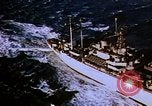
Shows shellback initiation rites and rough seas refueling aboard USS Mount Olympus in Central Group Operation High Jump
Relates to the U.S. Antarctic expedition,Operation High Jump. Shows shellback initiation rites held aboard the USS Mount Olympus (AGC-8), under Captain Cruzen, sailing in Atlantic upon the crossing of the equator. U.S. vessels caught in a heavy sea-storm. Ships move through heavy seas. USS Cacapon (AO-52) along side the USS Mount Olympus in heavy seas for refueling. Captain of USS Cacapon comes aboard the Mount Olympus to discuss and urge rapid refueling for safety of the ships. Seaplane aboard a seaplane tender falls in the sea due to heavy turbulence. Surgeons operate an injured sailor at the sick-bay on a vessel.
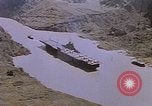
USS Philippine Sea underway in the Panama Canal.
Relates to the U.S. Antarctic expedition,Operation High Jump. Shows USS Philippine Sea underway in the Panama Canal. U.S. Navy Admiral Richard E. Byrd in conversation with naval officers on the deck. Sailors attach ice skis to the landing gears of the Douglas DC-3 aircraft aboard the deck.
CRITICALPAST.COM: About Us | Contact Us | FAQs - How to Order | License Agreement | My Account | My Lightboxes | Shopping Cart | Advanced Search | Featured Collections | Website Terms & Conditions | Privacy Policy ©2026 CriticalPast LLC.
License Agreement |
Terms & Conditions |
Privacy Policy
©2026 CriticalPast LLC.