


 Francais
 Deutsch
 Italiano
Refine Your Search
US-Gliders- stock footage and images
- Showing 12703 to 12708 of 21917 results more
more Hide
Hide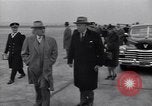
President Truman arrives to send off Secretary of State George C. Marshall at an airport.
President Harry Truman and Secretary of State George C. Marshall step out of a car and move to address the press media on an airport. Behind them a U.S. Airforce aircraft is visible. President addresses the press. Both dignitaries shake hands. Secretary Marshall moves toward the airplane. U.S. military personnel salute the officials.
History of Germany as a group of 300 medieval princely states with feudalistic rulers.
Mix of actor portrayals and actual footage: Church, homes and schools of America. Various United States soldiers. Views of German soldiers. German soldiers marching in a parade ground. Rulers and dictators of Germany: Adolf Hitler (World War II), Kaiser Wilhelm II, Otto Von Bismarck who laid identity of Germany as Nazi, Huns, and Prussians respectively. Historic overview of Germany. Princes and feudalistic rulers of the states. In contrast the US, French and British parliamentary system. King Frederick, the Great of Prussia with his cavalry and in his court. Prussian war against Austria, Russia, Sweden, France. German women wave for victorious troops. Portraits of Scharnhorst and Gneisenau. Dictums of Clausewitz, crushing of the 1848 revolt in Prussia. Germans emigrate to the U.S. Otto Von Bismarck addresses the ministry his policies of blood and iron.
Film juxtaposing German defeat in World War 1, with its defeat in World War II, and comparative postwar impacts.
Film begins stressing the historic aggressive military traditions of Germany. A brief view of thousands of Adolf Hitler's Nazi troopers assembled in dramatic formation at the Nazi party rally grounds in Nuremberg, Germany. Explosion of the Nazi eagle, with swastika symbol, atop the Zeppelintribüne grandstand at Zeppelinfeld in Nuremberg, being blown up by U.S. Army soldiers at the end of World War 2 in Europe. Germans celebrating the armistice ending World War One. German soldiers captured, in unconditional surrender, ending World War Two. Huge open field filled with defeated German soldiers in the second world war. German armies parading through Berlin at the end of World War One. American troops occupying the entire country of Germany after the second world war. A Nazi eagle being destroyed on a German government building at end of the second world war. Old photograph of the German general staff, led by Helmuth von Moltke the Younger, that was still intact, after World War I. In contrast, after World War 2, the entire Nazi military was held and subject to trials at Nuremberg. Großadmiral Erich Raeder seen being taken in custody. Closeup of Field Marshal Wilhelm Keitel. German industry unimpaired by World War I, contrasted with utter destruction in the second world war. American officer coordinating resumed operation of of a postwar plant. View of German diplomats remaining in office after WWI. Proclamation barring Nazi party members from all offices after WWII. German Kaiser Wilhelm II in peaceful exile in Holland after the first world war. A Nazi officer war criminal, is taken in custody by American Military Policemen, and executed by a firing squad. World War 1 did not affect German schools and curriculums. After World War 2 all Nazi doctrines were destroyed. New text books and curriculums were prepared by the Allies for German use. Map shows small area of post World War 1 occupation, in contrast the the entire Germany after WWII. Weimar Republic government, post WWI is contrasted with post World War 2 government by the Allied military powers. British Marshal Bernard Montgomery, American General Dwight D. Eisenhower, Soviet Marshal Zhukov, and French General Charles de Gaulle, are shown. Views of American soldiers interacting with German citizens during their occupation of Germany. Images of Germans: Frederick the Great, Otto von Bismarck, and Kaiser Wilhelm. Views of German farmer sowing seed, postman delivering mail, policemen escorting children. Normal activities resumed in Germany, in areas of culture such as orchestral concerts, etc.

Guided Bomb GB-1 missile launch and explosion
U.S. military technical report titled "Review of Guided Missiles-Guided Bomb GB-1". A GB-1 suspended for display. A B-17 Bomber of the U.S. Army Air Corps takes off with a GB-1 attached. Launching of GB-1. It follows a long aerial path and then hits the target. (World War II period).
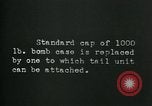
Tail section and smoke flares attached to a glide bomb and operators observe its glide towards its target on ground.
A review of remote controlled weapons of the U.S. Army Air Force. A worker replaces cap of a bomb by a tail section. Smoke flares attached with this tail section. Bomb is placed on a cart and dragged towards a B-25 bomber aircraft of the U.S. Army Air Force. Operators work on instruments to observe the glide of the bomb through a lower gun turret well. Bomb dropped traverses towards its target on ground (World War II period).
Azon Bomb tail sections attached with smoke flares by a technician in China-Burma-India Theater during World War II.
Azon Bombs in China-Burma-India Theater during World War II. A U.S. Army Air Force technician in uniform works with multiple tail sections of Azon Bombs kept in a series on a wooden board. He attaches smoke flares and fastens the screws with the tail sections using a screw driver. He makes entries in his record book.
CRITICALPAST.COM: About Us | Contact Us | FAQs - How to Order | License Agreement | My Account | My Lightboxes | Shopping Cart | Advanced Search | Featured Collections | Website Terms & Conditions | Privacy Policy ©2026 CriticalPast LLC.
License Agreement |
Terms & Conditions |
Privacy Policy
©2026 CriticalPast LLC.