


 Francais
 Deutsch
 Italiano
Refine Your Search
US-Gliders- stock footage and images
- Showing 12757 to 12762 of 21917 results more
more Hide
Hide
Allied troops fighting toward and entering Rome, Italy during World War 2
British and troop patrols converge on the road to Rome, in the beginning of this film. Soldiers of the 1st Canadian Infantry Division and 5th Canadian Armored Division are seen next, mopping up after breaching the Hitler Line, on 24 May 1944. They are seen leaving the area to advance further. Brief view of soldiers tending to a tank and marching past an abandoned anti-aircraft gun. Captured German prisoners march rearward along a road as a camouflaged (with foliage) Canadian M4 Sherman tank advances along a road. It carries many infantrymen riding along atop it. (Narrator states they are en route to Pontecarvo.) Allied artillery pounds the ruined streets of the city. Canadian troops are seen next,entering the destroyed town of Aquino. British Hawker fighter planes flying over water in trail formation, behind the camera plane. Allied patrol from the Anzio front engages a German strong point, using bazookas and small arms. Glimpse of burning German armored vehicle. Polish troops are seen entering the village of Piedimonte. They pull a German from his hideout in a trench. German prisoners marching under guard. Stretcher bearers carry wounded to an open field where they are being tended. Polish forces hold a ceremonial parade where British General Sir Harold Alexander decorates a Polish soldier. Brief closeup of General Alexander. June 4, 1944, American troops enter Rome. German Sturmpanzer (panzer) IV "Grizzly Bear" tank abandoned on the street. U.S. troops walking about in the city and in area of Piazza Venezia. Altar of the Fatherland in background. Local inhabitants cheering the Americans. Italians mob the local fascist controlled radio studio and force occupants to leave the building, abusing some as they depart. Views of happy crowds. Some showing newspapers announcing the arrival of the Allies.
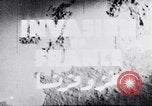
Allied D-Day preparations and invasion of Normandy, France during World War 2
General Dwight D Eisenhower, General Spaatz and Air Marshal Mallory discuss the plan for invading Normandy, France during World War II. Supplies are massed in England for the invasion. British soldiers and U.S. Army soldiers preparing for invasion and boarding ships for the voyage across the English Channel. Some British troops carry bicycles on board. U.S. soldiers marching toward landing craft and boarding landing craft. United States bomber aircraft fly and bombard coastal defenses in France. Aerial camera view from inside allied aircraft as it flies low over German Atlantic Wall defenses and fires rockets at the coastal defenses. Aerial view of beaches of Normandy in the days soon after the D-Day invasion of France. Allied troops landing and bringing supplies ashore. Groups of German soldier prisoners of war lined up under Allied guard. General Montgomery visits Normandy, arriving and jumping down to the beach from a DUKW amphibious vehicle. People in England receive news about the invasion through newspapers. British citizens holding the Evening Standard newspaper with headline reading "The Invasion of Europe Begins." British civilians buying newspapers and reading the news. A busy street in England and a queue of people buying newspapers at a newsstand. View of Allied aircraft flying in formation and closeup views of faces of British civilians looking up at the sky.
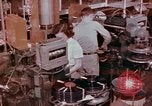
Production and packaging of music phonograph records by RCA Corporation in the United States
Phonograph music records, in long play and 45rpm form, being produced, manufactured, inspected, verified, packaged, and shipped at a RCA Corporation production facility in the United States. Engineer works to create first pressing a long play record album. Shows granular vinyl used, creation of liquid vinyl ready for molding, and pressing of vinyl to create phonograph record pressing on pressing machine. Engineer delivers the first pressing to other employees in charge of quality inspections, including visual inspections and audio playback. After approval, mass production pressing begins for the record. View of factory and processes for pressing records. Packaging process underway. Shows large punch card machines being used for managing shipment information and shipment quantities. Staff in shipping area involved in final packaging, boxing, and shipment of vinyl phonograph records. Also scenes of reel-to-reel tape duplication machines operating in mass production of tape recordings. Montage of scenes showing many vinyl records of the 1950s under the RCA label. View of Maestro Charles Munch, conductor, directing orchestra. View of a phonograph record player turntable turning, and playing a RCA vinyl record.
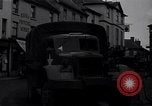
American military trucks and tanks pass through English village of Shaftesbury, Dorset, in World War II
American military trucks and tanks traverse New Road through village of Shaftesbury, Dorset, England. An African American soldier drives one of the trucks. An overhead crane pulls a 2-1/2 ton cargo truck,two wheeled trailer aboard a ship. Trucks and two M1 tanks drive through, turning in front of the Abbey Printing Works. Several townsfolk stand in front of V.F. Pike & Co.Ltd. shop and watch tanks driving past. U.S. soldiers ride in an open stake trucks pulling field artillery. View from vehicle moving along village street past army trucks and entering a courtyard, between stone pillars. A U.S. Military policeman directing truck traffic in center of town. View from truck driving over rails and into port where large ship is being loaded by cranes.
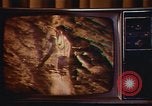
USAF Security Service activities to detect and prevent intercept of classified or secret information from electromagnetic emanations
View of a TV screen image distorted by emanations from an electric razor held nearby A woman typing on a classified message teletype typewriter machine. Signals being detected on an oscilloscope screen. Closeup view of round head of typewriter applying type while typewriter is in use. View of woman typing a letter or memo on an early model electronic typewriter. Two Airmen walking toward the entrance of the Headquarters, United States Air Force Security Service. A Security Service van used to detect electromagnetic emanations capable of intercept. Air Force technicians charting such problems.
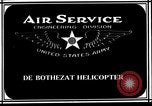
De Bothezat helicopter being tested during its development at the engineering division of McCook Field in Dayton,Ohio
Shows the rotor blade for the de Bothezat helicopter being tested during its development at the engineering division of McCook Field in Dayton,Ohio. Inventor George de Bothezat was hired by the U.S. Army Air Service in 1921 to produce a helicopter. This footage shows various tests being conducted: First a test of the " plane radical lifting screw ". The rotor is seen moving at high speed and lifting the front of the cart to which it is anchored. Second is a test showing the pitch variation mechanism. Next sequence show U.S. Army Lieutenant Colonel J.E. Fechet, Major T.H. Bane, and the inventor of the helicopter George deBothezat discussing with each other. De Bothezat points to the aircraft mechanism as he talks to the officers. De Bothezat and four Army officers sit in the helicopter to test the lift capability. The rotor rotates and lifts the front end of the cart with the 5 men seated in it, absorbing 30 horsepower.
CRITICALPAST.COM: About Us | Contact Us | FAQs - How to Order | License Agreement | My Account | My Lightboxes | Shopping Cart | Advanced Search | Featured Collections | Website Terms & Conditions | Privacy Policy ©2026 CriticalPast LLC.
License Agreement |
Terms & Conditions |
Privacy Policy
©2026 CriticalPast LLC.