


 Francais
 Deutsch
 Italiano
Refine Your Search
US-Gliders- stock footage and images
- Showing 1273 to 1278 of 21920 results more
more Hide
Hide
U.S. Army Chaplain Edward Elson reads prayers and Army Chorus sings during state funeral of J. Edgar Hoover
State funeral ceremony of J. Edgar Hoover underway at the National Presbyterian Church (4101 Nebraska Ave NW, Washington, DC 20016, United States) in Washington, DC. Dignitaries including U.S. President Richard Nixon, First Lady Pat Nixon, Vice President Spiro Agnew and others sit on front seats at the church. U.S. Army Chaplain Edward Elson stands near the casket and reads prayers. Casket of the dead covered with the U.S. national flag, kept at the front of church prayer hall. Members of the U.S. Army Chorus sing. The Holy Cross at the church.
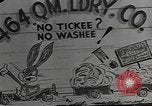
The U.S. Army Quartermaster Corps provides numerous support services to troops in the South Pacific in World War II
The U.S. Army Quartermaster Corps delivers laundry and myriad other services in the South Pacific during World War 2. Opening scene show a cartoon sign by the 464th Quartermaster Laundry Company featuring Bugs Bunny in a jeep pulling mobile laundry equipment in wagons. Next, U.S. troops are seen in jungles subject to rain and mud of the South Pacific. A soldier crouches in a riverbed and washes his clothes. A mobile laundry installed near a river. Soldiers using washers and dryers in the facility. Views of larger fixed installation Quartermaster laundry, such as in New Caledonia; Fiji; and the New Hebrides. Quartermaster salvage and repair workers operating sewing machines as they repair military clothing. A sign identifies "Island Quartermaster C&E Repair Shops" (Clothing and Equipage Repair Shops). Here workers sort, repair, and remark sizes on salvaged clothing. Two workers sit in a mound of garments that they cut into rags and toss into a heap behind them. Two workers repair broken shoes. Soldiers' feet seen walking through mud. A stack of army shoes needing repair. A team of army workers using modern machines to repair them. View of finished shoes, as good as if repaired in the U.S.A. Sign identifies Orthopedic Department where a man works on specially designed and fitted shoes prescribed for an injured soldier by a medical officer. A nurse and a doctor place the special shoe on a patient. A nurse assists the patient to walk. Typewriters needing repairs line shelves. Technicians are seen at work stations, repairing typewriters. The final sequence begins with a sign reading: "Tent Repair, Drive in here. All tents must be clean, dry, and folded properly." Quartermaster workers raise a tent inside a shelter and then identify and repair a hole in it by applying fabric glue and a patch.

U.S. Secretary of State Cordell Hull addresses the 8th International Pan-American Conference in Lima, Peru.
U.S. Secretary of State Cordell Hull leads the U.S. delegation to the 8th International Pan-American Conference in Lima, Peru. The U.S. delegation arrives in Lima by ship. The delegates are received by Peruvian dignitaries and local crowds. Secretary Hull is greeted by the Peruvian dignitaries. Other delegates disembark the ship and greet the crowd. Little Peruvian girls with flowers welcome the delegation. The Pan-American Conference venue. Flags of the participating nations. Delegates and dignitaries arrive for the Conference. The delegates seated inside. Secretary hull opens the conference with a military speech warning dictator states abroad that the U.S. is willing and able to safeguard the Western Hemisphere.

U.S. infantrymen move up on a road and dead soldiers near a wrecked recon car in Pont Bellenger, France.
Troops of U.S. 35th Infantry Division, 137th Infantry Regiment in Pont Bellenger, France during World War II. U.S. infantrymen on the road to Vire, France. A wrecked U.S. recon car. U.S. soldiers killed by a German land mine. German soldiers killed by the same mine. A dead driver and a passenger in a car.
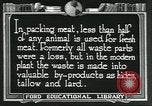
Horns, hides , tallow, blood and bones of cattle are used for making various articles in the United States.
Meat packing industry in the United States. All waste parts used to make by-products like hides, tallow and lard. Horns of cattle are used for making combs, pipes, buttons, forks and spoons. The hide is used for making leather and shoes. Candles are made of tallow. Blood used to make color. A sack of fertilizer. A pot of glue.
Supplies are being loaded onto ships in the United States and a U.S. convoy at sea; recruitment film for Merchant Marines
A World War II recruitment film bulletin 'Wanted: Men for Merchant Marine' asking men to join the United States Merchant Marines and go aboard Liberty Ships and other cargo ships supporting the United States war effort during World War 2. A World War II American ship convoy at sea. An official works in Ship Personnel Office aboard a ship. Merchant seamen board a ship. A group of engineers, seamen, radio telegraphers, cooks, bakers and mess men during a training. Supplies are loaded onto a ship. Tanks, bombs and locomotive are hoisted by a crane and loaded onto the ship. Seamen work aboard the ships. Narrator speaks of military materiel delivered by ships and a series of images of American military equipment in action in Europe during World War 2 is shown: Line of camouflage U.S. army tanks fire. U.S. Army Air Force bomber aircraft at an airfield including one with a damaged nose. U.S. Army tractor hauls a long artillery piece on war torn streets of a European city. U.S. Army tank moving by fast on a European paved roadway. A merchant ship at sea. A ship convoy at sea.
CRITICALPAST.COM: About Us | Contact Us | FAQs - How to Order | License Agreement | My Account | My Lightboxes | Shopping Cart | Advanced Search | Featured Collections | Website Terms & Conditions | Privacy Policy ©2026 CriticalPast LLC.
License Agreement |
Terms & Conditions |
Privacy Policy
©2026 CriticalPast LLC.