


 Francais
 Deutsch
 Italiano
Refine Your Search
US-Gliders- stock footage and images
- Showing 12793 to 12798 of 21917 results more
more Hide
Hide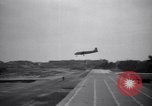
Airlift operations at Tempelhof Airfield where Germans, Americans, French and Britishers work together.
Berlin Airlift operations at Templehof Airfield during Berlin Blockade by the Soviet Union, as supplies are being brought from all over with roadways blocked by Russians. U.S. Air Force plane landing at Tempelhof Airfield in Berlin and a Berliner showing newspaper to two U.S. Air Force pilots. Crowd massed up outside a building. Pilot in flight talking into radio and airmen on ground responding. An aircraft with cargo crashes and firemen trying to put off fire. Aircraft operations going at ground and in air. Crowd walking at Tempelhof Airfield. Aircraft takes off.
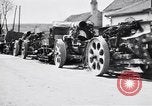
American Expeditionary Forces with captured German Big Bertha howitzers in world War I
U.S. Army holt tractors are hooked up to large wheeled trailers loaded with parts of German 42cm "Big Bertha" howitzers, captured by American Expeditionary forces (AEF) near end of World War 1. Camera pans along the line of tractors. Closeup profile of a Holt tractor with several Army mechanics working around it. Camera pans along tractors and Big Bertha carriers and parts. Camera focuses into rifled barrel of one of the howitzers. Several U.S. soldiers are seen waving to the camera, through the barrel. Several American soldiers climb upon a carrier holding one of the 42cm barrels. One soldier crawls through the barrel. Two soldiers display a 42cm shell casing for the camera. Writing on one of the captured German vehicles reads: "Ersatzbremsflussigkeit (Perglyzerin)" describing substitute brake fluid. The convoy of tractors, led by a staff car and accompanied by soldiers on motorcycles, proceed along the road to Beaune, France. (World War I; World War 1; WWI; WW1)

Red Cross workers making prosthetic masks for wounded American and French soldiers in First World War.
Red Cross workers in Paris make prosthesis masks for French and U.S. soldiers' whose faces have been disfigured during World War I. Red Cross woman makes plaster molds of the wounded men's face and wax model of the heads from the molds, for use in making prosthetic face masks following injuries such as gas attacks.

Major General John Samford's statement on 'Flying Saucers'.
Doughnut shaped piece of cloth suspended by wire. United States Air Force Chief General John Samford discusses the 'flying saucer' UFO because he says it is an obligation of the USAF to investigate anything in the air that might prove a threat to the nation. He credits others as the result of aircraft or meteorological and astronomical phenomena. He reveals that there is not a pattern or measurement for analysis. His conclusions are that they represent no threat to us. He adds that flying saucers are not the result of a secret development by U.S. agency.

United States troops move to seize German scientific documents and transfer the headquarters in Heidelberg.
Near end of World War 2, U.S. troops in Heidelberg to seize German scientific records as a part of Alsos mission. U.S. troops leave in jeeps from T Force headquarters in Mannheim and on the way to Heidelberg. Corporal Lusnia on night duty. Troops in yard of University of Heidelberg and inspect documents inside the University. Heidelberg town across the river as seen from the hill. Troops near vehicles. Houses across Neckar River. Troops prepare for the trip. The British Contingent. Men walk in streets.

Short film describing why Europeans emigrated to America around 1900
f Opening image shows handwritten letter written by an imigrant to the U.S. from Europe. Camera pans over various outdoor scenes of the United States, as voices of men and women in the background extols marvels of America. A map of Europe is shown as narrator describes the problems in European countries. A woman sowing seed by hand on a European farm. European farmers using shovels to spread something over a plot of land. A farmer walking behind a plow pulled by a single horse. An old man tells how the land they had in Europe wasn't enough to feed their family of three, So his father decided to come to America (probably in the period from 1880 to 1920).
CRITICALPAST.COM: About Us | Contact Us | FAQs - How to Order | License Agreement | My Account | My Lightboxes | Shopping Cart | Advanced Search | Featured Collections | Website Terms & Conditions | Privacy Policy ©2026 CriticalPast LLC.
License Agreement |
Terms & Conditions |
Privacy Policy
©2026 CriticalPast LLC.