


 Francais
 Deutsch
 Italiano
Refine Your Search
US-Gliders- stock footage and images
- Showing 1333 to 1338 of 21920 results more
more Hide
Hide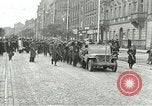
Czech partisans and U.S. soldiers round up German soldiers and civilians in Pilsen, at the end of World War II
A U.S. Army jeep rolls slowly in front of a group of civilians with their hands raised in Pilsen, Czechoslovakia, at the end of World War 2, in Europe. They are guarded by Czech partisans and Czech citizens. (The civilians are likely German civilians during expulsion of Germans from Czechoslovia at the end of the war. They may also include Czech civilians accused of collaboration with the Germans.) Two U.S. soldiers walk on sidewalk with a Czech policeman. The soldiers stand in front of a group of civilians on the sidewalk, looking upward. An elderly Czech civilian man with a rifle looks upward from edge of a building. A German officer is seen in window of a building. A white cloth (as flag of surrender) hangs from adjacent window. Armed U.S. soldiers escort high-ranking German officers, from their local headquarters, to a vehicle, as local citizens watch. U.S. soldiers and Czech partisans in a backyard, look for snipers in building nearby. German military prisoners, guarded by Czech partisans, stand with hands raised on a sidewalk. The partisans search German soldiers as they come out of a building. Some civilian women are held with the German soldiers.
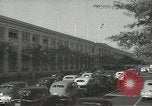
United States Secretary of Navy William Frank Knox and other officials at the U.S. Navy Department in Washington DC.
The U.S. Navy Department in Washington DC, United States. A number of vehicles drive past the U.S. Navy Department. The flag of the U.S. flutters from a pole on the building. United States Secretary of Navy William Frank Knox with U.S. Navy Admiral Harold Stark; Captain Beatty; Vice Admiral John Henry Towers and the Assistant Secretary of Navy ( Air) A. Gates. The officials discuss important issues during the meeting. William Frank Knox smokes a pipe while speaking to the group.
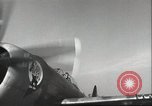
Tactics of U.S. 8th Air Force fighters for escorting bombers over Germany during World War II.
U.S.Army Air Corps P-47s with engines running, taxiing our for takeoff. Army personnel in Runway control unit with signal light.(Few seconds of film reversed.) Among the aircraft seen is P-47D, number 42-28543 named “Pat” piloted by Capt. Gordon S Stevens,of Smithfield,North Carolina, of the 63rd Fighter Squadron, 56th Fighter Group, stationed in England.(He was killed in action, 18 September 1944.) Views of the P-47s enroute to join up with B-17 bomber formations. P-51s and P-38s taking off. P-51s inflight to relieve P-47s of escort duty.US pilot with mission profile inked on back of his hand. Narrator (Ronald Reagan?) describes the way successive relays of U.S. fighters relieved each other performing bomber escort duties. Scenes from captured German film shows alarm sounding and German fighter pilots scrambling in Me-109s and FW-190s to intercept the U.S. bombers. Escorting U.S. P-51s jettison their long range drop tanks preparing to meet attacking German interceptors. Gun camera footage shows many German fighters being destroyed.P-47s, P-51s and P-38s firing their guns. Several Me-109s in formation. German gun camera clip showing many B-17s being shot to pieces by 22mm gunfire and falling, often in flames.
U.S. Army Air Forces officers confer with General Electric executives about producing America's first turbojet airplane engine
Documentary film 'The Jet Engines' about the develpment of an American jet airplane, with help of the British who provide General Electric Company with a prototype engine developed by British RAF Group Captain Frank Whittle. A B-17 aircraft taxis and takes off from the runway. Vehicles carry U.S. Air Forces officers and civilian engineers to an airfield where a man stands with a gun next to a U.S. Army Air Forces B-17 Flying Fortress aircraft. The visitors look at cargo containers being offloaded from the aircraft. They contain a prototype British Whittle turbojet engine. Scene shifts to meeting of executives of the General Electric Company with U.S. Army Air Forces officers. They look at schematic of the Whittle engine. GE officials commit to building an American turbojet engine to power U.S. Air Forces airplanes.
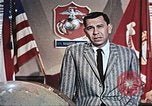
U.S. Navy and Marines coordinate planning and deployment of their joint forces in contingencies world wide.
Actor Jack Webb speaks from an office decorated with American and U.S. Marine Corps flags and other Marine symbols. With his hand on a world globe, he speaks of America's treaties and agreements with other nations in the world and the importance of the U.S. Navy/Marine Corps in supporting world peace efforts. Scene shifts to Marines on parade heading straight toward and to either side of the camera. More views from various places, of the marching marines. Next, various radar antennas are seen rotating, some on land and some on ships at sea. Two sailors are seen plotting positions of detected things with white grease pencils on a large plexiglass display. A sailor in a communications center hands a report to a Marine standing nearby. The next scene shows the Marine delivering the message to an officer in a command and control center, staffed with Navy and Marine Corps personnel. A Navy Commander stands in front of a large wall map covering the Indian Ocean and bordering land masses. He uses a pointer while briefing an audience of very high ranking officers about places in Southeast Asia, Indonesia and the Philippines. Seated in the front row are Commandant of the Marine Corps, General David M. Shoup. Beside him is Chief of Naval Operations, Admiral George W. Anderson, Jr. They both confer and decide that U.S. Marines should be deployed in this situation. Admiral Anderson questions the briefing officer.
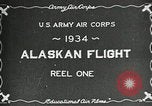
U.S. Army Air Corps airplanes and crews preparing for Alaskan Flight in 1934
Slate lists planned flight legs of U.S. Army Air Corps aircraft as: Washington DC to Edmonton, Alberta; Fairbanks Alaska to Seattle Washington; and Washington DC to San Diego California. Another slate explains that under command of Lieutenant Colonel H.H. Arnold,ten B-12 bombers demonstrate their capabilities in an 18,000 mile flight. Lt. Col Henry H. Arnold, U.S. Army Air Corps, stands in front of a large map on which planned flights are charted. Sign behind him identifies "Engineering Office," at Patterson Field. Arnold uses pointer to show the routings to another officer who has joined him. The next sequence shows Arnold describing the flight plans to more participants, using more charts. Camera pans across ten assembled Army personnel. Lt. Col. Arnold poses with 15 aviators in front of a YB-12 bomber (displaying air intake on port side of engine). Camera pans over eighteen mechanics and ground crewmen posed in front of the bomber. Symbol of eagle superimposed over map of alaska, is painted on side of forward fuselage. Arnold discussing the mission with Army officers and civilian officials, as they walk past a YB-10 (with air intakes atop the cowlings). Camera pans across Patterson field ramp, where officials, automobiles, YB-10 aircraft, and local civilian workers, including several women, are seen. Crew chief seen refueling a YB-10 with long hose from an underground fuel tank installed at edge of the ramp.
CRITICALPAST.COM: About Us | Contact Us | FAQs - How to Order | License Agreement | My Account | My Lightboxes | Shopping Cart | Advanced Search | Featured Collections | Website Terms & Conditions | Privacy Policy ©2026 CriticalPast LLC.
License Agreement |
Terms & Conditions |
Privacy Policy
©2026 CriticalPast LLC.