


 Francais
 Deutsch
 Italiano
Refine Your Search
US-Gliders- stock footage and images
- Showing 13375 to 13380 of 21917 results more
more Hide
Hide
Rock samples being extracted and placed in a box along hollow rods in New York, United States.
'The story of rock drilling ' about the various types of drills and bits used for drilling into rocks in the United States. An iron mine in northern New York. A diamond ore drill being used to explore rock samples. A man works on the drill. Men work on hollow drill rods with core along the lines of the rod. Men place the drill rods in a box in a sequence.
Workers drill holes and extract iron ore in a mine in New York, United States.
The various types of drills and bits used for drilling into rocks in the United States. An iron mine in northern New York. Men in a mine use a heavy hammer drill to dig out holes in rocks. A workers fills explosives in the holes. Fuses of the explosives being lit up. The extracted ore being transported in cars. A Corliss hoist in operation.
Workers drill with rotators to sink a shaft in a mine in Michigan, United States.
The various types of drills and bits used for drilling into rocks in the United States. A Corliss air compressor that furnishes air power for rock drilling. Men in a mine in northern Michigan as they work with rotator hammers to sink a shaft 1700 feet below the surface. Six workers drill with rotators. A worker drills into the wall and roof of the mine. An auger rotator being used to drill into a soft ore bench.
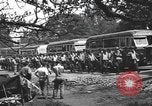
Allied forces assemble in England and depart for the invasion of Normandy in World War II
American paratroopers of the 82nd Airborne Division, boarding hired British commercial buses that take them to a marshaling point, in preparation for the invasion of Normandy, France, in World War 2. Views from below of U.S. Army Air Forces C-47 transport aircraft in formation, carrying paratroopers toward Normandy, France, on June 5, 1944. Aerial view of British and American invasion ships en route to rendezvous off the Isle of Wight. U.S. Army Air Forces B-26 and B-17 bombers in flight. B-17 dropping bombs on lines of communications in Normandy, to hinder German movements of reinforcements. Allied warships and transports beginning their move toward the coast of Normandy. British landing craft underway under cover of barrage balloons.
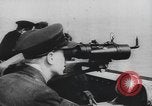
Scenes from Allied invasion of Normandy on D-Day, in World War II
Allied naval guns firing at the French coast during the invasion of Normandy on D-Day, during World War 2. Troops clamber down rope net, from their transport ship, into landing craft, headed toward Omaha beach. Rockets being fired from landing craft, LCT(R)s,above other landing craft. U.S. Army Air Forces B-26 and B-24 bombers dropping bombs on enemy targets. Allied warships firing heavy guns on inland targets. U.S. troops landing on Omaha beach, making their way through shore obstacles and suffering under heavy German gunfire that rakes the beach. Several American soldiers seen falling to German gunfire. Allied boats and rafts adrift and men being rescued by comrades. Medics assisting wounded.
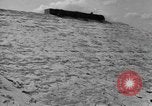
A demonstration about creating a gap in a 30 degree sloping wall with the help of bar charges in the United States.
A demonstration shows bar charges being placed and exploded against a wall in the United States. The face of a 30 degree sloping masonry wall. 24 packs of bar charges are placed on the face of the wall. An explosion occurs and smoke rises. The explosion results in an 18 feet wide gap. A U.S. Army tank passes through the gap. 24 packs of bar charges are placed at the center of the masonry wall. An explosion occurs and billows of smoke rise. A 16 feet wide gap is created and a U.S. Army tank passes through the gap.
CRITICALPAST.COM: About Us | Contact Us | FAQs - How to Order | License Agreement | My Account | My Lightboxes | Shopping Cart | Advanced Search | Featured Collections | Website Terms & Conditions | Privacy Policy ©2026 CriticalPast LLC.
License Agreement |
Terms & Conditions |
Privacy Policy
©2026 CriticalPast LLC.