


 Francais
 Deutsch
 Italiano
Refine Your Search
US-Gliders- stock footage and images
- Showing 13693 to 13698 of 21917 results more
more Hide
Hide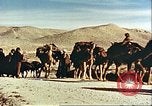
Afghans set up camps in prairies and irrigate the land with water from melting snow in mountains
A film about the life of people in Afghanistan .Film begins showing Nomads moving about in deserts of Afghanistan, some using camels and some using other heavily laden pack animals. Scene shifts to family tents set up in wide open spaces where some vestiges of greenery appear on the ground in the prairie lands of Afghanistan. View of a man standing near a tent, along with cattle and sheep. Closeup of three Nomadic men posing against blue sky background. A herd of sheep. an Afghan man and two boys plowing behind a camel. Men wielding pickaxes dig irrigation trenches in the arid river valleys. View of a castle on a hill with a snow-covered mountain in the background (that will serve as a source of water). Water seen descending in small streams from melting snow in Springtime. These are seen converging to form larger streams and rivers in the valleys below. Crude dams of cobblestones and sticks divert some water into small irrigation canals. Boys walking along the bank of a canal. A man tending to a canal. Views of trees and foliage thriving in the areas covered by water from melting snow. Flowering shrubs are seen. People walk across a graceful bridge crossing a river. A grove of evergreen trees. An elaborate flower garden. An annual festival where men carry shovels as they parade. An audience of local people watch as men exercise with weights and compete in wrestling matches.
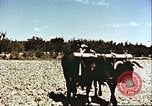
Modernization of Afghanistan transportation and housing in period 1950 to 1960.
Contrasting examples of changes in transportation and housing in Afghanistan during 1950 to 1960. Cattle draw a plow to till a piece of land in the past.. A tractor being used nowadays to till a farm. Men work on a farm with hand cultivators. Nomads migrate from an area on foot. In contrast, a truck is seen being used as a current means of transportation. Men ride on mules and in horse-drawn carts,as they move from one area to another, in the past. In contrast, a man gets into his automobile. People milling about on a street in a village. View of buildings and factories replacing former villages. Machines in operation inside a factory. New homes for factory workers.
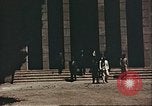
Modernization projects in Afghanistan in the 1950s and 1960s, undertaken by the .Morrison and Knutsen (M-K) Construction company
First scene shows several Afghan national leaders conversing outside a government building. Views of the Helmand and Arghandab rivers that are to be dammed as part of the Afghan modernization project. From this point much of the film is devoted to the actual construction activities of the Morrison and Knutsen (M-K) Construction company (organized for this endeavor as: Morison & Knudsen, Afghanistan, Inc aka MK-A). View of a steam shovel loading a truck. a truck passes several MK-A workers in hard hats near a river, as it moves earth from the work site. A caterpillar tractor pushes rocks into the river as part of the dam building. MK-A workers atop a bridge at the dam site. Formations of tractors work at the site using compaction rollers, alongside other grading equipment. A bulldozer with a large blade pushes a huge amount of earth. A tractor pulls a set of compaction rollers. A dynamite charge explodes breaking up rocks at the site. Construction equipment roars past donkeys carrying burdens on their backs. A succession of scenes showing heavy equipment at work, including a drag line being run from an equipment cab labeled: "Morrison and Knudsen, Afghanistan Inc." Views of a canals created by MK-A as part of the project. Crops in fields watered by a network of secondary irrigation canals (unseen). An Afghan man seen silhouetted against light sky and river illuminated by setting sun. A vast field of grain. Small mountain valley with crops watered from mountain snow melts. Afghan farmers cultivating crop by hand on the farm. Farmers eating lunch on a small irrigated farm, as another walks past them plowing with a team of oxen. A mud wall fence marking property line. Masons constructing a home using mud.
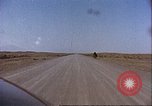
Morrison and Knudsen construction company building dams in Afghanistan
Opening scene shows view from vehicle traveling from the Pakistan border over the Spinbaldak-Kandahar highway. View from above of a yellow truck on that road and arriving at the Morrison and Knudsen (MK) construction company headquarters near Kandahar. Views of the buildings to house and otherwise provide for MK employees. View of several camels walking away from the camera in a desert area. An MK crane lifts a drag line bucket in process of laying out a canal. An old man and a young boy watch the process. View of the MK-built dam across the Helmand River that will supply canals with water for irrigation. The King of Afghanistan, Mohammad Zahir Shah, arrives with aides to inspect the project. (Narrator notes the King was present at the gate-opening of the dam in 1949.) An MK engineer converses with the King. View of water flowing for the first time into a new canal. (The water approaches a man walking in the dry canal.) Engineers converse while standing above a canal construction site. Below, teams of Afghan workers work on the canal sides. An Afghan surveyor, using a transit, to lay out the center line for a canal, waves his arms to an assistant in the distance. Closeup of man driving a stake and another holding the line that will mark the center line. Earth moving equipment being used to prepare the canal bed. Closeup of machine wheels turning. Glimpse of freshly-dug long canal
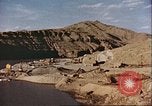
Morrison and Knudson company undertakes construction of the Kajaki Dam across the Helmand River in Kandahar Province, Afghanistan.
Opening scene shows glimpse of the construction site where Morrison-Knudsen company of Afghanistan (MKA) is building the Kajaki Dam across the Helmand River in Afghanistan. Wooden forms are already in place and Afghan workers fill them with rocks as they construct what narrator describes as "warehouse buildings and shops." Rock houses and dormitories are built to serve American supervisors and their families. An American girl and boy walk from their house. An American construction superintendent consults with an Afghan foreman. View of the Helmand River. Next, drilling crews are seen at the steep walls of the canyon placing dynamite charges. View of dynamite charges exploding along a stretch of canyon wall, and near the top of in another place. Following the blasts, men use poles to loosen large boulders. One is seen crashing down from the top of the canyon wall. View from above of a vehicle moving across a temporary bridge, built to allow work on both sides of the river. Men walking past one of two 35-foot diversion tunnels. View from the river side of the two diversion tunnels that will carry river water during dam construction. A large jutting rock in the water marks the location of a future cofferdam that will divert the river into the tunnels. Views of dump trucks discharging earth and rocks at the side of the river, and a caterpillar tractor smoothing the fill to create a cofferdam. Water surging as the river width narrows. Overview of the site as the cofferdam finally fills the gap. View of the river moving into the first diversion tunnel, followed by view from the other side, as water exits to continue the river's normal flow. High above, workers use high pressure water hoses to wash loose materials from the canyon walls. A power shovel begins digging the dam's foundation trench.
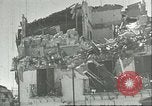
Damaged buildings in Sicily, Italy after an air raid by the 86th Fighter Bomber Group during World War II.
The role of U.S. Army Air Forces 86th Fighter Bomber Group during Allied invasion of Sicily, Italy in World War II. Damaged buildings in Sicily after an air raid by U.S. 86th Fighter Bomber Group. Rubble on the ground. A bulldozer removes rubble. A damaged church. Bells on the top of the building. Men remove rubble. A tank pulls a barrel with a chain.
CRITICALPAST.COM: About Us | Contact Us | FAQs - How to Order | License Agreement | My Account | My Lightboxes | Shopping Cart | Advanced Search | Featured Collections | Website Terms & Conditions | Privacy Policy ©2026 CriticalPast LLC.
License Agreement |
Terms & Conditions |
Privacy Policy
©2026 CriticalPast LLC.