


 Francais
 Deutsch
 Italiano
Refine Your Search
US-Gliders- stock footage and images
- Showing 13765 to 13770 of 21917 results more
more Hide
Hide
Scientists work in a nuclear reactor and animation depicts the process of bombardment to produce energy in Russia Soviet Union.
A scientific documentary film about the peaceful use of atomic energy in Russia. Scientists work on a nuclear reactor. They insert rods inside the reactor. A scientist removes the protective lid of the reactor. Animation depicts : a lattice of rods in the rector. Aluminum coated rods of metallic uranium in the reactor. A nucleus of Uranium consists of protons and neutrons. Neutron bombardment splits the nucleus releasing nuclear energy and neutrons. Initiation of a chain reaction. The rods inserted absorb the extra neutrons. A cross sectional view of the reactor shows a concrete wall around the reactor. Water to reduce the speed of the neutron and to carry heat. Turbo generators used to convert heat to electricity.
Atomic reactor for bombardment of materials and scientists handle radioactive isotopes in chambers in Russia Soviet Union.
A scientific documentary film about the peaceful use of atomic energy in Russia. Turbo generators are used to convert heat to electricity. An atomic reactor for bombardment of materials. A rod of the material to be bombarded is inserted inside the reactor. A crane lowers the lid of the reactor. Technicians leave a room. They work on the control panel. Animation depict neutrons being bombarded on the rods. Rays emitted after the bombardment. Alpha particles are stopped by a piece of paper. Electrons are stopped by a slab of glass. Gamma particles are emitted by a thick concrete slab. The rod is removed after bombardment. An operator removes the rod. The rod is placed in a man hold.
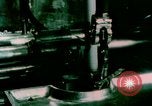
Technicians handle radioactive isotopes in special chambers and work on machines in a laboratory in Russia.
A scientific documentary about the peaceful use of atomic energy in Russia Soviet Union. An isotope is placed in a special container. A technician checks for the radioactive content on surface of the container. The container is taken to a Hot laboratory. The technician opens the door of the laboratory. The door is then closed. A technician operates manipulators and watches through a glass window. Isotopes taken out of the container. A tube is put back into the container. The technician replaces tongs. Rods are picked using the tongs. The rod is cut and shaped under water. Samples of the different shapes of rod placed on a table. A sample rod is put and then removed after refining from an apparatus. A man studies the chemical nature of the rod. A technician operates screw manipulators. Technicians in special suits work. A technician places a sample in a centrifuging machine. Different machines in the laboratory.
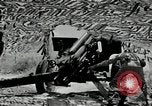
Men lay flat net and place a howitzer under the flat net to avoid enemy detection in the United States
A film about use of flat net to avoid enemy detection in the United States. Men fire artillery mounted on a tank. The tank under a flat net supported by poles. The materials used to support a flat net are poles,sticks,wire gauge,nails,pliers and hammers. A men carry material to lay net. A Non Commissioned officer indicates position of laying the frame. A man hammers nails on top of a pole and on side of the pole. Men place poles on ground. Men string wire on nails. The completed wire pattern. Men place wire on top of pole. Men place wire on edges of poles. Men hammers nails on pole. A man tests the tightness of wire. Net is placed over a wire frame. Net is fastened to the edge of the frame. A howitzer is placed under the flat net. Men break shadow of the net by placing shrubs. (World War II period).
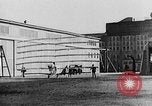
Early experimental failures in airplane development. Lawrence Sperry and his "Messenger" airplane
Film showing early history of flight with many early unsuccessful flying machines. As Igor Sikorsky speaks, in the background, about such earlier failures, the first scene shows a early 1900s seven wing airplane, with its propeller turning, being pushed by several men. Suddenly the the entire thing collapses into a heap, as the men run to safety. They quickly return to check on the occupant. Next, an experimental four-rotor helicopter is seen lifting above the ground, successfully, but not otherwise controllable. Then a contraption (labeled "Sky Car") employs a pulsating umbrella. It jumps up and down but does not accomplish anything else. A tricycle gear contraption, using an array of sails, and displaying the number, 691, moves along under power, but does not ever leave the ground. A helicopter of sorts, with several different size rotors falls sideways, as the pilot is adjusting it. He steps away to safety. Another glimpse of the "Sky Car." A wing-flapping contraption that does nothing else. Aviation pioneer, Lawrence Sperry, moves his early biplane up to a gasoline pump to refuel. He holds the fuel hose to his gas tank while another man pumps the fuel. Next, his airplane taxis along a public road, followed by a motorcyclist. The aircraft takes off. Sperry piloting his small single-place bi-plane "Messenger" aircraft, is seen flying above the U.S. Capitol dome, on March 22, 1922. Next, he lands on the Capitol Plaza and quickly turns the aircraft so it actually ascends several Capitol steps, before rolling back to park. Sperry climbs from the cockpit and is greeted by policemen and officials who surround him and congratulate him. (Sperry perished flying across the English Channel in 1924.) View of the Great Dome on Building 10 at the campus of MIT (Massachusetts Institute of Technology). Dr. Jerome Hunsaker, pioneer aeronautical engineer and educator, is seen in a laboratory. He speaks of beginning the aeronautical engineering education program at MIT in 1913, with Donald Douglas as an assistant.
Highlights in life of Henry Ford from 1863 through circa 1920
A 1950 film depicting highlights in the life of Henry Ford, the founder of the Ford Motor Company, in the United States. The Henry Ford Museum Clock Tower and Greenfield Village. Children enter the museum. Pictures of Henry Ford on a quadricycle. Henry Ford with others working in a workshop. A picture of Henry Ford and Thomas Edison with their spouses. A picture of Henry Ford sitting near a fire place. Sketches depict the Battle of Gettysburg of 1863. A dramatization : Exteriors of the house of William Ford. William Ford runs up a flight of stairs as his wife Mary Litogot Ford gives birth to Henry Ford. Scene shifts to the boy Henry Ford going out of his home to play. Young Henry Ford working with various mechanical gadgets. Henry Ford with William Ford in a horse drawn wagon. Henry Ford runs and climbs on a steam engine. He goes out from the house for work. He works in a jewelry shop. Henry Ford works in the night. A clock on a wall. Henry Ford with his quadricycle. He rides his qudricycle. Farmers work in a field. Workers use various machinery for construction. People assemble parts of Henry Ford quadricycle. Development of faster production methods using specialization. Ford Model T cars on an assembly line.
CRITICALPAST.COM: About Us | Contact Us | FAQs - How to Order | License Agreement | My Account | My Lightboxes | Shopping Cart | Advanced Search | Featured Collections | Website Terms & Conditions | Privacy Policy ©2026 CriticalPast LLC.
License Agreement |
Terms & Conditions |
Privacy Policy
©2026 CriticalPast LLC.