


 Francais
 Deutsch
 Italiano
Refine Your Search
US-Gliders- stock footage and images
- Showing 14023 to 14028 of 21917 results more
more Hide
Hide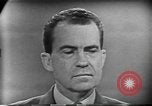
During a debate in Chicago, Illinois Nixon talks about his major recommendations which were adopted by the administration.
The first Kennedy-Nixon Presidential Debate in Chicago, Illinois. Stuart Novins from CBS News asks Republican candidate U.S. Vice President Richard M. Nixon about his major proposals in last eight years that have been adopted by the administration. Nixon answers and states that his major recommendations and proposals that have being adopted by the administration include: increase in the exchange programs like exchange of persons of leaders in the labor and information field. He further talks about his proposals like setting up of separate inter-American lending agency, his recommendations for the Hungarian refugee situation and price stability and economic growth that had been adopted. Democratic candidate Senator John F. Kennedy states his points on that question. He says that he disagrees with progress figures used by Nixon in his speech regarding the Truman Administration. He disagrees with the recommendations made by Nixon like price stability, exchange of students and labor unions being adopted by the administration.
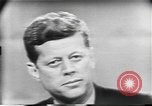
Kennedy states the reasons of failure of passing of Congress bills during a presidential election debate in Chicago, Illinois.
The first Kennedy-Nixon Presidential Debate in Chicago, Illinois. Sander Vanocur from NBC News asks Democratic candidate Senator John F Kennedy about the failure in passing the Congress bills on medical aid to the aged, minimum hourly wage bill and federal aid to education. Kennedy answers and states that his bill to provide a dollar twenty-five cent minimum wage failed because the House of Representatives did not pass it and the House failed by eleven votes. He states the reasons for the the failure of the federal aid to education bill and medical aid to aged bill in the Senate due to lack of votes and U.S. President's Veto power. Republican candidate U.S. Vice President Richard M. Nixon presents his views and disagrees with the statements made by Kennedy regarding action of the House Rules Committee and veto power of the President. He states that the majority of the members of the Congress agreement to the proposals leads to the clearance of a bill. He says that the reason for the failure of these bills was not the President but the people who were against it. He talks about his alternative proposals.
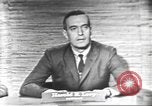
Kennedy and Nixon present their views about tax increments during a presidential election debate in Washington DC.
The second Kennedy-Nixon Presidential Debate in Washington DC, United States. Harold R. Levy of Newsday asks Democratic candidate Senator John F Kennedy about his recommendations to increase tax. Kennedy answers and states that in the present scenario tax increase is not desirable. He says that if it would be essential to U.S. security he would suggest a tax increase. He talks about his programs for economic growth, care for the aged, development of natural resources which would build the strength of the United States. He states that Americans can mobilize their economy and resources. Republican candidate U.S. Vice President Richard M Nixon comments on the increasing expenditures for defense, mutual security, economic and technical assistance. He says that he thinks it may be necessary to increase taxes to maintain a sound economy. He concludes and states that no president can add billions of dollars to his nations expenditures and not pay for it, after all the payment is made by peoples money.
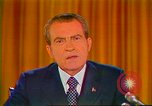
President Richard Nixon address the nation from the White House in Washington DC, United States at the end of the Vietnam War.
Television broadcast of U.S. President Richard Nixon's speech from the White House in Washington DC, United States on withdrawal of the remaining U.S. troops from Vietnam on 29th March 1973 during the Vietnam War. President Nixon speaks about the end of the Vietnam War. He speaks about differences about war which divides a nation. He talks about bringing peace and reducing the burden of armaments. He refers to nations in past which fell at the height of their wealth and strength and assures that it would not happen to the United States. He shares his experience of speaking to an American prisoner who survived in a communist prison during the Vietnam War.

President Nixon and Dr. Henry Kissinger walk towards a helicopter on the South Lawn of the White House in Washington DC.
U.S. President Richard Nixon on the South Lawn of the White House in Washington DC, United States. President Nixon and U.S. National Security Advisor Dr. Henry Kissinger walk on the South Lawn towards a helicopter. President Nixon takes two dogs on leashes from an attendant and goes into the helicopter. The helicopter lifts off.
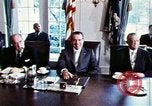
President Nixon, Attorney General Mitchell and FBI Director Hoover at the White House in Washington DC, United States.
U.S. President Richard Nixon at the White House in Washington DC, United States. President Nixon, U.S. Attorney General John N. Mitchell and Director of the Federal Bureau of Investigation John Edgar Hoover sitting at conference table in the Cabinet Room of the White House.
CRITICALPAST.COM: About Us | Contact Us | FAQs - How to Order | License Agreement | My Account | My Lightboxes | Shopping Cart | Advanced Search | Featured Collections | Website Terms & Conditions | Privacy Policy ©2026 CriticalPast LLC.
License Agreement |
Terms & Conditions |
Privacy Policy
©2026 CriticalPast LLC.