


 Francais
 Deutsch
 Italiano
Refine Your Search
US-Gliders- stock footage and images
- Showing 14053 to 14058 of 21917 results more
more Hide
Hide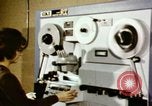
Workers get training in various automatic data processing activities at Internal Revenue Service National Computer Center.
A film discussing use of early computers for automatic data processing in tax administration at U.S. Internal Revenue Service National Computer Center. Workers operate various ADP (Automatic Data Processing) equipment. Training given to employees in various processing activities. View of a round 24 hour hand clock on a wall. Group of men executives wearing suits and discussing during a conference. Forms and punch cards being processed by computers and printers. The workers carry documents into a large room with computer equipment.
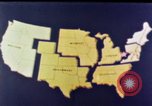
The process of tax return processing with aid of early computers at Internal Revenue Service Centers in the United States.
A film discussing automatic data processing in tax administration at U.S. Internal Revenue Service National Computer Center. Workers process the income tax returns and make use of ADP (Automatic Data Processing) machines or computers at computer service centers in the United States. The workers sort tax return papers, open packets and empty mail bags filled with tax return documents. A chart depicts the whole process of income tax return processing. Computer data tapes are stored at service centers. Examiners check essential preliminaries on tax return form like signatures, dates, address, and social security number. Information is then sent to punch cards. Female workers at equipment. It is explained how error is checked and Good Tape, Error Tape, and Error Register machines are shown. An error register equipment gives details of problems causes during the tax processing which is handled by Error Resolution Branch. Letters listing the problems encountered in processing tax information are sent to tax payer if necessary from service division. Return file is maintained. Functions of the service station involves sending of notices sent to tax papers which includes notice for due balance and notice of error. A settlement register is examined by trained personnel. Workers at various equipment in service station. It is further explained how a tax payer can avoid errors by shows the essential entries on W-2 form. Various entries including social security number are highlighted.
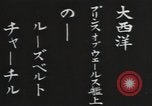
Allied leaders aboard HMS Prince of Wales underway in Placentia Bay during Atlantic Charter Conference in World War II.
A promotional documentary justifying Japanese involvement in World War II. U.S. President Franklin Roosevelt and Prime Minister of UK Winston Churchill on board HMS Prince of Wales underway in Placentia Bay, Newfoundland during Atlantic Conference, working on the Atlantic Charter. U.S. Army Chief of Staff George Marshall and other officers stand behind the leaders. President Roosevelt as he imposes embargo on oil and gasoline exports to Japan.
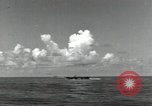
Explosions and fire on USS Princeton (CVL-23) after being bombed by Japanese plane in Leyte Gulf during World War 2
U.S. Task Force 38.3 in Leyte Gulf during Battle of Leyte in World War II. CVLs (Light Aircraft Carriers) and CVs (Fleet Aircraft Carrier) underway. USS Princeton (CVL-23) underway and burning. Japanese plane passes through flak. Princeton burns fiercely following attack by a Japanese Yokosuka D4Y 'Judy' Dive Bomber. The aircraft had dropped a bomb which struck the carrier between the elevators, crashing through the flight deck and hangar, and then exploding. U.S. Navy F6F Hellcat fighter parked on deck of carrier. Explosion on the after-deck of Princeton. Additional explosion on the USS Princeton. Japanese Zeke (Zero) dives on USS Langley (CVL-27), burns in flames, and crashes.
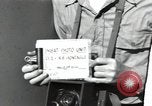
Captain C.W. Wieber talks to pilots aboard USS Essex (CV-9) of Task Force 38.3 underway during Battle of Leyte.
U.S. Task Force 38.3 in Leyte Gulf during Battle of Leyte in World War II. Captain C.W. Wieber talks to pilots aboard USS Essex (CV-9) underway. U.S. Navy F6F Hellcat fighter crash lands on flight deck of Essex. F6F approaches and lands on deck.
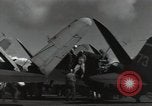
Pilot talks with his gunner on flight of a carrier of Task Force 38.3 underway during Battle of Leyte.
U.S. Task Force 38.3 in Leyte Gulf during Battle of Leyte in World War II. U.S. Navy F6F Hellcat fighters with folded wings parked on deck of carrier. Pilot talks to his gunner after strike. F6F lands on flight deck. Men wheel 2,000 lb. bomb no dolly.
CRITICALPAST.COM: About Us | Contact Us | FAQs - How to Order | License Agreement | My Account | My Lightboxes | Shopping Cart | Advanced Search | Featured Collections | Website Terms & Conditions | Privacy Policy ©2026 CriticalPast LLC.
License Agreement |
Terms & Conditions |
Privacy Policy
©2026 CriticalPast LLC.