


 Francais
 Deutsch
 Italiano
Refine Your Search
US-Gliders- stock footage and images
- Showing 14761 to 14766 of 21917 results more
more Hide
Hide
USS Mansfield engaged in Operation Sea Dragon during the Vietnam War.
The USS Mansfield (DD-728) fires a salvo, from 5-inch guns, to port at nighttime, during Operation Sea Dragon, in the Vietnam War. The firing generates a fireball and brown smoke that slowly drifts away to port. Next, are several scenes from the bridge of the Mansfield, looking down on her twin 5-inch gun turrets turned forward. These are taken as dawn gradually increases the ambient light. A sailor is seen at the Mk 37 Director position above the bridge of the Mansfield. The film ends with numerous views of a U.S. Army Cessna O-1E/L-19 observation plane making passes, at low altitude, near and above the Mansfield.
USS Mansfield (DD-728) fires her 8-inch guns in Operation Sea Dragon during the Vietnam War.
Opening scenes, photographed from the USS Mansfield (DD-728), shows a U.S. Allen M. Sumner-class destroyer bombarding the Vietnamese coast, during Operation Sea Dragon in the Vietnam War. Next, a sailor is seen looking through binoculars at the Mk 37 Director position above the bridge of the Mansfield. Closeup of the gun director. Next the Mansfield fires a salvo to port from one of her forward twin 8-inch guns. Smoke is seen above the shoreline. More views of the gun director punctuated by more salvos from the 8-inch guns. Closeup of gun barrels as they fire. Sailors on deck watching as smoke from firing drifts away. View forward from amidship, showing sailors looking over railing. A Browning .50 Caliber Machine Gun (M2) dominates foreground, where it is affixed to the ship railing. More salvos are fired from the Mansfield's forward guns. Shells strike the shore area.
Still pictures and comments about Aviation pioneers who stimulated interest in propulsion methods.
Still pictures and comments about three pioneers who stimulated international thinking about rocketry. The first shown is German, Hermann Ganswindt (1856-1934), who proposed using high explosives to propel aircraft. Next is Russian, Konstantin Eduardovich Tsiolkovsky, AKA Ziolkowsky, (1857-1935), some of whose popular writings on the possiblilities of rocket propulsion are shown. Last is a picture and comments about Austro-Hungarian Hermann J Oberth (1894-1989) who developed the first theory of the liquid rocket. A copy of his original treatise is shown and then opened to its table of contents. Another of his books,"wege zur Raumschiffahrt" (Pathways to Space Travel) published in 1929, is shown and opened to its table of contents.
Tribute to rocket pioneers. Images of German rocket researchers appear. Various types of research and applications
Tribute to rocket pioneers. Pictures of German rocket scientists appear.Research in powder and fluid rocket engines. Two men push rocket powder in a hole with a stick. Views of exploding fireworks displays and use of powder in wartime rockets and artillery shells and munitions. Photo-rocket and signal rocket. Two men in a field put a signal rocket in a launch tube. The end of rocket is tied to a fuse cord that remains outside the tube. The fuse is ignited and the rocket launches. It rises up and releases signal smoke. Men wearing safety jackets arrange a rocket on hillside. A line is tied on a rocket. A ship in distress. The rocket is fired. It rises up with the line and reaches the ship. Rope line released from a roll.

Montage of pictures related to early liquid rocket development in Germany.
Serious work on rocket development in Germany. Engineer at work. A small rocket test. Sketches for high altitude rocket motor. Sketch and model of high altitude liquid fuel rocket like that envisioned by theorist Hermann Oberth. Rudolf Nebel and Werner von Braun, members of the Space Travel Club (Verein für Raumschiffahrt) in 1928. They carry rockets over their shoulders at the Raketenflugplatz (Rocket launch facility) used by the club in Berlin-Reinickendorf. Launch stand for the Oberth high altitude rocket. Man placing rocket on the stand. Picture of a rocket descending by parachute.
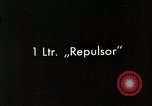
Hermann Oberth conducts burn test of rocket engine fueled with ethyl alcohol and liquid oxygen
Hermann Oberth performing a burn test on an Oxygen-alcohol fueled "Repulsor" rocket motor. Diagram of the 1 liter "Repulsor"motor and view of the actual motor, with electrodes atop it. The rocke motor on the ground. Hermann Oberth standing near an air-cooled rocket motor. External view of a combustion chamber of light metal, for 25kg of thrust. A view of interior is superimposed on it. A cutaway model is held in man's hand. He shows paths of fuel flow to combustion chamber and exhaust port. Hermann Oberth with his hand on the the actual rocket engine, as they prepare to fuel it with ethyl alcohol and liquid oxygen, at the Berlin Rocket field, in April 1932. The fuel cylinders are seen and vapors rise as they fuel the motor.. Using his hand, Oberth traces the paths of the oxygen and alcohol into the motor body, and the combustion exhaust path. The team steps back as Oberth pours alcohol into one side of the motor. The team steps back quickly and climbs stairs up a hill overlooking the test stand, where several other people await them. At the control site, they close the ignition circuit to the motor. Fumes flow down and flames flare up, but the rocket sustains a controlled burn fairly well, in spite of occasional flareups, and creates sustained thrust measured by the apparatus surrounding the test stand.
CRITICALPAST.COM: About Us | Contact Us | FAQs - How to Order | License Agreement | My Account | My Lightboxes | Shopping Cart | Advanced Search | Featured Collections | Website Terms & Conditions | Privacy Policy ©2026 CriticalPast LLC.
License Agreement |
Terms & Conditions |
Privacy Policy
©2026 CriticalPast LLC.