


 Francais
 Deutsch
 Italiano
Refine Your Search
US-Gliders- stock footage and images
- Showing 1507 to 1512 of 21920 results more
more Hide
Hide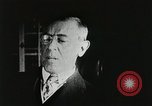
U.S. President Woodrow Wilson seated during an interview
U.S. President Woodrow Wilson in the United States during World War I. President Wilson seated in his office, talking. An map is shown with smoke rising from parts of the land masses. An overlay of a U.S. flag then is superimposed over the map. A U.S. military flag symbol with an eagle atop.
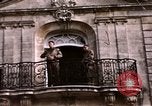
U.S. Army officers and war correspondents at the bombed, abandoned French Chateau de Pont-Rilly during World War II after D-Day
Uniformed U.S. war correspondents and U.S. Army officers explore the house and grounds of the French Chateau de Pont-Rilly, in Négreville near Normandy France, soon after the Invasion of Europe. (The chateau was designed in 1765 by architect Pierre-Raphaël de Lozon for the Marquis d'Ourville). U.S. Army officers in the balcony of the mansion overlooking the entrance. Exteriors of the palatial chateau. A large bomb hole is visible in the roof, right of the main entrance. A French boy points out something distant on the grounds of the Chateau. A swan in a pond. Exteriors of the mansion. At the end of July 1944, near the time this footage was shot, the chateau became the headquarters of Advance Section of Com Z, also known as "ADSEC" (Advance Section, Communications Zone).
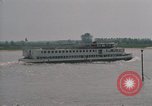
American correspondents visit cemetery in Opijnen, Gelderland, the Netherlands for Memorial Day ceremony honoring U.S. B-17 crew
American correspondents in Netherlands to mark 25th anniversary of Allied invasion of Europe in World War II. A steamer underway in a canal. Views in the village of Opijnen, in Gelderland, the Netherlands. A correspondent and his wife come out of a house. American correspondents near a bus. Houses along a road. An American flag at the walled cemetery in Opijnen, beside its 17th century Dutch Reformed Church, where the crew members of an American B-17 bomber from the 323 Squadron of the 91st Bomb Group (H) of the U.S. 8th Army Air Force are buried; shot down July 30, 1943 by the German Luftwaffe. Gravestones bearing the names of American soldiers who lost their lives when their crippled B-17 was shot down, including: Mike Anthony Perrotta, Hermon Daines Poling, Harold Royce Sparks, Robert Urquhart Duggan, Douglas Victor Blackwood, Americo Cianfichi. U.S. Color Guard marches from a town building toward the cemetery. A woman correspondent takes pictures. An American flag flies at half mast. Men, women and children at the cemetery. Dutch children carry flowers in their hands. The mayor of Opijnen speaks into a microphone. He and a woman place flowered wreaths at the graves of dead American soldiers. Two groups of four U.S. Convair F-102 Delta Dagger aircraft fly overhead followed by four F-104 Starfighters of the Royal Netherlands Airforce. Children walk past the graves. Additional propeller aircraft pass overhead honoring the airmen.

Officer Young explains the use of Dits and Dahs for phonetic alphabets.
Officer Young explains the sound of three beat letters on screen. He explains the use of Morse Code Dits and Dahs for phonetic alphabets Seirra Oscar Seirra (SOS). He further talks about the use of Dits and Dahs for Phonetic alphabets India(I),Mike(M),Echo(E),Tango(T). An Army operator demonstrates use of Dits and Dahs for phonetic alphabet Yankee(Y),Charlie(C),Juliet(J),Romeo(R) through steps. Officer Young explains the pattern of phonetic alphabets Lima Oscor Water(LOW).
U.S. Secretary of War, Dwight F. Davis visits military facilities in Honolulu, Hawaii.
Alice Davis, daughter of U.S. Secretary of War, Dwight F. Davis, together with Mr. John H. Holliday, his civilian aide, step from a launch bringing them from the USS Pennslyvania, to a dock at Honolulu, Hawaii. They are greeted by two Army officers and a Naval officer. An Army band plays on the dock, in the background. They are joined by Secretary Davis. In change of scene, the camera pans across the parade ground of Fort Shafter, where troops of the 64th Coast Artillery Regiment(AA) are seen marching in formation. Secretary Davis stands with Army officers reviewing the troops. Next, Secretary Davis is seen on steps of the U.S. Army tripler General Hospital, following a visit there. He is accompanied to his car. Scene shifts to the quarters of Major General Fox conner, Commander of the U.S. Army Hawaiian Department. The staff car carrying Secretary Davis drives into Honolulu, where offices of Goodyear International, and Royal Hawaiian Sales Company, Ltd. are seen along the street. The car parks, and Davis's military aide, 1st Lieutenant Lester J. Maitland, opens the door for a rear admiral, and Secretary Davis, who step from the car. Davis is dressed formally in top hat. (Slate indicates they are visiting opening ceremonies for the new Army and Navy YMCA in Honolulu.)
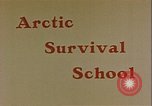
U.S. Air Force personnel undergo Arctic Survival School training in Labrador, Newfoundland Canada.
U.S. Air Force Arctic Survival School training and practice at Goose Air Base in Labrador, Newfoundland, Canada (near Goose Bay). Shows an aerial view of SOS stamped out in snow. Survival class instructor points out to cold weather gear that includes gloves, coat,socks and boots. He demonstrates construction of shelters, animal snares and traps with the help of model. Students strap on necessary equipment and get into snowshoes. U.S. Air Force personnel go into field for survival training. They construct parachute tent, fell trees to be used for firewood, Air Force personnel ice fishing with weighted net. They build fire signals and stamp SOS on snow covered open field.
CRITICALPAST.COM: About Us | Contact Us | FAQs - How to Order | License Agreement | My Account | My Lightboxes | Shopping Cart | Advanced Search | Featured Collections | Website Terms & Conditions | Privacy Policy ©2026 CriticalPast LLC.
License Agreement |
Terms & Conditions |
Privacy Policy
©2026 CriticalPast LLC.