


 Francais
 Deutsch
 Italiano
Refine Your Search
US-Gliders- stock footage and images
- Showing 15313 to 15318 of 21917 results more
more Hide
Hide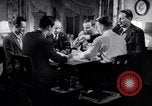
British factory worker and his American counterpart on an international exchange visit to the Lockheed aircraft plant in Los Angeles (WW2)
A British guest on labor exchange program visit to the U.S. is staying as a house guest of his counterpart American in Los Angeles, California. We see him with several friends of his host, who also work at the Lockheed aircraft plant. They are teaching him the card game of poker. The leave to attend a meeting of District Lodge 727, International Association of Machinists and Aerospace Workers, AFL-CIO (Lockheed-California Company). There the British guest is allowed to ask questions of the union. He and his American counterpart are seen at a podium as the Briton asks about the strength of the union inside the Lockheed plant. The local union Secretary responds that they have 45 thousand members in the Lockheed plant and, noting that the British man was a shop steward back in England, mentioned that the local also had 3000 shop stewards in the Lockheed factory. The British visitor asked how the union would be affected after the war, when labor requirements would be reduced. A member answers that the first action would be to return to a 40 hour work week (from the wartime 50 hour week). He states that some workers would return to pre-war work and jobs. Finally, he says they expect Lockheed to expand the scope of its manufacturing to include consumer goods. The union is asked about accommodating workers returning from the military and answers that it is covered in the union contract, which calls for their seniority to continue to accrue while in service. The union also provides for war injured handicapped workers to return to work, and sponsored legislation to provide post-service education opportunities for all returning veterans. Asked about women now employed in the plants, one woman union member stated that many would return to their homes. But the immediate need is to employ more women to the help the Allied forces win World War II as soon as possible. Regarding the prospect of post-war employment, one union member noted the national need to convert from wartime production to the manufacture of consumer goods. The union members favored the idea of continuing labor union exchange visits between the Allied countries in the future.
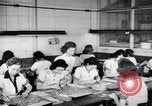
Blind, deaf, disabled and old American workers assisting in the war production effort in Dayton, Ohio, during World War II
Disabled and elderly war production workers contributing to the labor force during World War 2, in Dayton Ohio. Opening scene shows a woman supervisor observing deaf mute women in a lens factory, cleaning segments of bifocal lenses. Closeup of supervisor and one worker communicating by American sign language. A blind man in a shop, using a snap gauge to check finished parts for conformity. A man on crutches taking his place on a war production line. Older men in the shipping department of a factory, packaging and sealing boxes labeled, "Delicate instruments. Handle with care." and placing them on a dolly. Women can be seen at work in another part of the plant. Members of the Dayton Junior Association of Commerce, lined up applying for part-time employment of 4 hours a day, to help the war effort. Students leaving a High School building. (Narrator states schedules were re-arranged for students who would take part-time jobs.)
Husky dogs during polar expedition in Antarctica.
Relates to the U.S. Antarctic expedition,Operation High Jump. Aerial shot of the Antarctic seals in Antarctica. Husky dogs bark at a seal. Husky sledge is being prepared. Husky puppies fight for food.
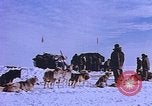
LVTs (landing vehicle tracked) hauling supply sledges move along the icy surface of Antarctica.
Relates to the U.S. Antarctic expedition,Operation High Jump. Two LVTs (landing vehicle tracked) hauling supply sledges move along the icy surface of Antarctica. American flags mounted on them. A DC-3's landing gear wheels are replaced with snow skis to adapt its landing. Oil is pumped into the plane through special pumps. Plane takes off.
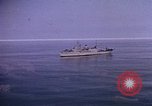
Admiral Richard E. Byrd makes a photographic survey of Antarctica in his plane.
Relates to the U.S. Antarctic expedition,Operation High Jump. Show USS Pine Island (AV-12) and its crew. A PBM-5 Mariner takes off to map the Phantom coast in Antarctica. Shows Admiral Richard E. Byrd's plane in flight above Antarctica. Photographic survey of Antarctica is made. Valuable data is recorded. Byrd's plane falls short of fuel and loses altitude rapidly. Altitude meter shows a rapid drop in the altitude. Extra weight is dumped from the plane. Byrd's plane manages to land successfully.
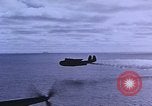
Search and rescue mission for PBM Mariner George I, in Antarctica during Operation High Jump
Relates to the U.S. Antarctic expedition,Operation High Jump in 1946. Reconnaissance aircraft take off for a search and rescue mission in Antarctica. Crew members of a PMB-5 Mariner aircraft fly above the Antarctica in search of a crashed airplane crew - the crew of the Mariner George 1. The missing crew is located on Thurston Island after 13 days by Commander Howell, supplies are dropped for the survivors and they are rescued finally. Aerial scenes of the crew discovered and the names of the dead painted by the survivors on the plane wing. Three did not survive: Max Lopez, Bud Hendersin, Fred Williams. Captain George Dufek welcomes the survivors. Survivors Captain Caldwell, Moore, Robbins, Kearns, McCarthy, eating their food (not including seriously injured "Frenchie" LeBlanc). Coastguard icebreaker arrives. Supplies and equipment are loaded back on the ships. Admiral Richard E. Byrd is seen. Animated map shows the statistics of Operation High Jump.
CRITICALPAST.COM: About Us | Contact Us | FAQs - How to Order | License Agreement | My Account | My Lightboxes | Shopping Cart | Advanced Search | Featured Collections | Website Terms & Conditions | Privacy Policy ©2026 CriticalPast LLC.
License Agreement |
Terms & Conditions |
Privacy Policy
©2026 CriticalPast LLC.