


 Francais
 Deutsch
 Italiano
Refine Your Search
US-Gliders- stock footage and images
- Showing 15535 to 15540 of 21917 results more
more Hide
Hide
Steel wire and barbed wire production in the United States (WW2)
Steel production for war materiel in the United States during World War II. Worker in factory with open tilting windows. Coil of steel rod suspended by crane. Worker feeds end of steel rod into reducing die, through which it is pulled by machine power. Worker uses gauge to check diameter of emerging steel. Steel being pulled and wound as wire in spools. Barbed wire being made by a machine that twists pointed lengths of steel wire on another wire passing through the machine.
Fabrication of seamless steel tubing during WWII
By means of special machines in a steel mill, a hot billet of solid steel is pierced and transformed into a seamless tube. Rolling reduces the thickness of the wall of the tube and increases its Length. Operator is seen as the tube is run through a reeling mill to make the wall thickness uniform.and round up the tube. View of tubing being cold drawn by machine to improve its surface,consistency and strength. Other steel products like sheets, rails strips etc are manufactured with the help of specialized equipment. People inspect the machines. Tin sheets are ready to be used.
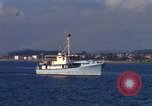
Eighty foot Research ship, Acona, operated by the Oregon State University, engaged in oceanographic research
Oregon State University (OSU) Department of Oceanography's 80-foot research vessel, R/V Acona, seen in waters off Newport, Oregon, United States. Using a boom on the foredeck, the crew lowers a container, takes a water sample and retrieves it. (Note: Reportedly, one of the two persons seen near the end of the footage may be Hugh Dobson, a technician from BC Canada, who worked for OSU Professor Kilho Park.) One of the two persons near the end of the footage looks like Hugh Dobson who was a technician from BC Canada who came to OSU to work for Professor Kilho Park (this insert provided by Iver Duedall, OSU graduate student 1963-66; spent time on Acona on cruises--most of the time I was seasick)
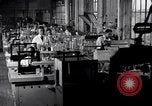
Scenes of laboratory in Ford Steel Plant. Chemical and metallurgical specialists at work
Numerous specialists, in lab coats, seen at work stations in large chemistry laboratory at Ford Steel plant. Glassware, balances, ovens, reagents, and other typical laboratory equipment is seen. One chemist seen heating erlenmeyer flask on ring stand over bunsen burner, under a hood. Natural light and tilting windows for ventilation. Metallurgist uses machine for testing strength of steel samples.
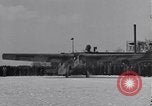
Ford-Stout 2-AT "Maiden Dearborn" carries Air Mail from snow-covered Ford Airport, Dearborn Michigan
Large group of spectators gathers at Ford airport, Dearborn, Michigan. A Ford-Stout 2-AT passenger and mail transport aircraft ,one of several having the name, "Maiden Dearborn" , which is written on its tail along with: "Ford Airport of Michigan." The Ford logo is painted on its fuselage, as is "U.S. Mail." The field is snow covered. Aircraft taxis out with"assistance" from well-meaning spectators who push on the empennage as the plane moves. The airplane taxis to end of field and takes off.
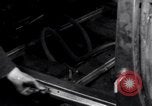
Manufacturing of automobile chassis.
Auto worker in Ford plant inserts rivet slugs into holes in part and secures them with pneumatic gun. Another worker, using wrenches. fastens bolts and nuts on auto parts. Two men work on a heavy press, forming sheet metal into auto parts. One places the unformed metal in from behind the machine, and the other removes finished piece from the front of press. The press is driven up and down by oscillating arms.
CRITICALPAST.COM: About Us | Contact Us | FAQs - How to Order | License Agreement | My Account | My Lightboxes | Shopping Cart | Advanced Search | Featured Collections | Website Terms & Conditions | Privacy Policy ©2026 CriticalPast LLC.
License Agreement |
Terms & Conditions |
Privacy Policy
©2026 CriticalPast LLC.