


 Francais
 Deutsch
 Italiano
Refine Your Search
US-Gliders- stock footage and images
- Showing 15625 to 15630 of 21917 results more
more Hide
Hide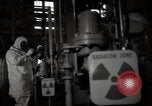
Technicians wearing protective suit work in radiation zone at Hanford Camp in Richland, Washington.
Activities of the Atomic Energy Commission at Hanford Camp in Richland, Washington. A technician wearing protective gear takes a reading from a gauge in radiation zone. He moves the valve of the gauge. A sign on a door reads 'Radiation Zone'. The technician opens the door to leave the area. He is met by Health Physics technician who uses scanning equipment to measure radiation on him after he removes his protective clothing and places it in a box. The protective gear reads 'SWP' (Special Work Permit). He then proceeds to a step-off pad where he removes his boots and respirator which are also boxed up, as contaminated.
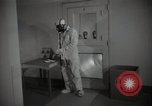
A technician works within a protective tunnel in a radiation contaminated area at Hanford Camp in Richland, Washington.
Activities of the Atomic Energy Commission at Hanford Camp in Richland, Washington. A technician in suit puts on foot protection and cap. He wears a respirator mask. He enters an inflated plastic tunnel in a laboratory. The tunnel is inflated and collapsed several times to demonstrate how it works. The technician crawls inside the tunnel. The back of his protective gear reads 'SWP' (Special Work Permit). He reaches the man-shaped end of the inflated plastic tunnel and stands. He is able to see clearly and works in the laboratory. He crawls back out of the plastic tunnel and is monitored for radiation by a health physics technician using a hand-held radiation detector and measurement device.
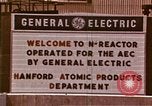
General Electric members work on a N-Reactor and John Fitzgerald Kennedy earlier speech in Richland, Washington.
Activities of the Atomic Energy Commission on the Hanford Project in Richland, Washington. A sign reads 'Welcome to N-Reactor Operated For The AEC By General Electric. Hanford Atomic Products Department'. General Electric members work in a communication room during the production of plutonium for any war and for the production of steam in 1959. Men speak over microphones. A man speaks into a telephone and moves towards a set of communication system. He presses a switch to raise an alarm. Many switches, dials, levers, blinking lights seen in the control room. In 1963 U.S. President John F Kennedy arrives at the Hanford nuclear power plant site to break ground for the construction of the nuclear power plant. He disembarks from a helicopter. He gives a speech. Other officials sit at the back on chairs and listen. People gathered in the front clap. An aerial view of the power plant. Interiors of the plant communication room and a generation area. Workers work in the plant. An aerial view of the nuclear power plant and the dual reactor facility. Electrical towers for electricity supply to homes and factories in the region.
Scientists protected by thick protective glasses study radioactive materials at Hanford site in Richland, Washington.
Activities of the Atomic Energy Commission on the Hanford Project in Richland, Washington. An animation depicts that a satellite can be run by the heat from the decay of a few pounds of plutonium. Scientists protected by thick protective glasses study the radioactive materials by remote control devices. A scientist stands near an impact forge. A scientist picks up a piece of plutonium using tongs. The piece of plutonium is placed on the forge. Hands of the scientist on the control of a the machine. Plutonium is pressed to a high density. A plutonium recycle test reactor. A scientist pours a powdered fuel. Scientists work on different machines for compacting uranium and plutonium into fuel elements by ultra sound waves.
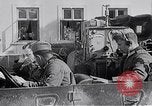
The invasion and siege of Warsaw, Poland by German forces during World War II
The German viewpoint of events during the Polish Campaign in Warsaw, Poland, during World War 2. Ostensibly to spare Warsaw from destruction, German radio operator soldiers wearing headphones, in a mobile communications center, issue an ultimatum from the German High Command, to the Commander of the city of Warsaw, demanding capitulation of defending forces within 12 hours. A German Junkers Ju-52 trimotor transport aircraft parked at a small airport. The aircraft takes off (to disperse handbills with this message.) A German Dornier DO-17 bomber takes off. Next, a German checkpoint is seen clogged with vehicles amd persons attempting to leave the city. Narrator states that only 870 members of the Diplomatic Corps and 1200 foreigners elected to leave. They are seen departing along a road set aside for that purpose by the German High Command. German officers supervise their departure. One, carrying Japanese envoys or diplomatic delegation, bears a large Japanese flag on its roof. Next, the siege of Warsaw begins, with German gunners loading and firing a 305mm siege mortar. They take refuge in a trench behind the weapon when it fires. Other German field artillery firing, including a 75mm field piece, a 15 cm sfh18 german heavy field howitzer and others not seen. German gunners using periscopic range finding equipment and looking through binoculars to direct artillery. A freight train hit by gunfire. More German 15cm sFH 18 guns firing. German troops watching the artillery barrages from a trench. Smoke rising in distance. More sfh18s firing. Smoke clouds forming above the city. Adolf Hitler observing the artillery siege through periscopic binoculars. Tops of the heads of his officer entourage (their uniform caps) as they crowd around Hitler. More smoke rising as the artillery barrages continue. Adolf Hitler holding binoculars as he stands in the company of army officers. He, and they, look up at sound of aircraft overhead. View of Ju-87 Stuka dive bombers low overhead. Aerial view of smoke on ground and formed into billowing clouds above the city. View from cockpit of observation plane, of smoke rising from Warsaw citadel.
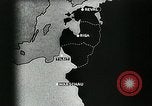
German units repulse attack of Soviet Offensive in Latvia, Estonia, during World War II on Eastern Front.
German forces repulse attack during Soviet Riga Offensive Operation in Latvia, Estonia, in World War 2. A map shows German-Soviet front around city of Riga, on Eastern Front.. German units repulse a Soviet attack, using artillery, Nebelwerfer rockets, tank destroyers and infantry with Panzerfaust antitank weapons. Medium shot of soldier firing Panzerfaust anti-tank weapon.
CRITICALPAST.COM: About Us | Contact Us | FAQs - How to Order | License Agreement | My Account | My Lightboxes | Shopping Cart | Advanced Search | Featured Collections | Website Terms & Conditions | Privacy Policy ©2026 CriticalPast LLC.
License Agreement |
Terms & Conditions |
Privacy Policy
©2026 CriticalPast LLC.