


 Francais
 Deutsch
 Italiano
Refine Your Search
US-Gliders- stock footage and images
- Showing 15895 to 15900 of 21917 results more
more Hide
Hide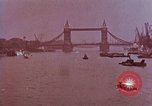
President and Mrs. John F. Kennedy visit London on the way back from Paris and Vienna, in 1961
Views of London Bridge and the Houses of Parliament in London, England. Closeup of Big Ben. Views of St. Paul's Cathedral, Trafalgar Square and Nelson's Column. Scene shifts to Royal Navy band, playing at London Heathrow airport, as the United States President's airplane, Air Force One, arrives. President John F. Kennedy and Mrs. Jacqueline Kennedy step from their aircraft and are greeted by The Lord Chamberlain, Roger Lumley, 11th Earl of Scarbrough, representing Queen Elizabeth II and by Prime Minister Harold Macmillan. The party walks on a red carpet and pauses for a salute from the Navy band. Lady Dorothy Macmillan and Mrs. Jacqueline Kennedy stand together next to the President's airplane, during these ceremonies. View of Admiralty House (temporary residence of the Prime Minister, due to renovation at 10 Downing Street). President Kennedy and Prime Minister Macmillan walk to the President's car following their consultations. President Kennedy and Mrs. Kennedy say their good-byes. Britons cheer as the car drives away. A new sequence shows guards parading during the Changing of the Guard at Buckingham Palace. Police strain to hold back crowds of spectators during arrival of President and Mrs. Kennedy, on June 5, 1961. But some manage to break through and approach closer as their car arrives, bringing the Kennedys for a private dinner with Queen Elizabeth II and Prince Philip, the Duke of Edinburgh. The next scenes show President Kennedy still in formal attire, from the Royal dinner, escorted to his airplane by Prime Minister Macmillan. U.S. Ambassador to the Court of St. James, David Bruce, is the last to shake hands with the President as he ascends the steps to Air Force One, which then taxis out for takeoff, at midnight. Scene shifts to the White House in Washington, DC, and President Kennedy's broadcast report on June 6th to the Nation about his trip.
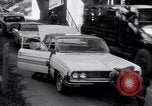
Soldiers search cars during Mississippi riots (Ole Miss riots of 1962).
Soldiers search private cars entering University of Mississippi, or Ole Miss, college campus during the Mississippi riots of segregationists against education integration during the civil rights movement. A military truck passing. A soldier talks. Civilian in a car. Board reads 'U.S. Army'.
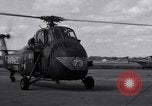
Troops rest in hangar during Mississippi riots.
U.S. Marines helicopter. Troops resting in hangar during Mississippi riots in Oxford, Mississippi. Soldiers drill going on and a supervisor keeps eye on them. (These are forces called in for Ole Miss riot response to segregationists against education integration during the civil rights movement.)
Activities of anti-Batista revolutionaries, including Fidel Castro and Che Guevera, in Cuba
Cuban President Fulgenci Batista greets visiting officials as they enter the Presidential Palace in Havana. Armed soldiers guard the entrance way and an antiaircraft gun is seen on the sidewalk. Street scenes of armed conflict March 13, 1957, as a group of university students storms the Presidential Palace intent on executing dictator Fulgencio Batista. People scurrying for cover as armed police engage the attackers on downtown streets. Police armored personnel carrier sits in the street. A truck full of armed police reinforcements arrives. Ambulance drives on street. A policeman carries a wounded woman. Bullet holes in windows. A person killed in the conflict. Scene shifts to a rural area where a jeep drives along a dirt road past a revolutionary sentry. Several revolutionaries from Venuezela and other Latin American countries are seen along with Cubans, in the company of Fidel Castro, who converses with them. On July 30, 1957, a funeral is held in Santiago de Cuba, for revolutionary, Frank Pais, assassinated by police. People crowd the street as his coffin is carried out of the church.They shout "venganza," (revenge). Elsewhere, police stand over the bodies of killed revolutionaries. Scenes of people meeting and grieving. Revolutionaries in the bush country of Oriente province. They ride horses. Che Guevara seen with them working with arms and explosives. Burning building and damage resulting from attacks by Batista forces. Castro with revolutionaries organizing in Oriente. Che Guevera instructing in use of arms and explosives. Revolutionaries unleashing heavy gunfire at Bastista forces. A revolutionaries hospital treating a wounded member. Open fire fights between Bastista forces and Castro revolutionaries.
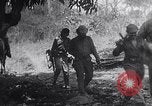
Castro revolutionaries make concerted assault against Batista's Federal forces in Cuba
Revolutionaries moving through the mountains during Cuban revolution. Buildings bombed and burned by Batista forces. Armed soldiers in defensive positions atop the Presidential Palace in Havana. President Fulgenci Batista with others. Cuban General Staff Chief, Francisco Tabernilla Dolz and a Lieutenant General discussing defense matters. Cuban soldiers on tanks. Castro addresses guerrillas. Che Guevera working with rebels in the mountains. They assemble and test rifle-launched grenades. Fire fights between revolutionaries and the Batista forces. The Cuban Army Air Force (FAEC--Fuerza Aérea Ejército de Cuba) attacks using P-47 aircraft, seen firing at revolutionaries on the ground. Rebels firing heavy machine guns, rifles, and rifle grenades. Castro's revolutionaries, under the leadership of Ernesto “Ché” Guevara, engage Federal troops at Santa Clara. They are seen taking prisoners and in the city itself. A building sign reads: "Seccion Policia Nacional Vigilante Hidalgo." An FAEC B-26 bomber is seen low overhead. Rebels fire at it with small arms from a truck moving along the street. FAEC B-26s engaged in nighttime support missions with Batista forces (commencing November 10, 1958). B-26s dropping bombs. P-47 aircraft are also seen. Bombs exploding. Civilian women and children seeking escape from the bombing. Wounded revolutionaries being treated in a hospital. Armed women revolutionaries. Rebel forces eating a meal. Che Guevara being greeted as he walks amongst civilians in the city. Revolutionaries stand atop a building waving their flag. A woman holds an injured child. A cross is erected in a cemetery. Fidel Castro with some of his followers talking to a captured Federal officer
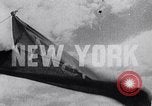
Fidel Castro visits New York City. Castro revolutionary firing squads execute Batista officials
Fidel Castro visits New York City, April 15, 1959, and gives a speech to large crowd in New York's Central Park. Back in Cuba, revolutionaries show officials and members of the press, a prison cell and injuries suffered by a former prisoner. They display instruments of torture used by the Batista regime. Colonel Cornelio Rojas, Chief of Police in Santa Clara, is seen in jail cell. He is walked under guard by revolutionaries and stands against a wall before a firing squad who execute him on orders of Ernesto "Che" Guevara. Revolutionaries bringing charges against Batista officials. People testify against them. Accused Lieutenant Enrique Despaigne Noret appears before a judgment panel. He is later seen, handcuffed, stepping from a vehicle at San Juan Hill,Santiago de Cuba, January 12, 1959. He stands before a firing squad and is allowed to write something on a paper. He is then shot and falls into a ditch or grave behind him.
CRITICALPAST.COM: About Us | Contact Us | FAQs - How to Order | License Agreement | My Account | My Lightboxes | Shopping Cart | Advanced Search | Featured Collections | Website Terms & Conditions | Privacy Policy ©2026 CriticalPast LLC.
License Agreement |
Terms & Conditions |
Privacy Policy
©2026 CriticalPast LLC.