


 Francais
 Deutsch
 Italiano
Refine Your Search
US-Gliders- stock footage and images
- Showing 16345 to 16350 of 21917 results more
more Hide
Hide
Allied soldiers rescued from invasion boats sunk on D-Day are brought to England during World War II
The HMS Nightingale, a British Mining Tender, flying the Royal Naval Ensign, approaches a pier in Plymouth England. Several Royal Navy officers and sailors are aboard along with a number of Allied soldiers who were rescued after their ships were sunk during the D-Day invasion of Normandy. Most of the rescued soldiers appear relatively unhurt. However, some are ambulatory wounded and others, more seriously injured, are carried off the boat on stretchers, by British sailors. All proceed up a gangway to a processing center. (Note:The soldier seen at 2 minute mark, fiddling with his gloves, is Private 1st class Paul Knor of E company, U.S. 2nd Ranger Battalion, whose boat was sunk while headed for Pointe Du Hoc. He rejoined his Battalion, soon afterwards.)
Logistic operations on Omaha Beach, Normandy, France,during World War 2
Wreckage of U.S. landing craft USS LCI(L)-497 in water's edge at invasion beachhead in Normandy, France. Logistic operations are underway, following the June 6th Allied invasion in World War II. A barrage balloon flies above a hill overlooking Omaha beach. At left edge of frame, the end of a Rhino Ferry is seen with one of its engines and screw (propeller) touching the sand. On the beach are two large white markers on poles, to guide arriving craft. A path (draw) upward and through the hill is seen in the background. In fading light, military equipment is silhouetted atop the hill. Soldiers walk along the beach. Closeup of some damage on hull, and then camera shows entire beached Landing Craft Infantry LCI(L) number 497, appearing otherwise, intact. The LCI had hit a mine during troop unloading operations on June 6, 1944. Views across the wide drained sand beach, at very low tide. Three army trucks backed up to a beached Rhino Ferry, are being loaded with supplies, by soldiers who slide them down from the barge on wooden planks. Closeup of the unloading/loading operations.
American infantrymen advance through jungle in Bougainville, Solomon Islands
American infantrymen scramble throught jungle in Bougainvilie, Solomon Islands. One soldier fires a flame thrower, which produces a large fireball that burns portions of the underbrush. American troops advance cautiously, in crouched positions.Smoke partially obscures the scene, as they employ more flame throwers. Riflemen watch carefully for emerging Japanese soldiers after flame throwers are used. (World War II period).
Tracking and radar telemetry preparations for NASA project Mercury orbital flights
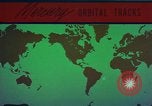
Animated map showing planned orbital flight paths planned for Project Mercury and associated telemetry and radar tracking installations worldwide. Chart notes some sites operated by the U.S. Air Force Air Research and Development Command (ARDC). Views of telemetry and radar tracking installation at Mercury network station 17, located at site A-20, Eglin AFB. Operator at control console setting azimuth and elevation controls of the Active Acquisition Aid (AGAVE). (This device is designed to receive the spacecraft telemetering signals and automatically track it, in angle, with sufficient accuracy so the radar can lock on to the spacecraft.) The Aquisition Aid quad helix antenna is seen rotating.
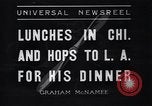
Howard Hughes flies a Northrup Gamma airplane from Chicago to Los Angeles in less than half a day
A newsreel titled 'Lunches in Chi. Hops to L.A. For his dinner.' Howard Hughes, famed industrialist and aviator, is seen dressed in a suit and tie, seated in a Chicago restaurant having lunch. He finishes and leaves. The next scene shows nose of a Northrop Gamma 2G airplane with engine running. A brief glimpse of Hughes,still in suit and tie, wearing leather flying helmet with goggles pushed up on his forehead. With Hughes piloting, the airplane taxis and takes off from Chicago. It is seen in a gentle left bank as it departs. Later, Hughes is seen landing at Union Air Terminal in Burbank, California. Hughes is seen in opened cockpit as he taxis in to the parking ramp. He taxis past a Stinson hangar, parks, and climbs down from the aircraft. He is accompanied by a number of men as he walks across the parking ramp. (Note: Howard Hughes is flying a modified Gamma 2G airplane, number NC13761,that he leased from famous woman aviator, Jacqueline Cochran, who ordered it powered by a liquid-cooled 700-hp Curtiss Conqueror engine,driving a two-blade propeller. Hughes modified it with a 1000-hp Wright SR-1820-G2 radial engine, driving a three-blade constant speed propeller, and used it to set a new transcontinental nonstop record, flying from Burbank, California to Newark, New Jersey in 9 hours 26 minutes 10 seconds with an average speed of 259 mph, on 13-14 January 1936. The flight shown here set a speed record of 8 hours and 10 minutes from Chicago, Illinois to Los Angeles, California.)

People viewing a festival that brings life and culture of Holland to United States
A newsreel titled 'Thousands view festival bringing Holland to US' shows people in large number view dancers perform a traditional dance at a festival depicting life and culture of Holland in United States. People from Holland move in a procession. Children play in a garden with tulips all around
CRITICALPAST.COM: About Us | Contact Us | FAQs - How to Order | License Agreement | My Account | My Lightboxes | Shopping Cart | Advanced Search | Featured Collections | Website Terms & Conditions | Privacy Policy ©2026 CriticalPast LLC.
License Agreement |
Terms & Conditions |
Privacy Policy
©2026 CriticalPast LLC.