


 Francais
 Deutsch
 Italiano
Refine Your Search
US-Gliders- stock footage and images
- Showing 16363 to 16368 of 21917 results more
more Hide
Hide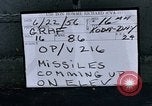
Sidewinder missiles are brought up on flight deck by elevator of the USS Bon Homme Richard
Ordnance men around bomb elevator on the deck of the USS Bon Homme Richard (CV-31) in waters off California. Elevator comes up with missile on a sled. Men remove guard chains and take the sled from the elevator. Aircraft seen in background carries markings of U.S. Navy Squadron VF-211 (Red Checkertails).
Pilots of VF-64 being briefed before their first air strike, to be launched from the USS Boxer, in the Korean War
Navy Commander R.W. Rynd, Commander of U.S. Navy Fighter Squadron VF-64, is seen briefing squadron pilots, aboard the USS Boxer (CV-21) prior to the Squadron's first air strike in the Korean War.
F4U aircraft returns from air strike and lands on United States Navy aircraft carrier USS Boxer
Aircraft returns to United States Navy aircraft carrier US Boxer (CV-21) after striking North Korean positions during the Korean War. Plane handlers park the plane. Lieutenant Commander Coffman gets out of the cockpit of F4U aircraft.
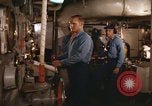
Engine room of United States Navy destroyer escort Charles E. Brannon in Seattle, Washington
A sailor monitors instruments and makes adjustments at main control panel in engine room of U.S. Navy Destroyer Escort, USS Charles E. Brannon (DE-446), in Seattle,Washington. Above decks, a sailor lookout peers through a pair of binoculars. Back in the engine room, the ship's power indicator shifts from "stop," to 1/3 backing power and then back to "stop," again.
Japanese attack on Pearl Harbor in Hawaii,United States on December 7, 1941
Opening scenes show formations of World War 2 Japanese Mitsubishi G3M bombers in flight. Slate reads: "Pearl Harbor December 7,1941." U.S. B-17 bombers are parked on an airfield. Ships and facilities are seen at the Pearl Harbor Naval station in Hawaii. Views of Japanese Mitsubishi G3M bombers flying in formation above clouds. Explosions and fire destroying aircraft and facilities at the Ford Island Naval Air Station. The USS Arizona burning and filling the air with heavy black smoke as she lists and sinks from bombing. Subsequent views of the destruction wrought by the bombing.
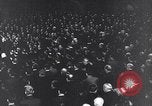
Isolationist versus interventionist sentiments of people in the United States regarding America entering World War 2
Americans express their views about United States entering into World War II after the Pearl Harbor attack. Anti-war isolationist and interventionist views are presented. Senator Gerald P. Nye advocates in favor of an arms embargo. Urging against American involvement in war, Senator Burton K. Wheeler cautions that war mongers and interventioners or intervention advocates control most of the avenues of propaganda. Wendell Willkie speaks advocating unity of purpose in America and importance of assisting the threatened democracies of Europe with war materiel and supplies. Next, Senator Joshua B. Lee of Oklahoma strongly urges support for lend-lease and "setting in motion an industrial blitzkrieg (of war materiel) that will make it possible for England to blast Hitlarism from the face of the earth." View of Congress meeting in the U.S. Capitol chamber. Anti-war college aged students protests against involvement in war and picket at the White House in Washington D.C.,United States. Adjacent to them are other protestors picketing against the peace advocates, with signs like "Americans are against subversive organizations picketing the White House" and "We Americans protest Communists picketing the White House. A women's organization advocating peace or protectionism or isolationism is seen wearing all black. They pull down black veils over their faces in a show of unity against war and the possible loss of American boys to war. An outdoor rally of a fascist organization meeting in America. Also scenes from a German American Bund meeting in 1939 at Madison Square Garden in New York City. Speaker at the meeting is Fritz Julius Kuhn who watches as a protestor leaps on the stage and is subdued by guards. Scenes shown from various other protests in the United States during the same era, including labor strikes and lockouts, and a group holding a rally in favor of equal rights or civil rights, with a woman holding a sign "Did Lincoln Free the Slaves?"
CRITICALPAST.COM: About Us | Contact Us | FAQs - How to Order | License Agreement | My Account | My Lightboxes | Shopping Cart | Advanced Search | Featured Collections | Website Terms & Conditions | Privacy Policy ©2026 CriticalPast LLC.
License Agreement |
Terms & Conditions |
Privacy Policy
©2026 CriticalPast LLC.