


 Francais
 Deutsch
 Italiano
Refine Your Search
US-Gliders- stock footage and images
- Showing 17023 to 17028 of 21918 results more
more Hide
Hide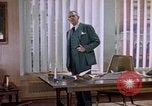
Animated map of Canada and the United States, illustrating North American Air Defense system.
Actor Raymond Massey introducing the subject of North American Air Defense, which is a joint enterprise of Canada and the United States. A map of the United States, Canada and the Arctic. Animation shows radar sites comprising the Dew Line, Mid Canada Line and Pine Tree Line in Canada, as well as coastal and ship borne sites around the United States. Internal U.S. sites tied to the automated SAGE system (Semi Automatic Ground Environment) are shown. SAGE is a computerized control system for tracking and intercepting enemy bombers. The headquarters of NORAD (North American Air Defense) is shown, at Cheyenne Mountain, Colorado. Mr. Massey points out models of new antiaircraft missiles displayed on his desk. Animation shows how these can be fired from the ships at sea.
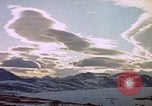
Building the Dew line of the North American Air Defense System in extreme weather conditions in Northern Canada.
Aerial view of a Dew line installation. Pacific Western DC-3 lands on a snow runway. An icebreaker ship navigates arctic waters. Plows remove snow from a runway. A C-119 aircraft airdrops supplies to a Dew line site. Carpenters work in arctic conditions. Blowing snow obscures a site. Towers being erected in milder weather. Geodesic spheres being assembled. Aerial view of a completed Dew line installation. Barren snow-covered landscape. Workers using dog teams and sleds. View from sled of husky dog team pulling ahead. Aerial views of completed Dew Line installations. Ground views of installations.
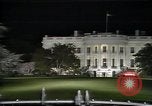
President Ronald Reagan gives a speech on the Defense Budget at the White House in Washington DC.
U.S. President Ronald Reagan at the White House in Washington DC. President Ronald Reagan gives a speech on the Defense Budget and on the need for increased defense spending. He speaks about the Defense Program America needs. President Reagan states that the American security should be prepared for all situations. He presents various comparison charts depicting weapons of the Soviet Union versus the United States. An animation shows 'Intercontinental Missiles'. Intermediate Range Weapons from 1978-1982. An animation shows the difference in production of submarines, artillery and weapons between the United States and the Soviet Union. Labeled reconnaissance photograph shows the Soviet Communications Intelligence Facility in Lourdes, Cuba. Aerial reconnaissance photos of the Soviet Weaponry Sandino Airfield in Nicaragua. An airfield under construction in Grenada. President Reagan in his speech states that the American military force should be ready to respond to any emergency situation. An animated graph shows the percent of budget from 1960-1980 dedicated to defense versus social services, with defense spending falling proportionally as spending on social programs increased. At the end of the speech President Ronald Reagan asks for America's prayers and support.
President Ronald Reagan addresses the nation in Washington DC after his meeting with Mikhail Gorbachev in Iceland.
U.S. President Ronald Reagan addresses the nation in Washington DC. The seal of the President of the United States. President Ronald Reagan addresses the nation after his meeting with General Secretary of the Communist Party of the Soviet Union Mikhail Gorbachev in Reykjavik, Iceland. He talks about the Arms Reduction Policy and ballistic missile elimination. President Ronald Reagan and Mikhail Gorbachev also discussed the SDI (Strategic Defense Initiative). They agreed on eliminating the ballistic missiles to 50 percent in five years. They also had talks on how to maintain peace between both the countries.
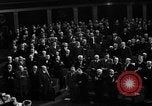
President Harry Truman addresses Joint Session of Congress in Washington DC, United States.
U.S. President Harry Truman addresses Joint Session of Congress in Washington DC. The gallery is packed with spectators. The President is applauded upon arrival. Members of Congress listen as the President speaks.
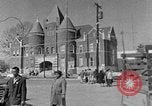
Mayor Carl Burton Stokes elected as Mayor of Cleveland in 1967; citizens of Cleveland and its City Council; Stokes meeting with President Nixon
Mayor Carl Burton Stokes, African American political leader in Cleveland, at the time of his election as Mayor of Cleveland on November 7, 1967. Views of his campaign headquarters and posters in it that read 'Stokes For Progress'. Men and women wearing Stokes hats. The crowd cheers at his mayoral victory. Newly elected Mayor Stokes addresses the crowd from microphone and receives constant applause and cheering. Audio of new Mayor Stokes speaking to supporters in his victory speech while scenes are shown of African American and white men and women citizens of Cleveland walking on streets of the city in typical late 1960's and early 1970's fashions. Scene includes pedestrians young and old walking and boarding a city bus. Mayor Stokes seen exiting a building and walking in Cleveland. Meeting in progress in Cleveland City Council chamber. Views of various City Council members including a number of African American council members. Mayor Stokes seated with U.S. President Richard Nixon and other big city mayors discussing the urban crisis.
CRITICALPAST.COM: About Us | Contact Us | FAQs - How to Order | License Agreement | My Account | My Lightboxes | Shopping Cart | Advanced Search | Featured Collections | Website Terms & Conditions | Privacy Policy ©2026 CriticalPast LLC.
License Agreement |
Terms & Conditions |
Privacy Policy
©2026 CriticalPast LLC.