


 Francais
 Deutsch
 Italiano
Refine Your Search
US-Gliders- stock footage and images
- Showing 17047 to 17052 of 21918 results more
more Hide
Hide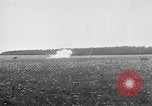
Members of the American Expeditionary Force dig a trench wearing gas masks in France during World War I.
Chemical warfare activities of the AEF (American Expeditionary Force) in France during World War I. Phosphorous shells explode on the ground. Smoke rises from the explosion. Members of the American Expeditionary Force stand outside a tent wearing gas masks. A soldier speaks over a loudspeaker. Another soldier speaks over a phone and another one writes on a piece of paper. U.S. troops dig a trench.
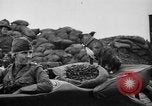
United States soldiers manufacture gas masks in a factory in Europe.
Manufacturing of gas masks in Europe during World War I. United States soldiers carry peach pits on a vehicle. A dog sits near them in the vehicle. Peach pits are burned in furnaces and charcoal is extracted and placed in drums. A U.S. soldier carries a drum in a small trolley. Exterior of a factory with a goods trains in the front.
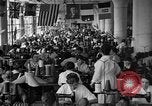
Workers attach nose clamps, head straps, mouthpiece and breathing tubes to the face pieces of masks at a factory in France.
Manufacturing of gas masks in Europe during World War I. A large group of French women stitch rubberized fabric. A worker cuts the fabric after marking it. Rubber rimmed eyepieces are cemented in place. A worker attaches nose clamps, head straps, mouthpieces and breathing tubes to the face pieces of masks. French women workers give finishing to the gas masks. A U.S. soldier stands with the finished product.
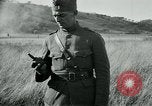
318th Infantry Regiment, 80th Division, American Expeditionary Force troops test gas grenades in France.
Chemical warfare activities of the AEF (American Expeditionary Force) during World War I. Troops of the 318th Infantry Regiment, 80th Division, American Expeditionary Force in France. An American soldier stands holding a gas grenade and examines it. Clip shows U.S. Army forces practicing with various gas delivery weapons. 318th Infantry soldiers throw gas grenades. Scenes of various hand and rifle grenades exploding, including smoke, thermite, and phosphorus. Smoke rises from the explosions on the ground.
British troops in trenches don gas masks after hearing a warning by a Strombos horn on the Western Front in World War I
British troops in deep trenches lined with woven branches, on the Western Front in World War 1. Slate refers to gas alarm with Strombos horn. British soldiers immediately don their gas masks and take up defensive firing positions in their trench. Gas fumes are seen drifting over the trench. View from the trench, of gas cloud over No-Man's land, with barbed wire and some snow on the ground. [Note: The Strombos horn,was operated by compressed air and could be heard for several miles. But as use of gas shells increased, and such attacks tended to be localized, other alarms were employed, instead, such as metal shell cases, steel triangles, watchmen's rattles, klaxon horns, etc.] (World War I; World War 1; WWI; WW1)
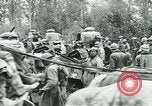
American and French forces marshaling in France, during World War I. French deploy Renault FT tanks.
American soldiers and supplies being moved towards the front in France during World War 1I. A unit of French Renault FT tanks drives through the U.S troops, who move aside to allow them passage. The tanks proceed, along a dirt road, towards the front. (Note: After World War 1, the Renault FT tank was often called the FT-17.) (World War I; World War 1; WWI; WW1)
CRITICALPAST.COM: About Us | Contact Us | FAQs - How to Order | License Agreement | My Account | My Lightboxes | Shopping Cart | Advanced Search | Featured Collections | Website Terms & Conditions | Privacy Policy ©2026 CriticalPast LLC.
License Agreement |
Terms & Conditions |
Privacy Policy
©2026 CriticalPast LLC.