


 Francais
 Deutsch
 Italiano
Refine Your Search
US-Gliders- stock footage and images
- Showing 17083 to 17088 of 21918 results more
more Hide
Hide
Celebrations on White House lawn. President Hoover waves from balcony. Girls perform Maypole dance.
U.S. President Herbert Hoover at the White House in Washington DC. A large crowd of men women and children gathers on the White House lawn. Girls perform a Maypole dance, weaving different colored ribbons into an elaborate covering on the pole. President comes out on the balcony of the White House and waves at the crowd.

President and Mrs. Herbert Hoover relaxing at their rustic retreat on the Rapidan River in Blue Ridge Mountains of Virginia
U.S. President Herbert Hoover and his wife Louise Henry Hoover at the Presidential retreat, Camp Rapidan, located on Doubletop Mountain in the Blue Ridge Mountains, Madison County, Virginia. The camp is at the headwaters of the Rapidan River in the Shenandoah forest. The President does some fly casting in a stream. President and Mrs. Hoover seated in wicker chairs. The president pets his dog. The President reads a book and his wife knits. A waterfall in the background.
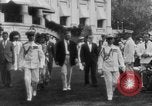
President and Mrs. Herbert Hoover greeting disabled war veterans in Soldiers Garden Party on South lawn of the White House.
Soldiers Garden Party held for disabled veterans of World War I. One thousand attended. U.S. President Herbert Hoover and the First Lady Louise Henry Hoover enter the South lawn of the White House, where they walk amongst and meet disabled war veterans assembled there. Later the President and First Lady stand and greet disabled veterans who are brought past them in wheel chairs pushed by nurses. They greet a war veteran lying on a stretcher. A veteran on crutches meets the President and the First Lady. Many of the disabled veterans suffered loss of limbs, including one who lost all except his right arm.

Munitions manufacturing in Germany during World War I. Initial Forging of heavy ingots
Munitions manufacture in Germany. Steel workers use chain hoists to move a 1650 kg steel ingot into a furnace. Another ingot, weighing 6000 kg is taken from the furnace and placed under a drop forge. Men maneuver the ingot as it is being hammered. it gradually reduces in circumference and increases in length. The useless end is cut off by placing a steel cutter under the forge hammer. The forged piece is conveyed to the next stage of manufacture.

manufacturing a gun barrel at munitions factory in Germany during World War I. Cylindrical steel stock bored and rifled
Gun barrel manufacture at munitions plant in Germany during World War I. Solid cylinder of steel is bored, and center core manually removed by men using sledge hammers and wedges. Weight of the barrel is 470 kg and the core weight is 240 kg. Rifling is then machined into the barrel by a milling machine that drives a milling plunger into the barrel. View of the rifled barrel.
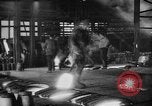
Crucible Steel-making at Bethlehem Steel company plant in Bethlehem, Pennsylvania, during World War I.
Making Crucible steel in Bethlehem Steel company plant, Bethlehem, Pennsylvania,during World War 1. View of the crucible steel shop. Men, each known as a "puller out " reach in with tongs and extract the crucibles from a furnace, below, raising them to the shop floor. The crucibles are then moved by dollies to the" teemers" who use their tongs to swing the crucibles toward the molds. View of Open Hearth furnace being tapped into a large crucible and poured from crucible into molds on mill floor. Large hot steel ingots being moved on rail flatcars pulled by locomotive. Many flat cars of ingots standing in steel mill yard. Hot ingots on rail cars being rearranged by large overhead cranes. Men look at and discuss an enormous steel forging on a rail car. Overhead crane moves iron ore and coke in the stockyard of the Bethlehem plant. A veritable mountain of iron ore in the background.
CRITICALPAST.COM: About Us | Contact Us | FAQs - How to Order | License Agreement | My Account | My Lightboxes | Shopping Cart | Advanced Search | Featured Collections | Website Terms & Conditions | Privacy Policy ©2026 CriticalPast LLC.
License Agreement |
Terms & Conditions |
Privacy Policy
©2026 CriticalPast LLC.