


 Francais
 Deutsch
 Italiano
Refine Your Search
US-Gliders- stock footage and images
- Showing 17251 to 17256 of 21918 results more
more Hide
Hide
Take off of the General Motors GM A-1 'Bug' missile from a launching automobile in Muroc, California.
A review of research and development in guided missiles by the United States Air Force from 1919 to 1948. General Motors power-driven bomb (GM A-1 Bug), number 9 on tail, in Muroc, California. Technicians work on the same. The bomb is raised into position for attaching to the launching automobile by means of a hoist on a truck. The missile is nick named the 'Bug'. Technicians work at the automobile being driven beneath the suspended missile. The missile is radio controlled. The automobile specifically built for the launch of the missile is powered by two 165 HP Cadillac engines attached to a single drive shaft. Attaching the 'bug' missile to the launching car. The tractor and the hoist are removed. The automobile is driven across terrain at Muroc. A testing station for testing radio control section of aircraft during test. A technician checks over the radio equipment and shows television camera and equipment used for test. The automobile start at a high speed across the launching strip. Take off of the missile from the automobile. 'Bug' missile in flight. Views from a control aircraft beside the GM A-1 Bug while the Bug is in flight. (World War II period).
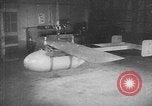
A GB-1 bomb is dropped from a B-17 and the launch of a GB-8 missile in the United States.
A review of research and development in guided missiles by the United States Air Force from 1919 to 1948. A GB-1 bomb is suspended from a chain hoist in the interior of a laboratory. This is a preset glide bomb. A B-17 with GB-1 attached, takes off. The B-17 in flight with GB-1s attached to the bottom of the aircraft. Aerial launching of the GB-1 from the B-17. Side view of a GB-8. Flares attached to the tail section of the GB-8. This is a radio-controlled missile, flares are used to assist in guiding the missile to target area. The GB-8 descends. Smoke trails behind. The GB-8 hits a flat open desert terrain. (World War II period).
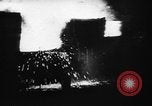
The launching and explosions of various test missiles in the United States.
A review of research and development in guided missiles by the United States Air Force from 1919 to 1948. Interior of a steel mill shows workers performing various duties around an open furnace. The exhaust section of a JB-2, flames erupting from the same. A JB-2 launching. It taxis in a wooded area. A large explosion. The exhaust section of V-2 during launching. Failed test as a V-2 rocket streaks down towards the earth after a launch and slams into a wooded area, with a huge explosion resulting. The first guided missile robot torpedo aircraft crashes at Arcadia, Florida. First successful launching of the U.S. aerial guided missile. Exhaust section of JB-2 starting operation attached to a wing of a B-17. The B-17 launching. JB-2 in flight. PQ-8 target aircraft dives towards the slope of a mountain and explodes. An atomic bomb explosion. Atomic cloud formation rises up in the air from the Trinity test, the first atomic explosion, in New Mexico.
The dropping of Mk 84 laser guided bomb from F-4D Phantom jet during Vietnam War.
Paveway I laser guided bomb carried by fighter bomber in Vietnam. Aerial view over wooded terrain of a U.S. Air Force F-4D Phantom jet, from Ubon Air Base in Thailand, descending and, while still at fairly high altitude, releasing a 2000 lb Mk 84 laser guided bomb against Viet Cong ground target.
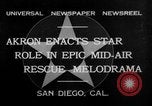
Sailor Charles (Bud) Cowart is rescued after dangling from the airship, USS Akron, two thousand feet above ground
Original footage and supplemental reenactment of event that took place about a week earlier when the U.S. Navy Zeppelin, USS Akron (ZRS-4) attempted to dock for refueling at Camp Kearny, San Diego, California. In clips from that actual event, spectators watch as a hundred Navy ground crew sailors attempt to hold down the dirigible. But one of the Akron cable rings breaks and the sailors are unable to hold her. All let go of the lines except for three sailors, two of whom fell to their deaths. Scenes are shown of the remaining sailor, Bud Cowart of Sand Springs, Oklahoma, as he hangs on for more than an hour until the USS Akron crew pulls him through a port hole to safety aboard the air ship. Views shot about a week later show officers inside the Akron and Sailor Cowart aboard the airship.
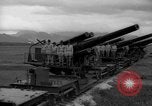
American Army training in Hawaii prior to World War 2
U.S. Army gun crews manning railroad guns as they proceed along a railroad. A field filled with massive columns of thousands of American soldiers in precise formations, performing drills. Army demolition teams blowing up parts of hillside to prepare defensive positions. Bulldozers and steam shovels removing rock and earth. Railroad gun crews maneuver their gun barrels as their train is in motion. Steam locomotive train moving and pulling the railroad guns.
CRITICALPAST.COM: About Us | Contact Us | FAQs - How to Order | License Agreement | My Account | My Lightboxes | Shopping Cart | Advanced Search | Featured Collections | Website Terms & Conditions | Privacy Policy ©2026 CriticalPast LLC.
License Agreement |
Terms & Conditions |
Privacy Policy
©2026 CriticalPast LLC.